

Child Sex Crimes Defense | Frisco, Texas
Accused of a Child Sex Crime in Texas? Here's What Happens Next
Heather Barbieri, a Frisco criminal defense lawyer, explains the stages of a child sex crime accusation, from the first police contact to formal charges, and why speaking with a lawyer early matters.
By Heather Barbieri · Published October 17, 2026
A child sex crime accusation in Texas starts a process with several agencies, and it can move on more than one track at once. A report can lead to a police investigation, a child protective investigation, or both. This guide explains those steps in order, names the agencies involved, and describes the Texas Penal Code offenses that most often come up.
What a Child Sex Crime Accusation Means Under Texas Law
An accusation is a report that someone made. It is not yet a charge. Many people hear about an accusation long before any formal case exists.
The stages are different. An accusation or report starts the inquiry. An arrest happens when police take a person into custody. A criminal complaint or charging document is the state’s written statement of the offense. An indictment is a formal charge returned in a felony case. Each stage brings different steps, and the paperwork at each one shows what the state claims.
The Texas Penal Code defines each offense. The charge depends on the specific conduct alleged, the child’s age, and sometimes the relationship between the people involved. Two accusations that sound similar can carry very different charges.
This guide follows the typical order of events. It covers who investigates, what happens from report to court, the main offenses, penalties, interviews, digital evidence, bond, and your options.
Not sure what your next step is?
Talk it through with our team — the first consultation is free, confidential, and carries no obligation.

Who Investigates: Police, Sheriff’s Offices, DFPS, and Advocacy Centers
Police departments and county sheriff’s offices conduct criminal investigations and make arrests. In Collin County and surrounding areas, the local agency that takes the report often depends on where the alleged conduct happened.
The Texas Department of Family and Protective Services (DFPS) may also investigate. DFPS looks at child safety, often when the alleged abuse involves a parent, caregiver, or household member. Its investigation runs separately from the criminal case. A DFPS finding and a criminal charge are different matters.
Children’s advocacy centers often coordinate forensic interviews. These interviews gather the child’s account. They do not decide guilt, but what the child says often shapes the criminal case.
Write down which agencies have contacted you. Note the names, the dates, and what each one asked for. That list matters later, because each agency may request a different interview, document, or appointment.
What Happens Next: The Texas Process From Report to Court
Most cases follow a general sequence. A report leads to an investigation. Investigators may ask for interviews, request records, or seek search warrants. An arrest or a summons may follow. The accused then goes before a magistrate, who sets bond and conditions.
Next, a felony case moves toward formal charges. The state presents its evidence, and a charge is filed. The case then reaches the court for arraignment, where the accused responds to the charge. The defense then reviews the state’s evidence, which lawyers call discovery.
After discovery, the case may move through pretrial motions. The parties may negotiate a plea, or the case may go to trial.
Timing varies by county and by case. Do not assume a timeline based on another case. Review the actual paperwork, including the dates on each notice, with your lawyer.
How Texas Defines the Main Child Sexual Offenses
Texas defines these offenses by conduct, by the child’s age, and sometimes by the number of acts.
Indecency with a child. Texas Penal Code § 21.11 covers a child younger than 17. Sexual contact, done with intent to arouse or gratify sexual desire, is one form. Exposing one’s anus or genitals to a child, knowing the child is present, is another. Causing a child to expose their body is a third form.
Continuous sexual abuse of a young child. Texas Penal Code § 21.02 requires two or more acts of sexual abuse during a period of 30 or more days. The person must be 17 or older. The child must be younger than 14, or the victim must be a disabled individual. Under Penal Code § 21.02, the jury must agree that the defendant committed two or more acts over a period of 30 or more days in duration. They do not have to agree on each specific act or date.
Sexual assault of a child. Texas Penal Code § 22.011 defines a child as a person younger than 17. The statute lists specific penetration and contact conduct involving a child. Its elements differ from indecency. Indecency focuses on sexual contact and exposure. Sexual assault focuses on penetration or contact of specific body parts.
Online solicitation of a minor. Texas Penal Code § 33.021 covers communication over the Internet, by email, text, or a commercial online service. A minor is a person younger than 17, or a person the actor believes is younger than 17. The statute covers sexually explicit communication, distributing explicit material to a minor, and soliciting a minor to meet for sexual contact. Cases involving online contact often turn on messages and account records.
Penalties, Enhancements, and Sex Offender Registration
Penalties depend on the offense and the felony degree. Enhancements can raise the range sharply.
Indecency involving sexual contact with a child is a second-degree felony. Continuous sexual abuse of a young child is a first-degree felony. Soliciting a minor to meet for sexual contact is a second-degree felony.
Continuous sexual abuse carries a higher minimum. Under Texas Penal Code § 21.02, the punishment is life, or a term of not less than 25 years and not more than 99 years.
Enhancements matter. Texas Penal Code § 12.42(c)(4) provides for life imprisonment without parole for certain repeat sex offenses. It applies when a defendant commits a sexually violent offense listed in that subsection on or after the 18th birthday and has been previously finally convicted of listed offenses. Texas Penal Code § 12.42(c)(2) provides that a defendant who has a prior conviction for a listed sex offense and is then convicted of a qualifying sex offense, such as one under §§ 21.11(a)(1), 22.011, or 22.021, must be sentenced to imprisonment for life (a mandatory life sentence). Under Texas Penal Code § 12.42(g)(1), a prior plea of guilty or nolo contendere in exchange for deferred adjudication counts as a conviction for this mandatory life enhancement. That is true even if no sentence was imposed and even if the person was later discharged from community supervision. Whether that enhancement applies turns on the particular current offense and prior conviction involved. Repeat-offender provisions in § 12.42 can also raise a case that is otherwise a lower felony.
Registration is also serious. Many of these offenses are reportable convictions under Texas Code of Criminal Procedure art. 62.001. The duty to register can last for life for some offenses. Duration depends on the offense and the outcome.
Collateral consequences such as employment, housing, and custody can follow a charge or conviction. These effects are separate from the criminal sentence.
Age of Consent and the Statutory Affirmative Defenses
Child sex offense statutes in Texas protect children younger than 17. The statutes set their own age conditions, so the age of the child and the age of the accused both matter.
Some defenses depend on age and relationship. The accused must have been not more than three years older than the victim and of the opposite sex. No duress, force, or threat may have been used. The accused must not have been required to register for life at the time of the offense. Being the child’s spouse is a separate defense in that section.
Under Texas Penal Code § 33.021(e), a defense to the solicitation-to-meet offense exists when the accused was married to the minor. Another defense applies when the accused was not more than three years older and the minor consented.
Each condition must fit the facts. Missing one condition can end the defense. Gather birth dates, school records, and any documents that show ages and dates. Share them with your lawyer early.
Not sure what your next step is?
Talk it through with our team — the first consultation is free, confidential, and carries no obligation.
Talking to Investigators: Interviews, Searches, and Your Right to Counsel
Use both. Investigators often ask for an informal interview. Ask for your lawyer before you answer questions about the accusation.
A voluntary conversation and a custodial interrogation are different. Even a friendly chat can become part of the file.
Tell your own lawyer everything. Share facts that seem unhelpful, too. Your lawyer cannot judge your options without the full picture.
Search warrants may cover your home, vehicle, phones, or computers. Ask for a copy of the warrant and any inventory. Note what officers took and when.
Do not contact the child, the child’s family, or witnesses about the accusation. Contact can create new problems. A protective order may already limit contact, and violating one is its own offense under Texas Penal Code § 25.07. Route every question about the case through your lawyer.
Forensic Interviews, Digital Evidence, and Online Cases
Forensic interviews of children are often recorded. The defense team can review the recording and the interviewer’s notes, and those records often shape the case.
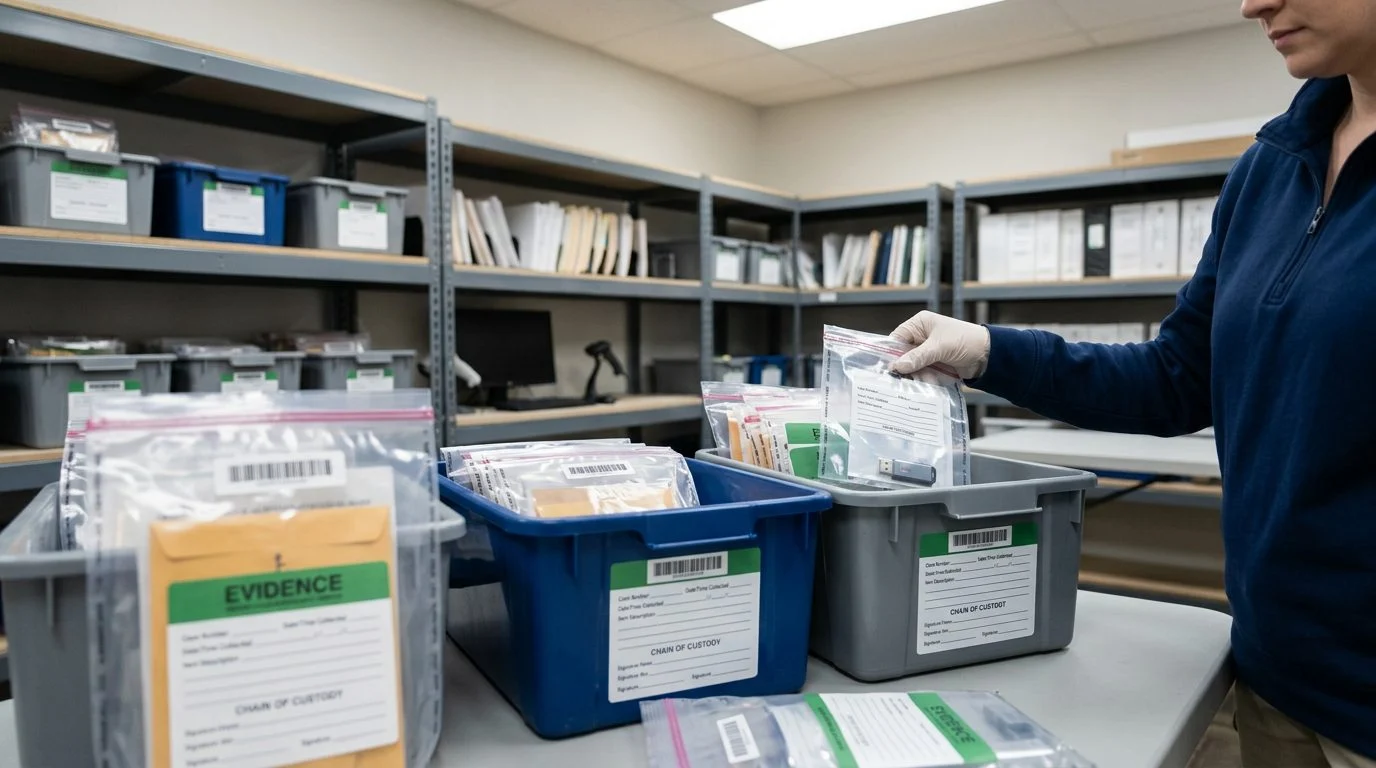
Digital evidence is common. Phones, computers, cloud accounts, and messaging records may be obtained through warrants and subpoenas. Each source needs separate review. Timestamps, the device used, and the chain of custody are common subjects of examination.
Online cases often rest on messages, account records, or proof of identity. Investigators may work with the Internet Crimes Against Children Task Force Program, which supports investigation of technology-facilitated child sexual exploitation. Federal law can apply alongside Texas law in these cases.
The National Center for Missing & Exploited Children describes what online enticement involves and the grooming tactics it often includes. That description helps explain how these cases are built, but it does not set Texas penalties or defenses.
Cases involving images or files carry their own procedures.
Legal Defenses and How the Evidence Is Challenged
Defenses depend on the facts, the exact charge, and the evidence the state can prove. No single defense fits every case.
One common approach tests the elements of the offense. If the proof is missing on one element, that gap matters.
Another approach looks at statements. The defense reviews how the statement was taken, what was recorded, and whether the account changed over time. Inconsistent statements, a lack of corroboration, and outside influence on a child’s account are all subjects of review.
Digital evidence gets its own review. The defense examines how the evidence was collected, stored, and analyzed.
Timing is also reviewed. The date of the alleged act, the date of the report, and the dates the accused had access to the child can all be significant.
Pretrial motions can challenge evidence. Whether a motion is filed depends on the facts.
Bond, Protective Orders, and Conditions Before Trial
After magistration, a judge or magistrate sets bond and conditions. The conditions are based on the case, and they can restrict contact and location.
Common conditions in child sex offense cases limit contact with the complainant, minors, or certain places. Violating a bond condition in a family violence, sexual assault, or related case can be charged under Texas Penal Code § 25.07. That section covers contact with a protected person, threats through another person, and going to a protected residence, workplace, or school.
Protective orders also matter. Texas Code of Criminal Procedure art. 7B.005 allows a court to bar an alleged offender from communicating with the applicant or household members. The exception is contact through the applicant’s attorney or a person the court appoints. The order can also bar going near a residence, workplace, child-care facility, or school. The order must describe each prohibited location.
Protective orders from family or civil courts can run alongside the criminal case. Their terms can overlap with bond conditions, so review both documents together.
Keep a written record of every court date and condition. Review each one with your lawyer before you act on it.
Your Options: Pretrial Motions, Plea Negotiations, and Trial
At each stage, several options may exist. You can challenge the charge, file pretrial motions, negotiate with the prosecutor, or go to trial before a judge or jury.
A plea agreement is a decision you make after your lawyer explains the consequences. Those consequences include registration, enhancements, and any collateral effects. A plea can carry lasting results, so review every term.
The right choice depends on the facts, the evidence, and your goals. No honest lawyer can say how any of these options will end.
Trial follows its own process. Jury selection comes first.
Not sure what your next step is?
Talk it through with our team — the first consultation is free, confidential, and carries no obligation.

Talk With Criminal Defense Counsel About Your Next Step
Heather Jean Barbieri is the founding attorney of Barbieri Law Firm in Frisco, Texas. Heather Jean Barbieri, Board Certified, Criminal Law — Texas Board of Legal Specialization.
Barbieri Law Firm is an all-women criminal defense practice. It defends people accused of sex crimes and assaultive offenses, including child sex crimes, online sex crimes, aggravated sexual assault, aggravated assault, family violence, and theft defense for students and non-citizens. The firm takes matters across Collin County, Dallas-Fort Worth, and Texas, including Plano, Prosper, McKinney, Allen, Celina, Southlake, Midland, and Dallas.
If an accusation has just reached you, or an investigator has asked to talk, you do not have to sort out the process alone. Our team can review the report, the charge, and the paperwork with you. Call (972) 424-1902 or send your case details. The initial consultation is free, with no obligation to continue.
Frequently asked questions
Is an accusation the same as a charge?
No. An accusation is a report. A charge comes later, in a formal document.
Can police interview me without arresting me?
Yes. Investigators may ask for an informal interview.
Does a Texas child sex offense conviction require registration?
Many listed offenses do. Duration depends on the offense and the outcome.
Can a bond be violated by contact with the complainant?
Yes. Violating a bond condition in these cases can be charged under Texas Penal Code § 25.07.
Attorney responsible for this site: Heather Jean Barbieri, Barbieri Law Firm, Frisco, Texas. Phone: (972) 424-1902.
How Barbieri Law Firm approaches a child sex crime case
An all-women criminal defense firm
Barbieri Law Firm is an all-women firm led by Heather Barbieri. We focus our criminal defense work on sex crimes and assaultive offenses across Collin County, Dallas-Fort Worth and Texas.
Review of the evidence
We review the police report, any recorded interviews, digital evidence and the charging documents so you understand what the State has and what it may argue.
Plain-language explanations
We explain each stage of the process, the questions you may face and the options available to you, so you can make informed decisions.
Early involvement
Speaking with a lawyer early helps you understand the process before important decisions are made, including decisions about speaking with investigators.
Before you speak with investigators, call a lawyer
Investigators may ask you to come in for an informal interview, even if you have not been arrested. Please speak with a lawyer before you answer questions or give any statement. No lawyer can predict or assure an outcome, but a consultation can help you understand your options.
What typically happens after a child sex crime accusation
1. The accusation
An accusation is a report made to police or another agency. It is not the same as a charge. A charge comes later, in a formal document.
2. The investigation
Investigators may gather statements, forensic interviews, phone and computer records, and other evidence. This stage is often when a lawyer's review is most useful.
3. Charges
If prosecutors file charges, the charging document identifies the offense alleged. We review it closely with you to explain the allegations and the penalties involved.
4. The court process
A criminal case moves through pretrial proceedings, negotiations and, if necessary, trial. We explain each step and what it may mean for your case.
Talk with Heather Barbieri about your situation
Related practice areas
Request a Consultation
Fill out the short form and we will take it from there.