


Collin County | Online Sex Crimes Defense
Charged After an Online Chat? Let's Review the Conversation Together
Heather Barbieri and our team examine the messages, the timeline and the investigator's steps to show how the State would have to prove its case.
By Heather Barbieri · Published November 18, 2026
An online sting arrest can make the chat screen feel like the whole case. It isn’t. Texas law sets specific things the State must prove, and each one can be tested.
Here is the short answer. No lawyer can say how a case will end, but that review is where your options begin.
What the online solicitation of a minor charge is, and who it affects
Online solicitation of a minor is a felony under Texas Penal Code § 33.021 that covers online messages aimed at a minor. The statute’s communication and distribution offense reaches a person 17 or older who uses the internet, email, text or a commercial online service; the solicitation-to-meet offense applies to any person who uses those means.
It has two main parts. Under one, the State must show that a person 17 or older, with intent to commit a listed offense, intentionally communicated in a sexually explicit manner with a minor or distributed sexually explicit material to a minor, over the internet, email, text or a commercial online service. Under the other, the State must show that you knowingly solicited a minor, over the internet, by electronic mail or text message or other electronic message service or system, or through a commercial online service, to meet another person, including you, intending that the minor engage in sexual contact, sexual intercourse or deviate sexual intercourse.
For this statute, a minor includes a person you believe is younger than 17. So what you believed about age is central to the review. The statute also lists two defenses to a solicitation-to-meet charge under subsection (c), applicable at the time that conduct was committed: the actor was married to the minor, or the actor was not more than three years older than the minor and the minor consented.
Felony degree depends on the part charged. A communication or distribution charge is a third-degree felony, raised to second-degree if the minor is younger than 14 or is an individual whom the actor believes to be younger than 14 years of age. For any charge under this section, the punishment rises to the next higher category if it is shown the offense occurred during regular public or private primary or secondary school hours and the actor knew or reasonably should have known the minor was enrolled in a public or private primary or secondary school. A meeting charge is a second-degree felony. Your charging papers name the exact subsection, so read them closely with your lawyer.
Entrapment is a separate question. Under Texas Penal Code § 8.06, it is a defense when a law enforcement agent induces the conduct using persuasion or other means likely to cause the offense. Giving someone an opportunity to offend is not enough.
In general, a sting follows a sequence: an investigator poses online, messages are exchanged, a meeting is arranged, and an arrest follows. If your case arrived during a divorce, custody fight or CPS matter, you’re juggling more than one problem. Those matters can run on separate timelines, so raise the charge with counsel before you decide anything.
If an online sting arrest has left you holding chat records you have only partly seen, our team can talk through your options in a free, confidential consultation. Talk it through with our team — the first consultation is free, confidential, and carries no obligation.
What the arrest file should show, and what to request
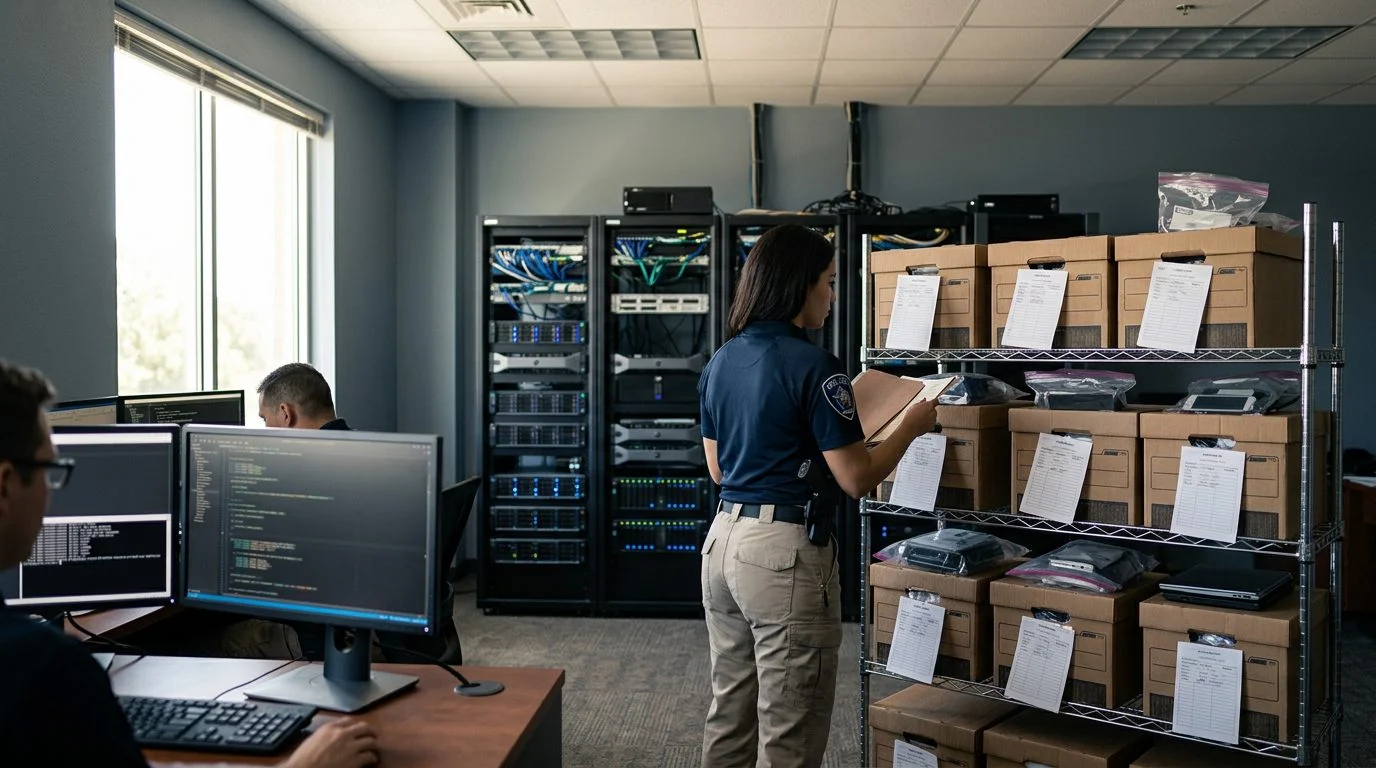
The arrest file should show the charge, the timeline and how each piece of evidence was gathered. A review looks at:
- The probable cause affidavit, offense report and arrest report.
- The charging papers and bond paperwork.
- Any warrant for a phone, computer or account, and the extraction report.
- The account’s creation date, the first contact, who started the conversation, and when the arrest and any meeting occurred.
Discovery is the State’s evidence file. Under Texas Code of Criminal Procedure art. 39.14, subject to the restrictions in Section 264.408, Family Code, and Article 39.15, after a timely request the State must, as soon as practicable, produce offense reports, recorded statements and other material evidence it holds.
Phones need close attention. Under Texas Code of Criminal Procedure art. 18.0215, an officer may not search a phone after a lawful arrest without a warrant, unless a listed exception applies, such as consent, a report that the phone was stolen, or a reasonable belief that the phone is held by a fugitive from justice for whom an arrest warrant has been issued for a felony offense, or that there exists an immediate life-threatening situation. The U.S. Supreme Court said in Riley v. California that a warrant is generally required before a cell phone search, even after an arrest. Check every extraction report against what the affidavit says the phone showed. A gap in the timeline is worth asking about. The Collin County charge guide covers the charge in more detail.
How the chat transcripts are reviewed, message by message
A chat review reads the full conversation, not only the lines quoted in an affidavit. Under the Texas Rules of Evidence, when one side introduces only part of an act, declaration, conversation, writing, or recorded statement, the adverse party may inquire into any other part on the same subject. The adverse party may also introduce any other act, declaration, conversation, writing, or recorded statement that is necessary to explain or allow the trier of fact to fully understand the part offered, and a deposition counts as a writing or recorded statement for this purpose. An adverse party may also introduce any other act, declaration, conversation, writing, or recorded statement that is necessary to explain or allow the trier of fact to fully understand the part offered by the opponent. “Writing or recorded statement” includes a deposition.
- Context. Messages before and after a quoted line can change what it means.
- Identity. Who controlled the account? Was it shared? Can the messages be tied to you?
- Age. What did the other person say about age? Was a profile or persona used? What do the records show about what you understood?
- Intent and tone. Look at wording, jokes, role-play and whether the State’s description matches the text.
- Completeness. Check timestamps, edits and any deleted or missing messages.
Ask for the full transcript, not only the excerpt. Each point gets written notes, so you can compare the State’s summary with the actual messages. The chats are only part of the picture. Device evidence and the timeline fill in the rest.
Your fears about prison, registration and your children, answered plainly
Your fears are real, and they deserve plain answers rather than guesses.
- Prison. Exposure depends on the subsection charged and the facts, so ask counsel to walk through the range for your charge.
- Registration. Texas Code of Criminal Procedure art. 62.001 lists a violation of § 33.021 among its defined offenses. Registration questions depend on the charge and the result, so review them with counsel.
- Follow every one exactly, and ask counsel about any condition that touches contact with children.
- Public exposure. Ask counsel how the case will appear in public records and news coverage.
- The outcome. No lawyer can say what a court or jury will do. The review tests the evidence and does not predict a result.
Custody, divorce and CPS matters can make statements harder to control. Talk with counsel before you say anything in those settings.
What to expect: the step-by-step process
The process starts with a free consultation and moves through the file, the chats and a meeting about your options.
- Consultation. The first consultation is free, confidential and comes with no obligation to continue. Under art. 1.051, a defendant who cannot afford a lawyer is entitled to appointed counsel in proceedings that may result in confinement.
- File gathering. We gather the affidavit, reports, bond terms and discovery as the State produces them.
- Chat and device review. We go through the full transcript, timeline and device evidence, and note what the records show and what they leave open.
- Options meeting. We explain your options at this stage, what the State still must prove, and which questions remain open.
- Ongoing settings. You stay in contact with counsel as court settings come up. Timing depends on the facts and the court’s schedule.
Why Barbieri Law Firm for a sting case review
Barbieri Law Firm is an all-women firm based in Frisco, Texas, that focuses on sex crimes and assaultive offenses. It serves Collin County, Dallas-Fort Worth and Texas.
Heather Jean Barbieri, Board Certified, Criminal Law — Texas Board of Legal Specialization.
Carrie Thomas is also one of the firm’s lawyers. Support staff, including assistants and office staff, work with our lawyers but are not lawyers.
Our lawyers review the evidence, including the arrest file, the chat records and any device evidence, then explain your options. For an online solicitation of a minor sting defense in Collin County, that review starts with the first consultation.
Not sure what your next step is?
Talk it through with our team — the first consultation is free, confidential, and carries no obligation.
Questions people ask about an online sting arrest
Does an online sting arrest always lead to a conviction?
No lawyer can say how a case will end, and no one can say what the result will be. A review tests whether the State can prove each element.
Should I talk to investigators before I speak with a lawyer?
Talk with counsel first. Under Dickerson v. United States, a statement made during custodial interrogation depends on whether police first gave the four Miranda warnings.
Can police search my phone after an arrest?
Under art. 18.0215, an officer generally needs a warrant before searching your phone after a lawful arrest, unless a listed exception applies. Riley v. California reached the same rule for phones seized during arrest.
Can my divorce or custody case be affected by the charge?
Those matters can move on separate timelines, and statements in one can matter in the other. Raise both with your lawyer before you say anything in either.
Will the case appear in the news?
Ask counsel how the case will appear in public records and news coverage. Plan with that answer in hand.
Your next step: a free, confidential consultation
If you’re still deciding, a consultation is a good place to begin. You may have been arrested for something you did not expect, you may have seen only part of the chat record, and your children and your future weigh on you.
Call (972) 424-1902, or send your case details through the contact page to schedule a free consultation.
Attorney responsible for this site: Heather Barbieri, Barbieri Law Firm, Frisco, Texas.
How we review an online solicitation sting case
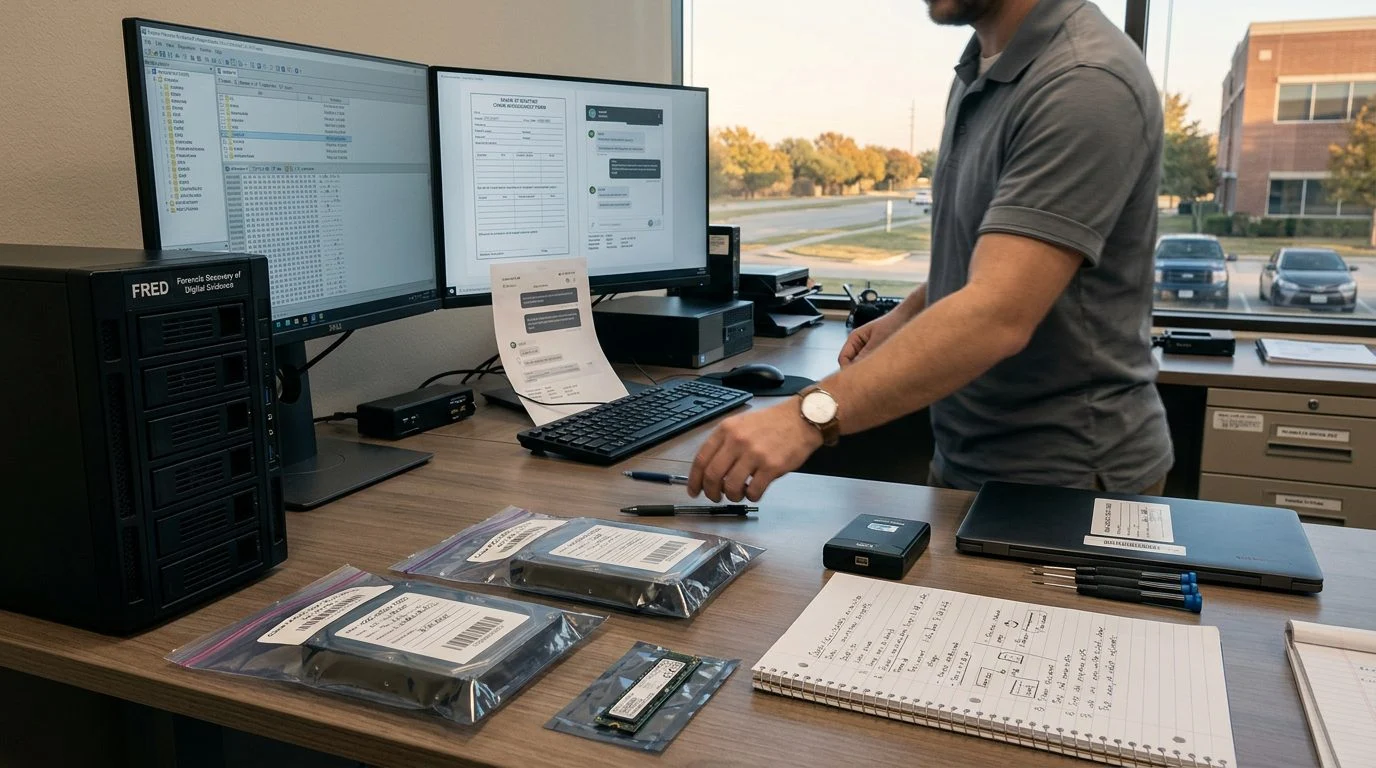
Chat transcript review
We read every message, the platform used, the timestamps and the claimed identities, and we look at whether the State can show who was on the other end.
A timeline of contact
We reconstruct when messages were sent, what was said before and after, and how the sting was set up and carried out.
A firm led by women lawyers
Barbieri Law Firm is an all-women firm in Frisco, Texas. Heather Jean Barbieri, Board Certified, Criminal Law — Texas Board of Legal Specialization, leads the defense of people accused of online sex crimes.
Before you speak with anyone
Do not discuss the chat, the sting or the investigator with anyone other than your lawyer, including by text message or on social media. Statements made to investigators can be used in the case. Talk with counsel first.
What a chat review can show
The messages
Who wrote what, when, and whether the conversation was started, continued or steered by the other party.
The identity
Whether the evidence actually links the account, phone number or profile to you, and what the investigators did to confirm it.
The investigation
How the sting was designed, what rules were followed, and whether the steps taken raise questions about the evidence.
Your options
We explain what the review shows and the choices available to you.
The initial consultation is free, confidential and carries no obligation to continue.
Related practice areas
Request a Consultation
Fill out the short form and we will take it from there.