


Criminal Defense | Frisco, Texas
A CPS Abuse Allegation Can Become a Criminal Case. Talk to a Lawyer Before You Respond.
Caseworkers and police investigators may ask for your account at different times, and what you say to either can matter later.
By Heather Barbieri · Published November 22, 2026
A caseworker has asked to talk with you, and you may be wondering whether you have to say anything at all. The short answer is that it depends on the facts of your case, and what you say can matter in a criminal case too. The Texas Family Code § 261.301 requires a prompt and thorough investigation of a report of child abuse or neglect allegedly committed by a person responsible for a child’s care, custody, or welfare.
This page explains how a CPS case differs from a criminal case, what a caseworker may look at, and why you should pause before any meeting.
If a CPS Caseworker Has Asked to Talk With You
Don’t decide on the spot. Take time to understand what the request means before you respond.
A caseworker who calls, leaves a card, or comes to your door is usually following up on an accusation. In your situation, that accusation may also have led to a criminal charge, or a charge may be coming. Two processes can move at the same time, and each one can affect the other.
You may feel pressure to explain everything right away. You may want to clear your name, protect your family, or fix things today. That urge is normal. It is also the moment when people often say more than they intended.
This page answers one question: whether you have to talk with the caseworker, and what the stakes are. For the wider picture, read our child sex crime charges in Texas guide.
If a caseworker has asked to meet while criminal charges are pending, you don't have to work out the next step alone, and our team is ready to talk it through with you. Talk it through with our team — the first consultation is free, confidential, and carries no obligation.
How a CPS Investigation Differs From a Criminal Case
A CPS investigation and a criminal case are separate tracks, and they can run at the same time. The Texas Department of Family and Protective Services separates its civil child-welfare investigations from law-enforcement criminal investigations of abuse allegations (DFPS report abuse guidance). CPS asks whether a child is safe. A criminal case asks whether the State can prove a specific offense.
The Family Code says an investigation goes forward without regard to any pending suit affecting the parent-child relationship (Texas Family Code § 261.301). So a pending divorce or custody case does not stop it.
Police may join quickly. When a report alleges a criminal offense that poses an immediate risk of physical or sexual abuse and could result in the death of or serious harm to the child, a peace officer must investigate jointly with the department. For reports alleging that a child has been or may be the victim of conduct that constitutes a criminal offense posing an immediate risk of physical or sexual abuse that could result in the death of or serious harm to the child, the department must notify the appropriate local law enforcement agency immediately on receipt.
The two tracks have separate steps. You should not assume that progress in one tells you what will happen in the other.
What a Caseworker Looks at During a Home Visit
A home visit is allowed unless the alleged abuse can be confirmed or clearly ruled out without one (Texas Family Code § 261.302).
A visit often covers the home, who lives there, and the children’s condition and daily routine. The investigation may also include an interview with the child. In some cases it may include a medical, psychological, or psychiatric examination (Texas Family Code § 261.302).
An interview with a child about the allegations must be audiotaped or videotaped. Narrow exceptions apply. Those recordings and the caseworker’s notes can become part of the record that others read later.
Ask what the caseworker needs, when they need it, and in what form. You can take time before you answer questions at the door.
Whether You Have to Answer a Caseworker’s Questions
A refusal to cooperate can lead CPS to ask a court for an order, so think carefully before you decline. The Family Code treats a failure to report within a reasonable time after proper notice as a refusal to cooperate. If the refusal poses a risk to the child’s safety, the department seeks a court order (Texas Family Code § 261.3031). If admission cannot be obtained, the court shall order entry for an interview only if it has good cause to believe the child is in imminent danger of being subjected to aggravated circumstances, or probable cause to believe admission is necessary to protect the child from abuse or neglect (Texas Family Code § 261.303).
The notice also says that your recording may be subject to subpoena under a court order (Texas Family Code § 261.3027). Before interviewing an alleged perpetrator, CPS must inform you orally and in writing that you may request and receive a copy of the department’s current recording policy (Texas Family Code § 261.3027(a)(3)). Before interviewing you, CPS must also notify you in writing that you may request an administrative review of its findings, and you sign that notice to acknowledge that you received it (Texas Family Code § 261.3091).
Two constitutional protections matter in a criminal case. The Fifth Amendment says no person shall be compelled in any criminal case to be a witness against himself (U.S. Constitution, Fifth Amendment). Texas law gives a defendant the right to consult privately with counsel in advance of a proceeding (Tex. Code Crim. Proc. art. 1.051).
Before you answer questions, a lawyer can explain how each answer may be used. You can also ask the caseworker to contact your lawyer and to put any meeting request in writing.
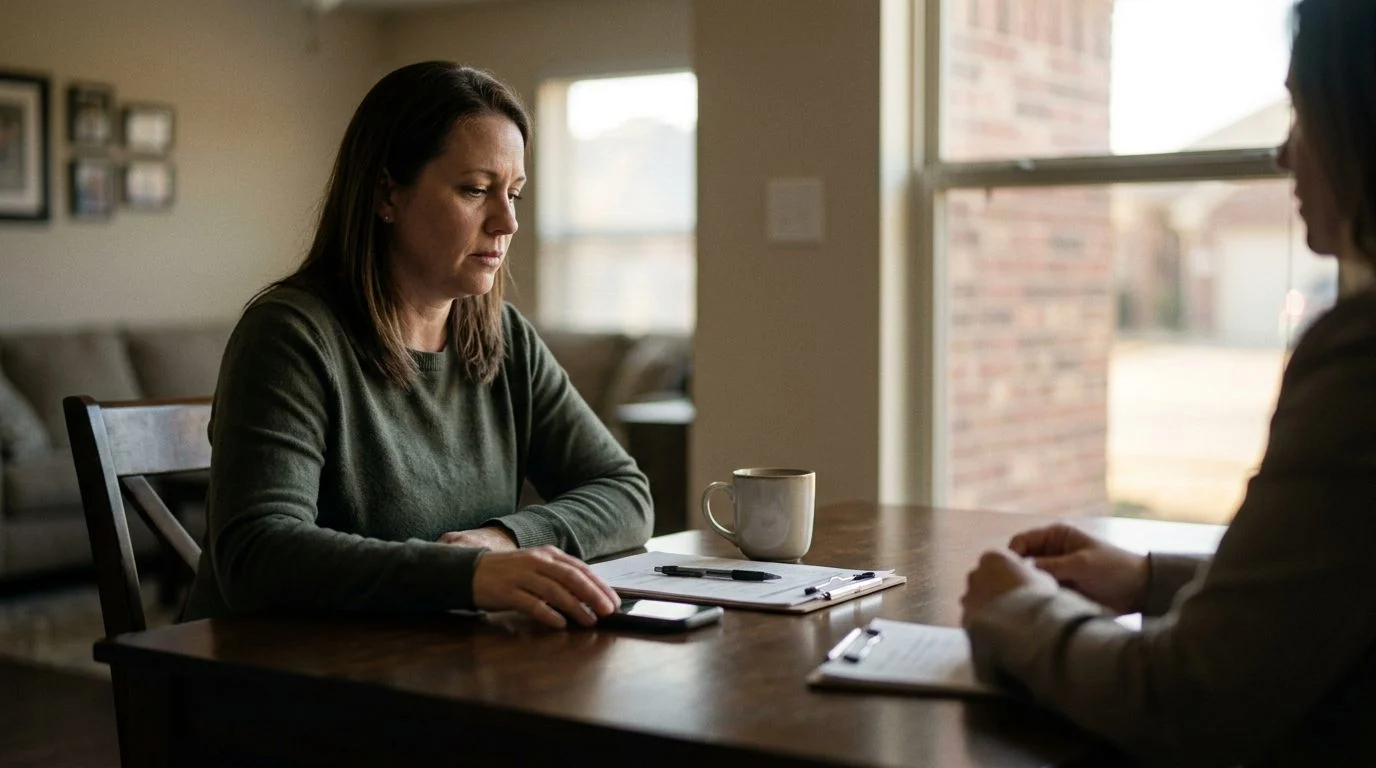
How What You Say to CPS Can Reach the Criminal Case
Anything you say to a caseworker can reach the people handling a criminal case. Treat every answer as something police or prosecutors may read later.
Joint investigations mean police may work alongside CPS on a serious report. Any audio or video recording you make yourself may be subject to subpoena under a court order, so the record can outlast the meeting.
Miranda warnings come from questioning by police while a person is in custody. The Supreme Court has held that those warnings govern whether statements from that questioning can be used in state and federal courts (Dickerson v. United States). Do not assume a caseworker’s questions come with those warnings.
A timeline you give casually at a home visit can later be compared with the charging papers and with what the child said. Small inconsistencies, even innocent ones, can be used to test your account in either setting.
If you are weighing a polygraph, see our polygraph guide for false accusations.
Contact With Your Children While CPS Is Involved
A safety plan or court order can limit your contact with your children, and the terms depend on the case. Read any written plan or order closely before you sign it or act on it.
A court can act fast when a child may be at immediate risk. If the court finds immediate danger of abuse or neglect, it may enter a temporary ex parte order without notice to you and without a hearing (Texas Family Code § 261.503).
Texas Penal Code § 25.07 covers conduct that violates certain orders or bond conditions in family violence, child abuse or neglect, sexual assault or abuse, indecent assault, stalking, or trafficking cases. That includes going to or near a child’s residence or school that the order describes. Where an order bars all communication with a protected person or family member, the statute makes an exception for communication through your attorney or a court-appointed person, but a threat passed through any person is still an offense.
Avoid questioning your children about the accusation yourself. Professional standards for child forensic interviews call for avoiding repeated questioning and using open-ended questions (OJJDP child abuse investigations resource). For a protective order request, see our protective order guide for child abuse allegations.
Not sure what your next step is?
Talk it through with our team — the first consultation is free, confidential, and carries no obligation.
Talking Through Your Situation Before Any Meeting With CPS
Before any meeting, write down what was asked, who asked, and when. A short written record helps you track what was said and what was requested.
- Write down the caseworker’s name, the date of contact, and what was requested.
- Keep copies of any paperwork you receive.
- Do not sign anything you have not read.
Your situation may involve a requested meeting, a scheduled home visit, or a criminal charge while CPS is already involved. Each one calls for its own plan, and the first step is a clear picture of your facts.
If you’re facing this now, you don’t have to work out the next step alone. Call (972) 424-1902 or send your case details through our contact page. The first consultation is free, confidential, and carries no obligation to continue. No lawyer can promise how a case will end.
Quick Answers
Do I have to talk to a CPS caseworker in Texas?
That turns on the details of your case, including any court order or criminal charge. Ask a lawyer to review the request before you answer.
Can CPS share what I say with police?
Some reports require a joint investigation with a peace officer, so your statements may reach police.
Can I record my own CPS interview?
Yes, you may record by audio or video, but Texas law does not allow other recording methods for that notice.
Can I see my children while CPS is involved?
A safety plan or court order may limit that contact, and a court can act without a hearing if it finds immediate danger.
Attorney responsible for this site: Heather Barbieri, Barbieri Law Firm, Frisco, Texas.
How Barbieri Law Firm Can Help
Review before you respond
We will review the CPS request, any paperwork you have received and any police involvement, then explain what you may be asked to do.
Clear explanation of both tracks
We will explain how a child welfare investigation can overlap with a criminal investigation and what that could mean for you.
Criminal defense focus
Barbieri Law Firm focuses on defending people accused of sex crimes, assaultive offenses and family violence in Collin County, Dallas-Fort Worth and across Texas.
Direct next step
Call (972) 424-1902 or send us your case details to begin with a confidential review.
Speak with a lawyer before you give a statement
What We Review in Your Case
The allegation
What is alleged, who made the report and what the caseworker has asked you to provide.
Police involvement
Whether a peace officer is investigating alongside CPS and what that investigation may involve.
What has already been said
Any statements you have made so far, to caseworkers, officers, family or anyone else.
The first consultation is free, confidential and carries no obligation to continue.
Request a Consultation
Fill out the short form and we will take it from there.