

Child Sex Crimes Defense | Frisco, Texas
Child Sex Crime Defense in Texas: Understanding How Your Case Will Move Forward
Barbieri Law Firm, Frisco, Texas, explains each stage of a Texas child sex crime case, from the first report through investigation, court and resolution, in Collin County and across Texas.
By Heather Barbieri · Published October 15, 2026
How Do Child Sex Crime Cases Work in Texas? A Stage-by-Stage Overview
A Texas child sex crime case usually moves in stages: a report, an investigation, an arrest or warrant, magistration and bond, grand jury review, and then plea negotiations or a trial. Not every case reaches every stage, and timing varies widely.
This page walks through each stage in plain terms. It covers the common charges, the penalty ranges that matter, and the defense questions that depend on the facts.
Accusations can start in several ways. A child may tell someone what happened. A parent, a school employee, or a medical provider may raise a concern. Sometimes the first sign is a call asking for an interview.
Barbieri Law Firm is an all-women criminal defense practice based in Frisco, Texas. It serves clients across Collin County, Dallas-Fort Worth and Texas. We will review the full file and explain your options. No lawyer can promise a particular outcome.
If a detective has asked for an interview or a bond condition has you unsure about your next court date, we can review your file and explain your options. Talk it through with our team — the first consultation is free, confidential, and carries no obligation.

How a Child Sex Crime Investigation Begins
Most investigations start with a report. The report can come from the child, a family member, a school, or a medical provider. Once police or a child protective agency gets involved, the case can move quickly.
A common step is a forensic interview. A trained interviewer, often at a child advocacy center, talks with the child, usually on video. The recording shows which questions were asked, how they were asked, and what the child said. Defense review looks closely at that recording, the interview protocol, and the interviewer’s training.
Investigators may ask the accused to talk or to set up an interview. You don’t have to answer every question. Talk with a lawyer before any interview, and share every fact with your lawyer so they can advise you.
Investigations don’t always end in an arrest. Prosecutors can accept a case, decline it, refer it, or keep investigating. The Travis County sexual assault report lists these categories and says its monthly figures don’t track cases over time.
Digital Evidence, Search Warrants, and Forensic Review
Investigators often collect phones, computers, cloud accounts, and messaging apps. They usually get them through a search warrant or with a person’s consent. Each route raises its own questions about scope and legality.
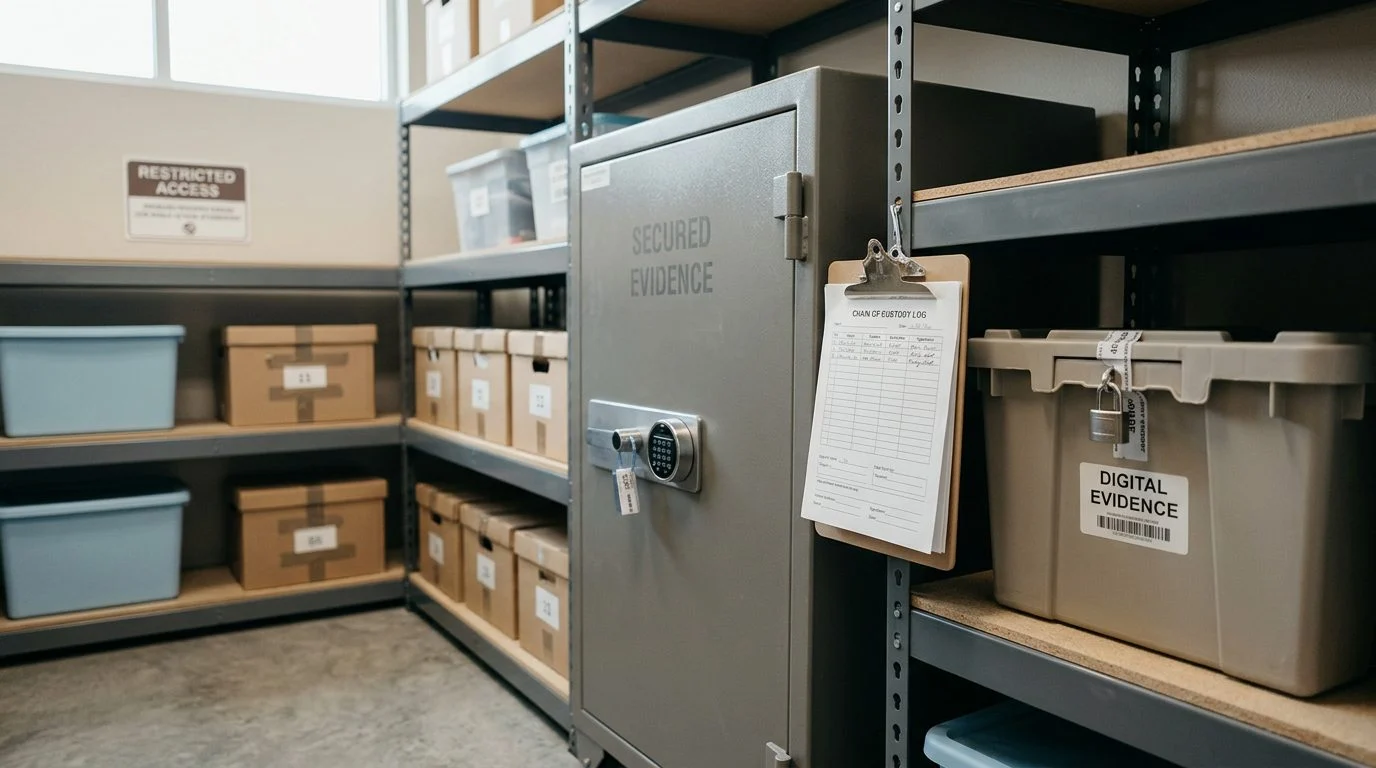
Defense review can include the warrant affidavit, the scope of the search, the chain of custody for each device, and the forensic extraction report. These records can show when files were accessed, which device held which data, and who had access. Review can also reveal gaps or errors. No review can predict what it will find.
Possession or promotion of child pornography is a separate offense under Texas law. Possessing fewer than 10 depictions is a third-degree felony. Possessing 10 or more but fewer than 50 is a second-degree felony. Other subsections set higher grades.
Arrest, Warrants, and Booking
An arrest usually happens in one of two ways. Officers may act on a warrant that a judge issued. Or they may arrest without a warrant when they have enough reason to believe a crime occurred.
After arrest comes booking. That process includes fingerprints, photographs, and a record of the charge. The charge listed at booking can differ from the charge the State later pursues. An arrest is not a conviction. The case process continues after booking.
Some people learn of a warrant from a detective’s call or a family member. If that happens, talk with a lawyer before going to any interview or court setting. Early steps can shape what comes next.
Common Child Sex Charges in Texas and How They Are Classified
Texas child sex cases fall under several Penal Code sections. Each has its own elements. The charge matters because it sets the penalty range.
Texas law defines sexual assault, including conduct involving a child. Aggravated sexual assault under Penal Code § 22.021 is a first-degree felony. One aggravating factor is a victim younger than 14. In Texas, a first-degree felony carries a punishment of life, or a term of 5 to 99 years, and may include a fine of up to $10,000.
If the victim is younger than six, the minimum term rises to 25 years under Penal Code § 22.021(f)(1). It also rises if the victim is younger than 14 and the conduct falls under § 22.021(a)(2)(A).
Indecency with a child applies to a child younger than 17. Sexual contact is a second-degree felony. Exposure is a third-degree felony. A narrow affirmative defense exists. It requires that the actor was not more than three years older, was of the opposite sex, used no duress, and had no life registration duty.
Continuous sexual abuse requires two or more acts of sexual abuse over a period of 30 or more days. The actor must be 17 or older, and the victim must be under 14 or disabled. It is a first-degree felony with a range of life, or 25 to 99 years. Jurors need not agree on specific acts or dates. They must agree that two or more acts occurred within 30 days or more.
Bond and Conditions of Release
Bond is typically addressed after booking, when the accused appears before a magistrate. The amount and conditions depend on the charge, criminal history, and the court’s practice. No one can predict a bond amount or release outcome.
Conditions in child sex cases may include no contact with the alleged victim, limits on contact with minors, electronic monitoring, and limits on internet use or devices. Read every line of the bond paperwork with your lawyer.
Violating a bond condition can lead to revocation and new charges. Texas law makes it an offense to knowingly violate certain court orders or bond conditions in a sexual assault or abuse case. The condition must relate to the safety of a victim or the community. Under Texas Penal Code § 25.07, a person commits an offense if, in violation of a bond condition set in a family violence, sexual assault or abuse, indecent assault, stalking, or trafficking case, and related to the safety of a victim or the community, the person knowingly or intentionally commits one of the specific acts the statute lists, such as committing family violence, communicating in a threatening or harassing manner, going to or near a protected place, possessing a firearm, or tampering with a monitoring device.
Not sure what your next step is?
Talk it through with our team — the first consultation is free, confidential, and carries no obligation.
Grand Jury, Indictment, and Pretrial Motions
In a felony case, a grand jury reviews the evidence the State presents. It then decides whether to issue an indictment. An indictment is a formal charge. It is not a finding of guilt.
After indictment, the accused is arraigned and enters a plea. The case then moves into discovery, which is the exchange of evidence. Pretrial motions can address forensic interview recordings, digital evidence, search warrants, and testimony from medical providers.
The timing of discovery and motions varies by court and case. No ruling can be predicted in advance. Each motion depends on the record and the law the court applies.
Penalties, Enhancements, and Collateral Consequences
Prior convictions can raise the penalty. Under Penal Code § 12.42, a prior felony conviction can change the punishment range. For a qualifying repeat sex offense, the enhancement framework includes a mandatory life sentence under § 12.42(c)(2).
Section 12.42(c)(4) requires life without parole for certain sexually violent offenses. Those offenses must be committed on or after the defendant’s 18th birthday, and specified prior final convictions must exist. Under § 12.42(d), two prior felony convictions, entered in sequence, can result in life or 25 to 99 years.
Sex offender registration is governed by Code of Criminal Procedure chapter 62. Article 62.001 lists several child sex offenses that can create a reportable conviction. Under art. 62.101, the duty ends at death for some listed offenses. For others, it ends on a set date after release, discharge, or dismissal. Which rule applies depends on the exact offense and history.
Other consequences can affect employment, housing, school, custody, and immigration status. These depend on the facts and need individual review.
Defense Options in a Texas Child Sex Crime Case
Defense options depend on the charge and the facts. Common questions include identity, timing, the child’s age, the specific conduct alleged, and whether statements are reliable and supported by other evidence.
Defense review usually covers the forensic interview recording and protocol, medical records, digital forensic reports, and the validity of any warrant. That request is called a suppression motion.
Some defenses are written into the statute. For aggravated sexual assault, § 22.021(c) treats the conduct as without consent in the circumstances listed in § 22.011(b). Consent is not an answer in those circumstances.
No lawyer can promise a particular result. Each option is weighed against the full file.
Plea Negotiations and Trial: How Each Path Works
In plea negotiation, the prosecutor and defense discuss whether an agreement is possible. A plea carries consequences, including registration duties and enhancement effects, so these must be understood before a decision.
A jury trial begins with jury selection. Witnesses and recordings are presented, and the jury returns a verdict. If the accused is found guilty, a punishment phase may follow.
The Texas Attorney General’s crime victims rights page describes protections, case updates, and participation in proceedings.
Whether to negotiate or go to trial depends on the evidence, the charge, and the accused person’s informed decision after consultation.

Talk Through Your Own Case: A Free Initial Consultation
If a detective has asked to schedule an interview, a warrant has been reported, or a bond condition has you unsure about your next court date, the next steps matter. You don’t have to figure them out alone.
Heather Jean Barbieri, Board Certified, Criminal Law — Texas Board of Legal Specialization, leads the firm’s criminal defense work in these cases. Call (972) 424-1902 or send your case details for a free initial consultation, with no obligation to continue. We will review the file, including the forensic interview, digital evidence, and any prior records, and explain your options.
Common Questions
How do child sex crime cases work in Texas?
They usually move from a report to an investigation, then to an arrest or warrant, bond, grand jury review, and finally a plea or trial.
Is an arrest the same as a conviction?
No. An arrest starts the case process. It is not a finding of guilt.
Can a child sex crime conviction require sex offender registration?
It can. Registration depends on the offense and on the rules in art. 62.101.
Can violating a bond condition lead to new charges?
Yes. Under § 25.07, certain violations are a separate offense.
Attorney responsible for this site: Heather Jean Barbieri, Barbieri Law Firm, Frisco, Texas.
Why Barbieri Law Firm
Criminal defense only
The firm focuses exclusively on criminal defense, including sex crimes, sexual assault and assaultive offenses.
Heather Jean Barbieri
Heather Jean Barbieri, Board Certified, Criminal Law — Texas Board of Legal Specialization, leads the firm's defense work.
Serving Collin County and beyond
The firm represents clients in Collin County, Dallas-Fort Worth and throughout Texas, including Frisco, Plano, McKinney, Allen, Prosper and Celina.
An all-women firm
Our team, led by Heather Barbieri, takes the time to explain each step so you understand what is happening and what your options are.
How a Texas child sex crime case typically moves
1. Report and investigation
A case often begins with a report to law enforcement.
2. Arrest, warrant and bond
Charges may lead to an arrest or a warrant.
3. Grand jury review
Defense counsel can review the charging documents and the evidence that is available.
4. Plea or trial
A case may be resolved by a plea agreement or taken to trial. We will review the evidence, explain the possible outcomes and the consequences of each path, and help you decide how to proceed.
Important: an arrest is not a conviction
Write down what you remember, gather any paperwork you have received, and bring it to your consultation so the firm can review your situation.
Talk with Heather Barbieri about your case. Your initial consultation is free and comes with no obligation to continue.
Request a Consultation
Fill out the short form and we will take it from there.