

Child Sex Crimes Defense | Collin County and Dallas-Fort Worth, Texas
Defense Investigation in a Texas Child Sex Crime Case
A careful review of the accusation, the timeline, the records and the evidence, so you understand where your case stands from the start.
By Heather Barbieri · Published October 30, 2026
A defense investigation in a Texas child sex crime case starts with the accusation and works outward from it. The defense reviews the timeline, interview records, devices, other records, witness accounts and bond or protective-order terms, one step at a time. This page explains what each review is for and how the steps fit together.
Starting With the Accusation and Its Timeline
The review starts with the exact accusation. It pins down the offense named, the date range, the location and the wording of any report or charging paper. Texas defines many of these offenses by specific acts, so the words matter. For example, “sexual contact” means touching the anus, breast or genitals of another person with intent to arouse or gratify sexual desire, under Penal Code § 21.01.
Next, the defense builds a timeline. Each alleged event is placed against the accused person’s work, school, travel and household schedule. Gaps and conflicts show up only when every date sits on one page. A conflict with a work shift can matter as much as a dramatic detail.
Accusations reach the system in different ways. A report may go to police, to the Texas Department of Family and Protective Services (DFPS), or come through a school. So the defense reviews how and when each report entered the system.
For the wider sequence of how these cases move through Texas courts, see our child sex crime case guide.
If a child's accusation has left you holding a bond sheet, a protective order or a request for devices, you don't have to face it alone; our team is ready to talk. Talk it through with our team — the first consultation is free, confidential, and carries no obligation.

Recorded Interviews and Forensic Interview Records
The defense requests every recorded or written interview of the child. It then compares what was asked with what was said. Many children are interviewed at a child advocacy center in a forensic interview, which is a structured session to gather the child’s account.
Reviewers check the questions for suggestive wording or questions that point toward a particular answer. They note whether the child’s account stayed the same across interviews. If it changed, they record what came before each change.
If the accused person gave a police interview, the review confirms what was said and when. It also checks whether the recording covers the whole session. A partial recording leaves gaps that the timeline has to fill.
Each interview is compared with the timeline. A detail can be confirmed, contradicted or left unresolved. An unresolved detail is still written down, so it stays visible as the case moves forward.
Phones, Computers and Online Account Records
In cases built on messages, images or online contact, the review covers every device the state seized or requested. That includes phones, tablets, computers and storage media. Each device is listed with its owner, its users and its role in the alleged contact.
Texas law makes online solicitation of a minor a crime. It covers certain sexually explicit communication with a minor, and soliciting a minor to meet for sexual contact, when done online or through electronic messaging, under Penal Code § 33.021. The exact subsection and the minor’s age drive the penalty, so the charge is checked first.
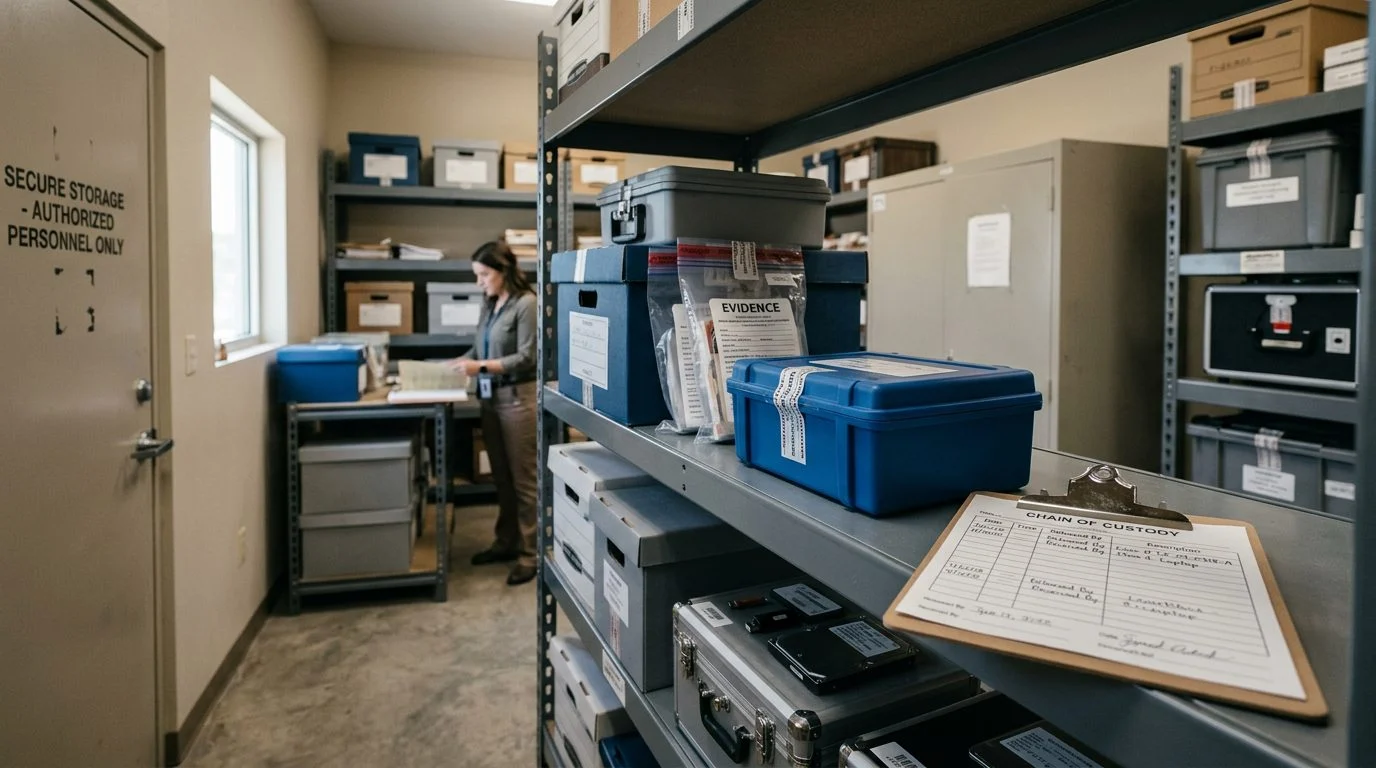
Reviewers examine account records, usernames, platforms and timestamps. They read forensic extraction reports for how the data was pulled. They also check whether chain-of-custody records are complete and whether the findings match the conduct charged.
Attribution is often the central question. Who had access to a device or account at a given time? The review tests that answer against logins, shared passwords, household use and the timeline.
Medical, School and Other Records Where They Apply
Medical and school records are requested when they bear on the accusation. They are not pulled simply because they exist. Each record is placed on the timeline with its date and its author.
School records can show when concerns were first written down and what they described. Attendance records, counselor notes and reports of behavior changes are all reviewed for dates.
A child protective services file can run alongside a criminal investigation. The two tracks are separate.
Witness Statements and Other Accounts
The review gathers every statement from witnesses who spoke to investigators. That includes family members, teachers, neighbors and other adults. Each statement is saved with its date and the person who took it.
Each statement is then compared with the timeline and with the others. Reviewers note where accounts agree and where they conflict. They also note where a witness knows something only because someone else told them.
Who first heard the accusation matters. The review tracks that person, what they heard and what they did next. The order in which people were told can shape how an account developed, so that sequence is recorded carefully.
The defense also looks for people who may support the accused person’s account. Each one is recorded with what they were in a position to know. A witness who was present adds more than one who heard about the event later.
Bond Conditions and Protective-Order Terms
The review starts with the exact bond conditions and any protective order. Each term is read, dated and checked against the court that issued it.
A protective order can bar threatening or harassing contact. It can also bar going to or near the residence or place of employment or business of a protected individual or a member of the family or household, or any child care facility, residence, or school where a child protected by the order normally resides or attends, and possessing a firearm. A location restriction must name each prohibited place and any minimum distance.
Duration matters too. A temporary order can be issued without notice or a hearing when the court finds a clear and present danger, under art. 7B.002. A protective order issued under Article 7B.003 may be effective for the duration of the lives of the offender and victim or for any shorter period stated in the order. If the order states no period, it remains in effect until the second anniversary of its issuance under art. 7B.007, unless the offender is convicted of or placed on deferred adjudication community supervision for a listed offense and must register for life as a sex offender, in which case the court shall issue an order effective for the duration of the lives of the offender and victim.
Violating a bond condition or protective order can be a separate crime. In a family violence or sexual assault case, going to or near places the order names can violate Penal Code § 25.07.
Conditions can affect where a person lives, works and sees their own children. Each term is mapped against the family’s real schedule. Any request to change a condition goes to the court through the proper filing.
Not sure what your next step is?
Talk it through with our team — the first consultation is free, confidential, and carries no obligation.

Talking Through Your Situation With Our Firm
If a child’s accusation has left you with a bond sheet, a protective order or a device request, the firm can review those papers with you. Barbieri Law Firm is based in Frisco, Texas. It defends people accused of child sex crimes and related offenses across Collin County, Dallas-Fort Worth and Texas.
Frequently Asked Questions
What does a defense investigation review first?
The review starts with the exact accusation, the charge and the timeline of events. Records, interviews and devices are then placed against that timeline.
Is a DFPS investigation the same as a criminal case?
No. DFPS handles the civil question of a child’s welfare, and law enforcement handles any criminal investigation. The two tracks run separately.
The firm is led by Heather Jean Barbieri, Board Certified, Criminal Law — Texas Board of Legal Specialization. We will review the accusation, the timeline and the records you have, and explain the options that apply. We cannot predict how your case will end. The first consultation is free, confidential and without obligation. To talk through your papers, call (972) 424-1902 or send your case details through our contact form.
Attorney responsible for this site: Heather Barbieri, Barbieri Law Firm, Frisco, Texas.
How Barbieri Law Firm approaches the investigation
We start with the accusation
We identify the exact charge, the statute cited and the specific conduct alleged, then build a timeline that every piece of evidence is measured against.
We review the evidence closely
We examine police reports, forensic interview recordings, medical and school records, and any messages, photos or devices connected to the accusation.
We look at the people involved
We evaluate witness accounts, prior statements and the circumstances in which each statement was made.
We explain your options
We walk you through what we found, what remains unclear and what choices are available, so you can make decisions with full information.
Protect your position from the first day
Do not delete, edit or hide messages, photos, social media accounts or devices connected to the accusation. Do not discuss the allegations with the accuser, their family, or anyone involved in an investigation before speaking with a lawyer. Anything said or posted can become part of the record.
What a defense investigation can include
Charge and timeline review
Comparing the accusation against dates, locations and records to find what is confirmed, what is disputed and what is missing.
Forensic interview review
Examining how and when a child was interviewed, who was present, and whether the process followed accepted practice.
Digital evidence
Reviewing phones, computers, accounts and message histories, with attention to who had access and when content was created.
Talk with Barbieri Law Firm about your case. Your first consultation is free, confidential and without obligation.
Request a Consultation
Fill out the short form and we will take it from there.