

Child Sex Crimes Defense | Frisco, Texas
When CPS and a Criminal Charge Involving a Child Arrive Together
Barbieri Law Firm defends people accused of child sex crimes in Collin County and across Texas. We review the criminal case, explain how a CPS investigation fits alongside it, and help you understand your options.
By Heather Barbieri · Published October 29, 2026
Short Answer: Yes, the Two Cases Can Affect Each Other
CPS and the criminal case run on separate tracks, with different goals and decision-makers. A CPS investigation does not decide a criminal charge, but facts, statements, and records from one can matter in the other. If you face a CPS investigation and child sex crime charge in Texas, treat both cases as active at the same time.
The Texas Department of Family and Protective Services (DFPS) handles the CPS side. Law enforcement, prosecutors, and the courts handle the criminal side. DFPS describes a CPS civil investigation of a child’s welfare as distinct from a law-enforcement criminal investigation.
Each track answers a different question. CPS asks whether a child is safe. The criminal case asks whether a person committed a crime under Texas law. An answer in one does not settle the other.
Why does this matter? A caseworker’s notes, a safety plan, or a statement you give can reach investigators. A bond condition from the criminal case can limit contact with children, even when CPS has closed its file. Missing a requirement in one track can hurt you in the other.
If a CPS caseworker has contacted your family while a child sex crime charge is pending, you don't have to sort out both cases alone. Call (972) 424-1902 or send your case details today. Talk it through with our team — the first consultation is free, confidential, and carries no obligation.

How a CPS Investigation and a Criminal Case Run Separately
The two tracks have different goals, different decision-makers, and different consequences. CPS focuses on child safety. The criminal track focuses on whether to file and pursue charges.
It does not set the court calendar.
El Paso County’s CPS guide makes this point when it separates DFPS investigations from the criminal process. Prosecutors decide what to file.
The charges come from the Texas Penal Code. Under Texas Penal Code § 21.11, an offense under Subsection (a)(1), which covers engaging in sexual contact with a child or causing a child to engage in sexual contact, is a felony of the second degree. Certain exposure-type conduct is a third-degree felony. The same section lists affirmative defenses with specific conditions, so the exact facts matter.
The two tracks also use different rules of proof and evidence. A CPS finding is not a criminal conviction. For the full timeline from report to verdict, read Child Sex Crime Case Process Texas: Report to Verdict.
What CPS Can and Cannot Decide About the Criminal Charge
Prosecutors and the courts make those decisions. That is the most important line between the two tracks.
CPS records still matter. Interviews, home visits, safety plans, and written notes can reach investigators and prosecutors. Treat every document from the CPS case as something the criminal side may read.
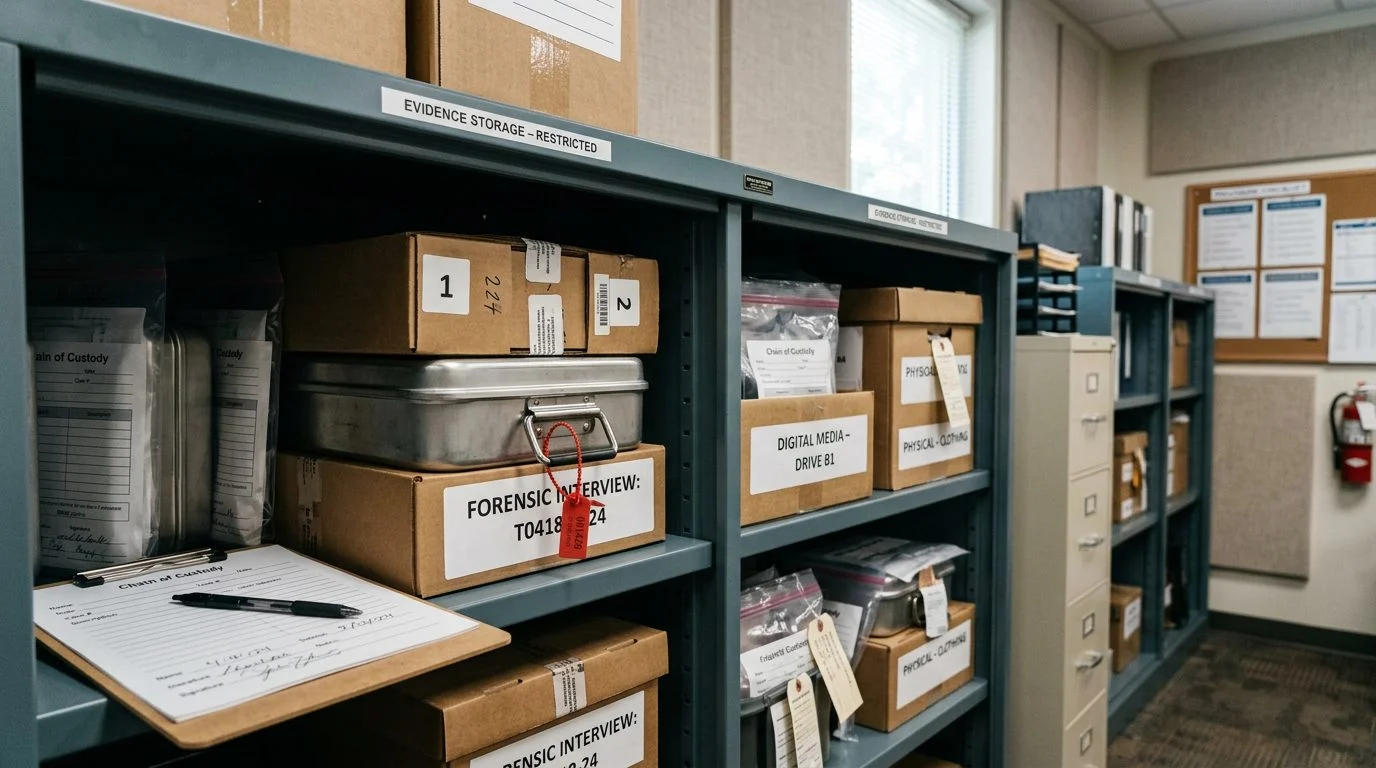
The defense reviews evidence from both tracks. That includes the child’s forensic interview, the CPS timeline, and any written statements. These details shape how the defense is built.
Timing is another gap. The child-protective services timeline does not set the criminal schedule. A criminal case may move on a different calendar. Keep the dates from both tracks in one place so nothing gets missed.
When Child Protective Services Is Also Involved
When CPS is involved, expect interviews, requests for information, and possibly a safety plan.
Children are often interviewed at a Children’s Advocacy Center. The Children’s Advocacy Centers of Texas educators guide explains what happens after a report is made. The National Children’s Alliance describes how CPS, law enforcement, medical, mental-health, prosecution, and victim-advocacy professionals coordinate these interviews and decisions.
Anything you tell a caseworker can be written down and reviewed later. Many people want to explain themselves right away. Pause before you answer, and think about how the answer could be read in both cases.
Be careful about discussing the allegation with the child, relatives, or other witnesses. Those conversations can be questioned later, and they can cause new problems in either case.
Bond Conditions and Contact With Children
A bond condition can limit contact with children, and a CPS safety plan is a separate requirement. Violating either one can create new problems.
Texas Penal Code § 25.07 makes it an offense to violate a bond condition in a family violence, sexual assault or abuse case. The condition must relate to the safety of a victim or the community. The statute covers direct threatening or harassing contact, a threat made through any person to a protected individual or a member of the family or household, any communication an order prohibits except through the person’s attorney or a person appointed by the court, committing family violence, going to or near places specifically described in the order or condition of bond, and removing or tampering with a GPS monitoring system or tracking a protected person’s property or vehicle without effective consent.
Family agreement does not change the order. Under § 25.07, reconciliatory actions or agreements between the affected people do not affect the validity of the order.
Repeated violations can be a separate offense. Texas Penal Code § 25.072 covers two or more violations within a period of 12 months or less.
A defense lawyer can review the bond terms and the safety plan side by side. If a condition should be raised with the court, that review is the place to start. For more on contact questions, read Can I See My Kids After a Sex Crime Charge Texas.
Family Court Runs on Its Own Track
Family court handles custody, possession, and access. It runs separately from the criminal case and from the CPS case. Its orders can differ from bond conditions, so check each one.
A family court filing can require sworn statements. Those statements can later matter in the criminal case. Review anything you sign against the other tracks before you file it.
The three tracks can overlap in time. A decision in one can affect the others. Keep a single timeline of every filing, hearing, interview, and order.
Not sure what your next step is?
Talk it through with our team — the first consultation is free, confidential, and carries no obligation.

Talk With Barbieri Law Firm About Your CPS and Criminal Case
If a CPS caseworker has contacted your family and a child sex crime charge is pending or has been filed, the two tracks need a plan. Barbieri Law Firm, an all-women criminal defense firm in Frisco, serves clients in Collin County and across Texas.
Common Questions
How a CPS finding relates to a criminal charge
Can I see my children while the case is pending?
Bond conditions and protective orders control contact. Violating them can be an offense under Penal Code § 25.07.
What is a forensic interview?
It is an interview of a child at a Children’s Advocacy Center, where several agencies coordinate.
Your next step is a conversation about the facts in your case. Send your case details through the contact form or call (972) 424-1902. The first consultation is free, confidential, and without obligation.
Attorney responsible for this site: Heather Barbieri, Barbieri Law Firm, Frisco, Texas.
How We Approach a CPS Investigation and a Criminal Charge
We review the full record
We look at the police report, any CPS documents, forensic interview recordings and Children's Advocacy Center records, so we understand what the State has and what it relies on.
We address statements before they are made
Anything said to a caseworker, investigator or forensic interviewer can end up in the criminal case. We explain these risks before you decide how to respond.
We explain bond and protective order conditions
Bond conditions and protective orders can control contact with children and others. We explain what each condition requires so you can follow it.
Led by a criminal defense lawyer
Heather Jean Barbieri, Board Certified, Criminal Law — Texas Board of Legal Specialization, leads the firm's criminal defense work. Our team handles scheduling, records requests and client communication.
Confidential, no-obligation first step
Your first consultation is free, confidential and without obligation to continue. Tell us what has happened, and we will explain how we would approach your case.
Talk to a Criminal Defense Lawyer Before You Give a Statement
A CPS interview, a school or agency interview and a police interview are separate proceedings. Statements made in one can affect the other. Before you give a recorded statement or sign a safety plan, speak with a criminal defense lawyer about the charge.
Key Issues in a Child Sex Crime Case With a CPS Investigation
Forensic interviews
Forensic interviews of children are often recorded at a Children's Advocacy Center, where several agencies coordinate. We review the recording, the interview protocol and how the interview was conducted.
Safety plans and contact limits
CPS may ask a family to agree to contact limits or a safety plan. We explain what these arrangements require and how they interact with the criminal case.
Bond and protective orders
Violating bond conditions or a protective order can lead to new charges. Penal Code § 25.07 addresses violations of certain family violence protective orders. We explain the conditions that apply to your case.
Talking with CPS and police
Caseworkers and investigators may ask for interviews, documents or access to a home. We help you understand these requests and how to respond while your criminal case is pending.
Talk With a Criminal Defense Lawyer About Your Case
Related practice areas
Request a Consultation
Fill out the short form and we will take it from there.