

Child Sex Crimes Defense | Frisco, Texas
Before Your Child Speaks With CPS, Get Your Own Questions Answered
A CPS interview can shape what happens next in a family and in a criminal case. Here is how a parent accused of abuse can think it through.
By Heather Barbieri · Published November 21, 2026
A caseworker or a children’s advocacy center wants to interview your child about an accusation made against you. Here’s the short answer for an accused parent in Texas: don’t try to block the CPS interview yourself, and don’t discuss the child sexual abuse allegation with your child until a lawyer has reviewed the case. The interview is often recorded, and that recording can become evidence in a criminal case, a custody case, or both.
Your child may be interviewed about an allegation against you
Your child can be interviewed as part of an abuse investigation, and you need a plan before that happens. The Texas Family Code lists an interview and examination of the child as a step an investigation may include, under Texas Family Code § 261.302. The investigating agency usually sets the schedule and the setting, not you.
Texas law makes it a Class B misdemeanor if you are notified of the time and starting location of a department transport of a child, are present at that location when the transport starts, and attempt to interfere with the department’s investigation. It is not an offense if the department requested you to be present at the site of the transport. Under Texas law, a person commits an offense only if, after being notified of the time and starting location of a department transport of a child and being present there, the person attempts to interfere with the department’s investigation. Trying to block the interview yourself carries real risk.
This page covers what to avoid, what to do, and what your defense does with the recording. If you want the wider picture, our family member guide covers the charges and the CPS process. Read it alongside this page, not instead of talking with a lawyer about your own facts.
Talk it through with our team — the first consultation is free, confidential, and carries no obligation.
What a children’s advocacy center forensic interview is
A forensic interview is a structured session in which a child talks about what happened, usually at a children’s advocacy center. Its goal is the child’s own account of events. A single report can bring in more than one agency.
The Children’s Advocacy Centers of Texas educator guide describes how DFPS and law enforcement can both become involved after a child abuse report.
Recording is the central point. For a DFPS interview in which the allegations are discussed, Texas Family Code § 261.302 requires an audio or video recording. The exceptions include broken equipment and a child who stays unwilling to be recorded after a reasonable effort. When another investigating agency interviews a child who may be a victim of physical or sexual abuse, the interview must be recorded unless that agency determines that good cause exists for not recording, under its own rules. If an investigating agency other than DFPS does not audiotape or videotape an interview with a child alleged to be a victim of physical or sexual abuse, that failure is admissible at the trial of the offense.
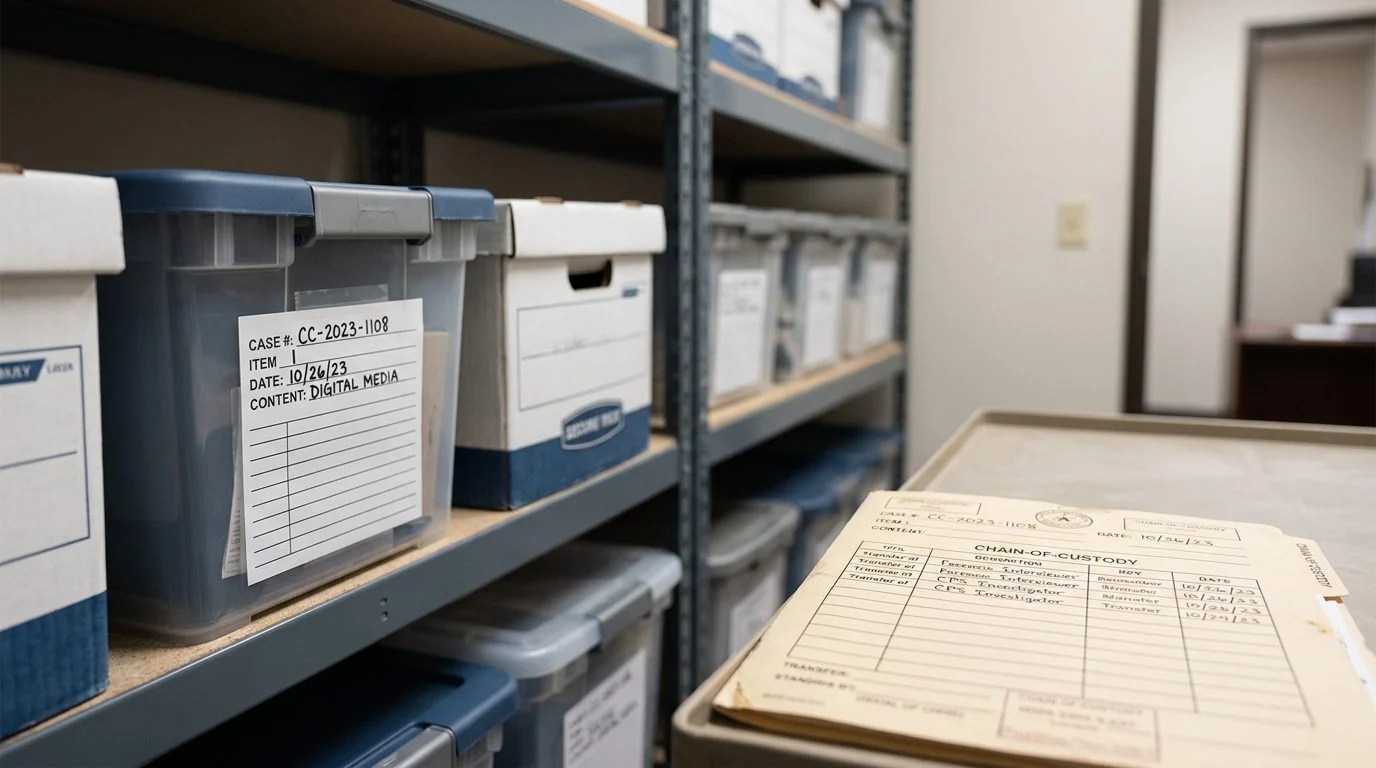
You usually don’t control the recording or where it’s kept. That’s why the defense treats the recording as the first item to obtain and review.
Why you should not contact your child about the allegation
Generally, an accused adult should not contact the child about the allegation. That includes phone calls, texts, social media messages, and face-to-face talks. Don’t use a relative or friend to pass messages, either.
Any conversation can become a point of dispute. The other side in a custody or divorce case can raise it. Prosecutors can describe it as an effort to shape the child’s account, even when you meant only to reassure your child.
The child’s words may also be compared over time. Extrinsic evidence of a witness’s prior inconsistent statement is not admissible unless the witness is first examined about that statement and fails to unequivocally admit making it; that condition does not apply to an opposing party’s statement under Rule 801(e)(2). A witness must first be told the statement’s contents, its time and place, and the person it was made to.
The safer step is simple. Raise the question with a lawyer before any contact. A lawyer can help you handle requests from a caseworker or the other parent, and can tell you how a conversation could be described later.
How the CPS, family court and criminal tracks run side by side
Three tracks can run at the same time: a CPS investigation, a family court case, and a criminal investigation. Each has its own rules, people and timeline. A deadline in one can arrive while another is still open.
Family court can move fast. Under Texas Family Code § 261.503, if the court finds from a protective order application that there is an immediate danger of abuse or neglect to the child, it may enter a temporary ex parte order. That order can be entered without further notice to you and without a hearing. Such an order can affect your time with your child while the case is pending.
Statements in one track can reach the others. What you tell a caseworker, a judge, or an investigator can end up in front of the others. That is why decisions about speaking and contact need to be coordinated across all three tracks. For more on this overlap, see our custody case guide.
How the defense requests and reviews the interview recording
The defense requests the recording and related records through discovery, and it asks early. Under the Texas discovery statute art. 39.14, on a timely request from the defendant, the state must produce, as soon as practicable, offense reports and written or recorded statements of the defendant or a witness. That right has limits set by other statutes, including art. 39.15 limits for certain child-related material.
The review starts with the full recording, not a summary. The defense looks at the wording and order of the questions, how the child’s account changes over time, and whether it matches earlier statements. Small details matter. A question that suggests an answer can change how the account should be read.
Then the defense compares the recording with police reports, CPS records, medical findings and the rest of the file. It also notes who made each record and when, because those details shape how much weight a statement can carry.
What the defense tests in the accusation and the evidence
The defense tests the whole accusation, not just the child’s words. It checks the interview method, the timeline, and whether the account fits the other evidence. It also asks what supports the accusation and what does not.
Hearsay rules matter too. Under Texas law, a child’s statement describing an offense in certain prosecutions involving a child victim may be admitted despite the hearsay rule only if the offering party gives notice by the 14th day before the proceeding begins, names the witness and provides a written summary of the statement, the court finds the statement reliable, and the child testifies or is available to testify. The child must testify or be available to testify. A defense can challenge each of those points.
A recording of a child’s oral statement made before a complaint is filed or an indictment returned can also be admitted under art. 38.071 recorded statements, but only on the motion of the attorney representing the state or the attorney representing the defendant and only if the court finds that the statute’s requirements have been substantially satisfied.
Medical findings, recorded calls or texts, and records of earlier disclosures often come up in these cases. Each one is checked for timing, source, and whether it supports or contradicts the account. The defense may also challenge the wording used with the child during the interview.
Not sure what your next step is?
Talk it through with our team — the first consultation is free, confidential, and carries no obligation.
Is a forensic interview enough to decide a case?
No. A single interview is one piece of the case, and a defense tests it against the rest of the evidence. It isn’t accepted on its own.
The charge matters a great deal. If the accusation is aggravated sexual assault of a child, Texas Penal Code § 22.021 makes it a first-degree felony. The minimum prison term rises to 25 years in certain cases, including a child under 10, or a child under 14 when an aggravating act listed in the statute is involved.
A first-degree felony carries life, or any term from 5 to 99 years, under Texas Penal Code § 12.32. A fine of up to $10,000 can be added.
The outcome of any case depends on the charge, the evidence and the court. No lawyer can promise how a case will end. Your decisions about speaking and contact now shape how the evidence develops. Early review lets the defense request the recording, preserve records and test the account before others draw conclusions. That is why timing matters.
If a detective or caseworker asks you to talk
Speak with a lawyer before you answer questions about the allegation. The Fifth Amendment text says no person shall be compelled in any criminal case to be a witness against himself.
Whether a statement made during custodial questioning can be used against you depends on several factors, including whether you were in custody, whether police interrogated you, whether you validly waived your rights, and whether a recognized exception applies. Dickerson v. United States reaffirmed that the warnings set out in Miranda v. Arizona are a constitutional rule.
Texas also entitles a defendant to consult in private with counsel sufficiently in advance of a proceeding, under art. 1.051 right to counsel.
If a caseworker interviews you, Texas Family Code § 261.3027 requires DFPS to tell you that you may make an audio or video recording of that interview, but may not record it in any other manner. The same notice says your recording may be subject to subpoena under a court order. Statements made without legal review can be used later in the criminal case or the custody case.
Can an accused parent get a copy of the recording of a CPS interview in Texas?
If charges are filed, the defense can request recorded statements through discovery.
Can a recorded interview of a child be used as evidence in Texas?
It can be, if the court finds the statutory requirements met. The defense can test whether those requirements were satisfied.
Do I have to answer a caseworker’s questions about the allegation?
Talk with a lawyer before you answer. In a criminal case, the Fifth Amendment protects you from being compelled to be a witness against yourself.
Before any contact with your child or the caseworker, talk with a lawyer
Heather Barbieri and our team at Barbieri Law Firm defend people accused of sex crimes and assaultive offenses across Collin County, Dallas-Fort Worth and Texas. If your child has been or will be interviewed, we will review the recording, the rest of the evidence and your options, and explain them in plain language. The initial consultation is free, confidential, and carries no obligation to continue. Call (972) 424-1902 or send your case details so the review can begin before any contact with your child.
Attorney responsible for this site: Heather Barbieri, Barbieri Law Firm, Frisco, Texas.
How Barbieri Law Firm Approaches These Cases
Confidential from the first call
The initial consultation is free, confidential and carries no obligation to continue.
Review of the record
We review CPS and law enforcement reports, any recorded interviews and related notes with you, so you understand what has been said and by whom.
Clear explanations
We explain how an interview may be used, what questions to expect and how your options may affect your family and your case.
Experienced criminal defense
Heather Jean Barbieri, Board Certified, Criminal Law — Texas Board of Legal Specialization, leads the firm. Our practice focuses on defending people accused of sex crimes and assaultive offenses in Collin County, Dallas-Fort Worth and across Texas.
Important Caution
Do not question your child about the allegations or ask them to repeat what they said. Well-meaning conversations can affect later interviews and the evidence in your case.
Questions Parents Often Ask Early
Can I be present?
Whether and how a parent may take part in a CPS interview depends on the situation. We can explain what to expect in your case.
Can the interview be recorded?
Interviews are sometimes recorded. A recording may later be requested and reviewed as part of a criminal case.
How can the interview be used?
Statements may be relied on by CPS, law enforcement and prosecutors. Knowing how they are used helps you plan your response.
What about my child's routine?
Keeping daily life steady for your child matters. We can help you think through conversations at home that do not interfere with the process.
Talk With Heather Barbieri Before Your Child's Interview
Related practice areas
Request a Consultation
Fill out the short form and we will take it from there.