

Online Sex Crimes Defense | Collin County and Texas
Chat Logs in a Texas Online Sex Crime Case: What You Need to Know
Message histories are often central to these cases. Here is how they are reviewed, what context matters, and how Barbieri Law Firm approaches the evidence.
By Heather Barbieri · Published October 27, 2026
For anyone facing chat log evidence online sex crime Texas charges, the core question is simple. Can the State prove the messages are complete, accurate and tied to the accused? The State builds that proof in steps, from the phone or account to the summary a jury sees. Each step can be tested. This guide explains those steps in plain terms.
What the State Must Show Before a Chat Log Reaches a Jury
In online sex crimes cases, whether chat logs are complete and accurate, and whether they can be linked to a particular person, are often central questions in reviewing the evidence. That question sits at the center of most chat log cases.
Texas makes online messages central to many charges. Under Texas Penal Code § 33.021(c), a person commits an offense if, over the Internet or by text, the person knowingly solicits a minor to meet. The solicitation must carry intent that the minor engage in sexual contact, sexual intercourse, or deviate sexual intercourse.
Because the words often carry the charge, the questions center on who wrote them. They also center on whether the printout matches the original data. A chat log can be a real record and still be incomplete or misread. The defense review asks whether the messages say what the State claims they say.
If a detective has mentioned your messages or taken your phone, you don't have to sort out the chat log alone. Barbieri Law Firm offers a free, confidential consultation. Talk it through with our team — the first consultation is free, confidential, and carries no obligation.

How Detectives Extract Chat Logs From Phones and Accounts
Detectives usually get chat logs from a seized phone or computer, a cloud backup, or records the platform provides. The source matters, because each one answers different questions.
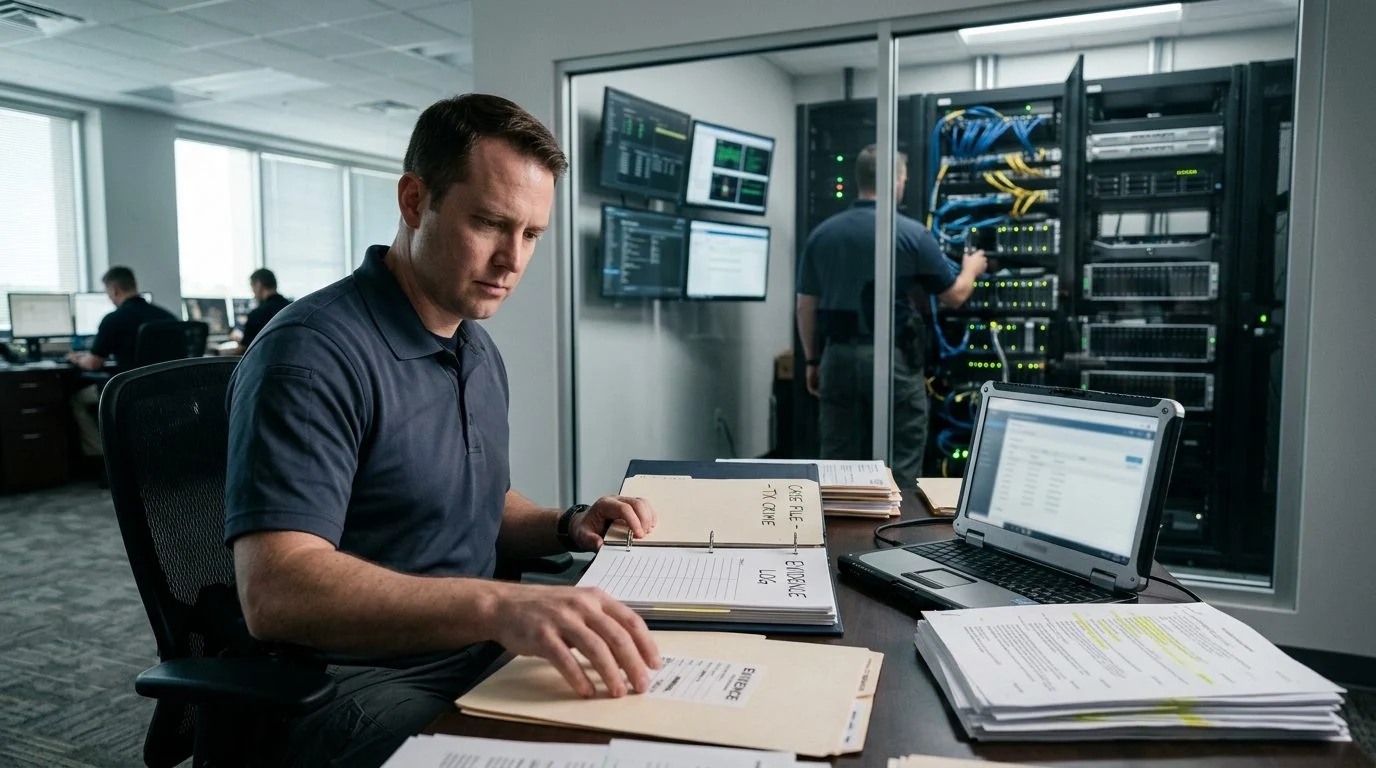
A forensic examiner copies device data with specialized software. The examiner does not simply scroll through screens. The full extraction is often large, but the State frequently shows jurors a smaller version.
Reports are commonly exported to PDF or spreadsheet files. Those files are often the first version prosecutors and jurors see. A search warrant defines what may be searched, so the scope of the extraction belongs in the legal review.
Some cases involve task force work, so more than one agency may handle the data. It investigates online child exploitation, including sexual solicitation.
How Evidence Is Preserved: Hash Values and Chain of Custody
Hash values and chain of custody records show whether a copy matches the original and who handled it. These records are where a defense review often starts.
A hash value works like a digital fingerprint. If the hash of a copy matches the hash of the original data, the two are the same. If they differ, something changed.
Chain of custody is the log of who had the device, when they had it, and where the data was stored. Gaps in that log raise questions. The examiner’s notes and the tool name and version show how the extraction was run. If the State calls the extraction reliable, those details test that claim.
Matching hash values support the copy’s integrity. They do not prove who typed each message. That question belongs to the next step.
Tying the Messages to the Accused: Account Ownership and Attribution
Questions about whether messages can be tied to a particular person are often part of how these cases are reviewed. It usually does this by showing that the person controlled the account, device or login used for the chats.
Evidence the State may use includes subscriber information from the platform, login and IP address records, and device ownership or usage records. Each one points to an account or device. None of them, alone, always points to the person typing.
Devices and accounts can be shared. A username, a profile photo or a nickname alone does not establish who was typing. Family members, roommates and others may use the same phone or login.
Undercover operations raise a separate question. An officer may use an online persona. Attribution questions, such as which account sent which message, are often examined closely when a case is evaluated.
Texas law also addresses how a sting is run. Under Texas Penal Code § 8.06(a), entrapment is a defense when a law enforcement agent induces the conduct with persuasion or other means likely to cause persons to commit the offense. Merely giving a person an opportunity to commit an offense is not entrapment.
How Detective Summaries and Transcripts Are Made
Most cases reach the jury through detective summaries, screenshots or selected excerpts, not the full extraction. A summary is a set of choices.
A detective decides which lines to quote and which to leave out. The summary may also describe what a message meant. Those descriptions reflect the detective’s view, and they can be tested.
Compare the summary line by line against the complete extraction. Check whether each quoted line appears in the right order, on the right date, and in the right thread. A short reply like “ok” or “sure” can read very differently with the messages before it.
Translations, abbreviations and slang readings are statements too. If a summary says what an abbreviation or phrase meant, that reading should be checked against the surrounding context.
People often assume a screenshot shows the whole conversation. Usually it shows only a slice.
What a Defense Lawyer Reviews in the Extraction
A defense review checks context, timestamps, metadata and the records behind the extraction. Each item is compared with the summary the State plans to use.
Start with the full thread before and after each excerpt. Next, check timestamps and the time zone used. Find out whether a timestamp is the sent time, the received time or the export time. A shift in time can change the order of messages.
Look at metadata, including device identifiers, account names, attachment records and any notes about deleted items. These show what the device stored and how the data was labeled.
Then request the documents behind the work. Those include the warrant and its return, examiner notes, the tool name and version, hash verification records and the chain of custody log. These records show how the State moved from the phone to the printout.
Not sure what your next step is?
Talk it through with our team — the first consultation is free, confidential, and carries no obligation.
Where a Chat Log Record Can Be Incomplete
A chat log can be incomplete when messages, attachments or platform records are missing. Gaps change what the jury sees.
Threads may lack messages from one side. Attachments may be unavailable. Platform records may not cover the full period in question. Each gap affects the overall picture.
Deleted messages may be partly recovered, but recovery has limits. A recovered fragment may not show the full message, its date or its sender. Those limits can change what the jury sees.
Messages sent before or after an excerpt can change how one line reads. A single line pulled from a longer conversation may mean something different in context.
Undercover messages matter too. If an operator’s messages are left out of a transcript, the accused’s replies can look different than they were in the full conversation.
Talk With Barbieri Law Firm About Your Chat Log Evidence
If a detective has mentioned your messages or seized your phone, the next step is a review of what the State actually has. Barbieri Law Firm will review the extraction, the summary and the attribution records with you. Then we will explain your options. No lawyer can promise an outcome.
Heather Jean Barbieri, Board Certified, Criminal Law — Texas Board of Legal Specialization, leads the firm. The firm defends clients in Collin County, Dallas-Fort Worth and across Texas. Related guides include Collin County sex crimes defense, Prosper sex crimes defense, McKinney sex crimes defense and the online sex crimes defense guide.
Your free initial consultation is confidential and carries no obligation to continue. Call (972) 424-1902 or send your case details through the contact form.
Common Questions About Chat Log Evidence
Can chat messages be used in a Texas online solicitation case?
Chat messages are often central to these cases. Completeness and connection to the person charged are among the issues examined when a case is reviewed.
Does the school-hours enhancement apply?
It can. Under Texas Penal Code § 33.021, punishment rises to the next higher category of offense if it is shown on the trial that the offense occurred during regular public or private primary or secondary school hours and the actor knew or reasonably should have known the minor was enrolled in such a school.
Whether registration follows depends on the facts of each case.
Attorney responsible for this site: Heather Barbieri, Barbieri Law Firm, Frisco, Texas.
Before you respond to anyone
Do not delete, edit or forward messages, and do not contact the other person about the case. Do not post about the matter online. Speak with a lawyer before answering questions about chat messages, devices or accounts.
What a defense review of chat logs examines
The full conversation
We review the complete message thread, not isolated excerpts, to understand who said what, in what order, and what came before and after the messages used in the case.
Connection to the person charged
We examine whether the account, device and messages can be tied to the person accused, and whether others had access to the phone or account.
Context and timing
Dates, times, stated ages, and the surrounding circumstances are reviewed carefully, because they can change how a conversation reads.
Evidence collection
We look at how messages were obtained, preserved and summarized, and whether the records presented are complete and accurate.
How Barbieri Law Firm approaches these cases
Careful evidence review
We will review the messages, the charging documents and the digital records, and explain what the evidence shows and what it does not.
Defense focus
Barbieri Law Firm focuses on criminal defense, including sex crimes, online sex crimes and aggravated sexual assault cases across Collin County, Dallas-Fort Worth and Texas.
Confidential first consultation
Your free initial consultation is confidential and carries no obligation to continue.
Talk with a Texas criminal defense lawyer about your chat log evidence
Related practice areas
- Online Sex Crimes Defense Lawyer | Collin County & Texas
- Online Sex Crimes Defense Lawyer in Collin County
- Sex Crimes Defense Lawyer in Prosper
- Online Sex Crimes Defense Lawyer in McKinney
Request a Consultation
Fill out the short form and we will take it from there.