

Forensic Interview at a Texas Children's Advocacy Center
By Heather Barbieri · Published November 14, 2026
If your loved one has been accused of a child sex offense in Texas, the words “forensic interview” may be new to you. A forensic interview is a structured, recorded conversation between a trained interviewer and a child. Its purpose is to learn what the child has experienced. In Texas, these interviews often take place at a Children’s Advocacy Center, and the recording can later become part of the criminal case.
This guide explains the process from the accused’s side. It covers the setting, the steps, the recording and how a defense team reviews it.
What Is a Forensic Interview With a Child?
A forensic interview is a child-focused conversation that gathers facts about possible abuse. Trained interviewers use open-ended questions and try to avoid asking the same thing over and over. The OJJDP guidance on child abuse investigations and forensic interviews describes these standards.
Usually one interviewer speaks with the child. That is different from a police station interview, where officers question a suspect. Good interviewers match their wording to the child’s age and language.
The purpose is information for child protection and the justice system. The session gives investigators a record of what the child said. That record can later enter the case file, so the words matter. Interviewers do not decide guilt. Their job is to record the child’s account as fully and accurately as they can.
What a Children’s Advocacy Center Is and Why a Child May Be Interviewed There
A Children’s Advocacy Center, often called a CAC, is a child-focused facility where several agencies work on the same case. The Children’s Advocacy Centers of Texas FY24 brochure says these multidisciplinary teams conduct and coordinate forensic interviews and related services.
The team can include law enforcement, child protective services, prosecutors and medical or mental-health providers. Each agency has its own role. They share one location and one plan for the case.
The setting is built for children. The Children’s Advocacy Centers of Texas February 2024 brochure describes these centers as providing a child-friendly setting where children can share their accounts. Rooms are usually designed to feel comfortable, not like an office or a courtroom.
Putting the work in one place helps limit how many times a child must repeat the story. Not every report leads to a CAC interview. The center is one part of the broader Texas child-protection and investigation process.
How a Report of Child Abuse in Texas Leads to an Interview
A report of suspected abuse starts the process, and an interview may follow. The report can reach the state or law enforcement. Investigators screen it, assign it and decide whether a forensic interview is needed.
The Texas DFPS handbook on the CPS basic investigation process describes an investigation that includes an ongoing child-safety assessment. That handbook also addresses confidentiality for people who report abuse or neglect.
Timing varies. When an interview happens depends on the facts of each report and on the agencies involved.
Most accused people learn about the report through law enforcement or the court process, not through the interview itself. That is why early legal help matters. A lawyer can review notices, request records and plan next steps as the case moves forward.
Why the Accused Is Generally Not Present for the Interview
The accused is generally not in the room for a CAC forensic interview. The setting is designed to limit pressure on the child. The accused’s lawyer is usually not in the room either.
The accused’s side still takes part, just not in the room. Counsel handles discovery, which is the exchange of evidence between the state and the defense. Counsel also reviews the recording, the interviewer’s notes and the records.
Contact with the child or the child’s family about the allegation is a serious mistake. Even a short text, a call or a social media post can create new legal problems. It can also complicate the case in ways that are hard to undo.
If you are a relative of someone accused, your role is different from theirs. Stay calm and write down what you were told, with dates. Bring those notes to a lawyer. Do not bring them to the child’s family.
What Interviewers Ask a Child and How the Session Is Structured
A typical session moves in stages. The interviewer builds rapport, sets ground rules for telling the truth, asks the child to describe a neutral event, moves to the topic with open prompts and then closes.
The exact order varies by interviewer and protocol. Many interviewers follow a recognized protocol, and the protocol shapes the sequence and wording of questions. That makes it a standard to compare the session against.
The defense looks for specific problems. Suggestive questions that put words in the child’s mouth stand out. So do repeated questions on the same topic, and props or anatomical diagrams used outside the protocol.
Statements that sound like they came from earlier talks with others also matter. These points help the defense judge how the account was gathered.
How Interviews Are Recorded and Who Can Access the Recording
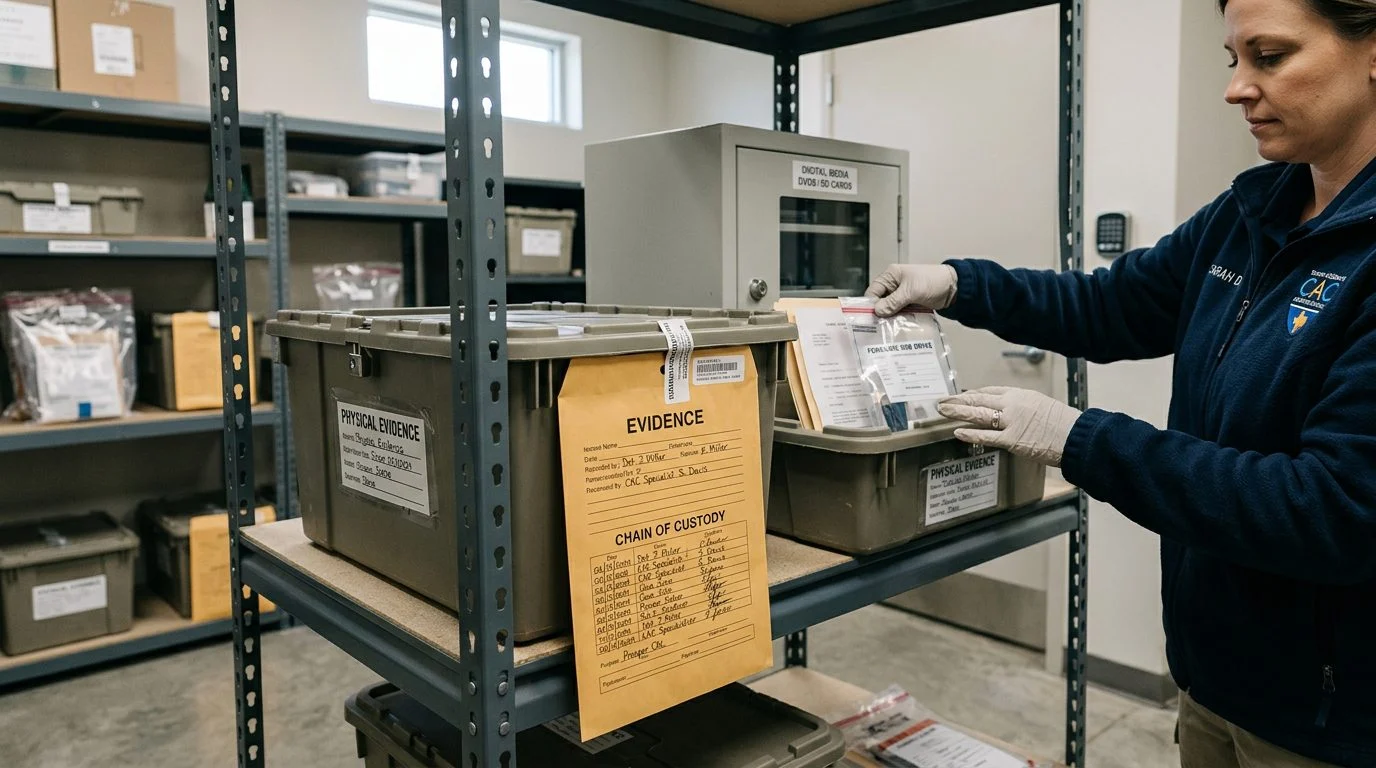
Forensic interviews are commonly audio and video recorded.
Texas law also addresses children’s statements in court. Under Texas Code of Criminal Procedure art. 7B.004, at a hearing on a protective order, a statement describing the offense made by a child younger than 14 who is the victim of certain listed offenses is admissible in the same manner as a child’s statement about abuse is admissible under Section 104.006 of the Family Code.
For background on the outcry statement that often comes up in these cases, see outcry witnesses in Texas child sex crime cases.
How the Defense Reviews the Recording and the Interview Protocol
The defense starts with the full recording and the interviewer’s notes. The review compares the session against the protocol the interviewer said was used. It also logs timing, the number of sessions and any gaps in the record. A missing segment or an unexplained break can matter.
The review looks beyond the room. It asks what happened before and after the interview. That includes earlier disclosures, medical findings and statements made to other adults.
The defense may consult qualified outside professionals on child development, memory and interview methods. These professionals help evaluate how the session was run.
The charge shapes the review too. Under Texas Penal Code § 21.11, indecency with a child involving sexual contact is a second-degree felony. Exposure-based conduct under the same section is a third-degree felony.
The statute also provides an affirmative defense, and every listed condition must be met: the actor must be of the opposite sex and not more than three years older than the other person, no duress, force or threat may have been used, and the actor must not have been required to register for life as a sex offender under Chapter 62, or must not have had a reportable conviction or adjudication under Chapter 62 for an offense under this section. Subsection (b-1) sets out a separate defense for spouses.
If a child later changes or withdraws an account, that raises its own questions. See recanted abuse accusations in Texas. For how long these cases can take, see child sex crime case timelines in Texas.
Questions a Family Can Bring to the First Consultation
The most useful first step is to bring the facts you already have. Bring a list of what you know:
- The report details, including what the report says.
- Whether an interview is scheduled or has already happened.
- Whether anyone has requested the recording.
- Any notices or deadlines you have received.
- The names of the agencies involved.
Heather Barbieri leads Barbieri Law Firm, an all-women firm in Frisco, Texas. The firm defends child sex crime charges in Collin County, Dallas-Fort Worth and across Texas.
Heather Jean Barbieri, Board Certified, Criminal Law — Texas Board of Legal Specialization.
If your loved one has been told a child will be interviewed at a Children’s Advocacy Center, or a recorded interview has already happened, call (972) 424-1902 or send your case details. The first consultation is free, confidential and carries no obligation to continue.
Frequently asked questions
Can the accused attend a forensic interview?
Generally not. The accused and the accused’s lawyer are usually not in the room.
Does the defense get the recording?
The recording becomes part of the case file and is disclosed to the defense through discovery.
What is a Children’s Advocacy Center?
It is a child-focused facility where a team of agencies coordinates its work on a case.
Attorney responsible for this site: Heather Barbieri, Barbieri Law Firm, Frisco, Texas.
Ready to take the next step?
Related practice areas
Request a Consultation
Fill out the short form and we will take it from there.