

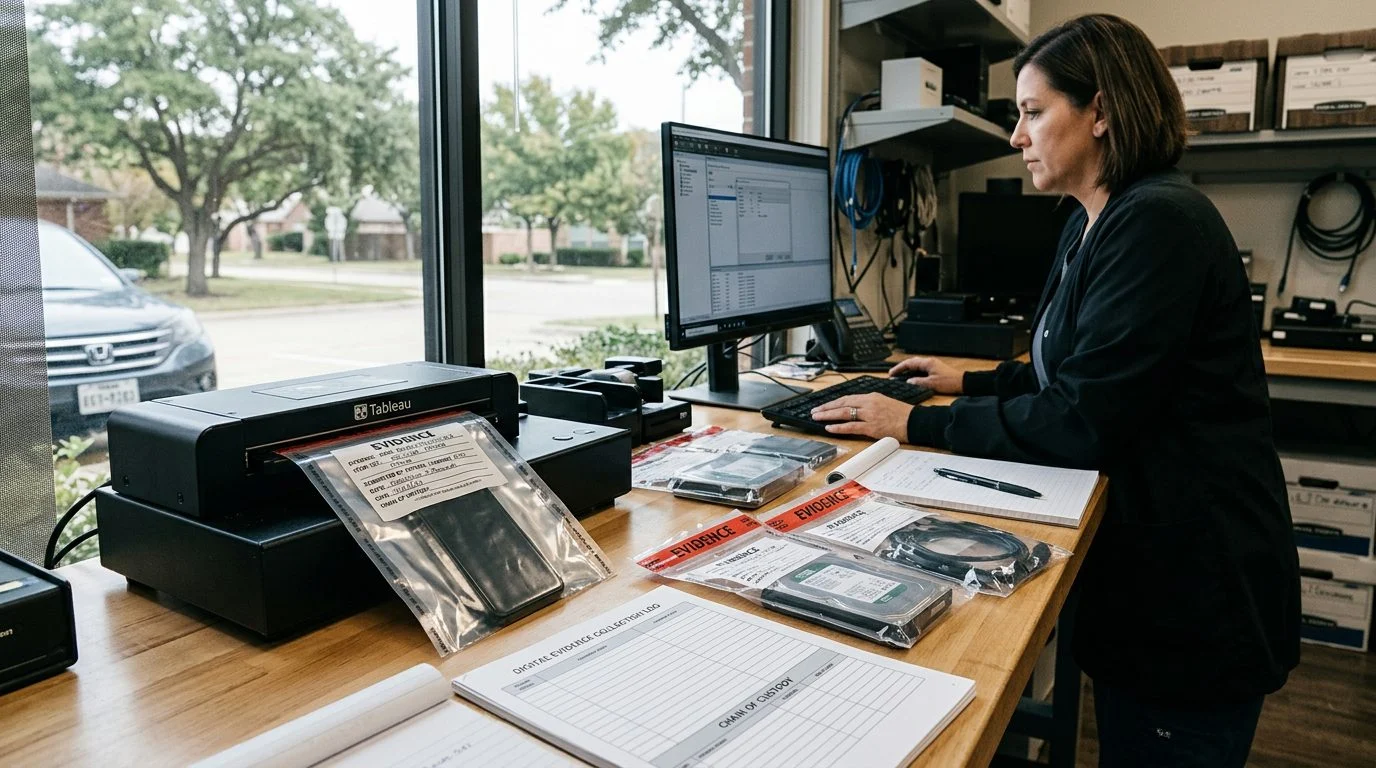
Online Sex Crimes Defense | Collin County, Texas
Phone Evidence in an Online Sex Crime Case Needs a Careful Review
Barbieri Law Firm examines how police obtained a phone, what the extraction report actually shows and what the evidence can and cannot prove.
By Heather Barbieri · Published November 17, 2026
You may have been arrested after a chat you thought was private, or police may have asked to look through your phone.
This guide explains where phone and message evidence comes from in an online sex crime case in Collin County, what it can and cannot show, and what a defense lawyer checks first. It is general information, and your case depends on its own facts.
What Phone and Message Evidence Means in Your Case
Phone and message evidence is any information police take from your phone, your accounts or the other person’s device. That can include texts, app messages, chat logs, images, call records, account data and screenshots.
In an online solicitation sting, the messages may be a chat with an officer posing as a minor or as an adult. For this offense, Texas defines a minor to include a person the actor believes is younger than 17 Penal Code § 33.021. A transcript is a record to test, not a neutral picture of what happened.
This page is for a man facing an online sex crime or child-related accusation in Collin County who needs to understand the digital evidence early. Barbieri Law Firm defends people accused of online sex crimes from its Frisco office and serves Collin County.
If police have your phone, messages or accounts, you do not have to face what that evidence means alone; send us your case details and we will review it with you. Talk it through with our team — the first consultation is free, confidential, and carries no obligation.
How Police Get Your Phone, Messages and Accounts
Police usually get this evidence in one of four ways: a warrant, consent, a seizure at arrest, or a request to a company. Each route leaves its own record, and the order of events matters.
A warrant is a written order from a magistrate. It must rest on a sworn affidavit that sets out facts establishing probable cause, and, except as otherwise provided by this code, that affidavit becomes public once the warrant is executed art. 18.01.
Consent is often requested at an arrest or a home visit. Treat that request as a decision with consequences, not a formality.
After a lawful arrest, officers may take a phone, but Art. 18.0215(a) generally bars searching it later without a warrant, except in the exceptions that statute lists. If a warrant issued to search for and seize data on a phone or other electronic device is executed by seizing the device before its time runs out, the data may be recovered and analyzed after that time closes art. 18.07.
Carrier records follow a separate track. Under Carpenter v. United States, the government generally must get a warrant supported by probable cause before obtaining a person’s historical cell-site location records from the phone company.
Reports of suspected online enticement can also start an investigation. NCMEC’s CyberTipline accepts these reports and refers them to law enforcement for possible investigation.
Can Police Search Your Phone Without a Warrant?
Generally, no. Texas law says a peace officer may not search a person’s phone after a lawful arrest without a warrant under art. 18.0215.
The U.S. Supreme Court held that police generally need a warrant to search a cell phone, even one seized during an arrest, in Riley v. California.
Texas law lists narrow exceptions. A phone may be searched without a warrant if its owner or possessor consents, if the owner reports it stolen, or in certain fugitive or life-threatening situations.
If an officer searches without a warrant because of a fugitive or immediate life-threatening situation, and the judge finds that situation did not occur and declines to issue the warrant, the evidence from that search is not admissible in a criminal action.
A warrant must also identify, as near as may be, what is to be seized and describe the place or thing to be searched art. 18.04. A defense lawyer checks whether the warrant meets that standard and whether the affidavit supports it.
If police claim consent, the questions change. Was it freely given? Who had authority to give it? Was it recorded?
What We Review in the Phone and Message Evidence
We review the warrant, the collection, the extraction and the transcript as separate steps. A problem in one step can weaken the whole chain.
- The extraction report. It shows what tool was used, what was copied, what was left out and whether each step was documented.
- Timestamps. We compare dates and times in the transcript with the device clock, the time zone and the platform’s records.
- Account attribution. Who created the account, who knew the password, and who else used the device or the home Wi-Fi.
- Deleted-item claims and screenshots. A screenshot can leave out the surrounding conversation. Recovery claims need the report behind them.
- Sting chats. We want the full transcript, the profile used, and whether the officer started the conversation.
Entrapment is also a defense in sting cases. It applies when a law enforcement agent induced the conduct using persuasion or other means likely to cause persons to commit the offense. Giving a person an opportunity to offend is not entrapment Penal Code § 8.06.
Discovery decides what your lawyer gets to see.
Some material is handled differently. For material such as child pornography, a court must deny a request to copy it when the state makes it reasonably available, such as for inspection at a state facility art. 39.15.
How a Phone and Message Evidence Review Works, Step by Step
The review starts with a consultation, then moves through records, analysis and a decision about your options. Each step builds on the one before it.
- Initial consultation. The initial consultation is free, confidential and carries no obligation to continue. You share the charge, the timeline and what police told you.
- Written discovery requests. We ask for the warrants, affidavits, extraction reports, full chat transcripts and sting records.
- Forensic review with you. We go through each report and list questions about collection and analysis.
- Motions where the records support them. A motion may challenge the warrant, the consent, the scope of a search or the reliability of data.
- A decision on options. We discuss negotiations, pretrial motions and trial preparation, so you choose with full information.
The court’s calendar and the volume of digital evidence set the pace. We explain what to expect once we have the records.
Protecting Your Position Right Now
Your first moves can affect the evidence. Start by keeping your devices and accounts as they are.
- Do not delete messages, accounts, apps or photos. Deletion raises new questions about what was removed and can complicate the review.
- Do not give a statement to police without a lawyer. Whether a statement from custodial questioning can be used depends in part on whether police first gave Miranda warnings, which include your right to have a lawyer present, as Dickerson v. United States explains.
- Do not contact the complaining person, their family or any child in the allegation. That includes social media.
- Write down, for your lawyer only, how you and others used each device and account. Name anyone who shared them with you.
- Keep copies of court orders, bond conditions and protective orders. Tell your lawyer about any custody or CPS deadlines.
Not sure what your next step is?
Talk it through with our team — the first consultation is free, confidential, and carries no obligation.
Why Barbieri Law Firm for Phone and Message Evidence Cases
Barbieri Law Firm is an all-women criminal defense firm in Frisco, Texas, serving Collin County, Dallas-Fort Worth and Texas. It defends people accused of sex crimes and assaultive offenses, including online sex crimes.
Heather Barbieri leads the firm and is the responsible lawyer for this page. Heather Jean Barbieri, Board Certified, Criminal Law — Texas Board of Legal Specialization. Carrie Thomas is also one of the firm’s lawyers.
Our team follows the order the evidence was collected: the warrant, the collection, the report and then the transcript. We walk through the records with you in plain language.
No lawyer can tell you how a case will end. We will review the evidence and explain your options.
Your Questions About Phone and Message Evidence, Answered
Most questions come down to what police have and how they got it.
Can police search my phone after an arrest?
Generally not without a warrant. Texas law allows limited exceptions, such as when the owner consents, under art. 18.0215.
Can deleted messages be recovered?
Recovery claims appear in the extraction report. They must be tested like any other evidence.
What level of felony is an online solicitation charge?
Under § 33.021(f-1), punishment is increased to the next higher category if the offense occurred during school hours and the actor knew or reasonably should have known the minor was enrolled in school. Other consequences depend on the charge and any conviction.
Will my divorce or custody case be affected?
A criminal case and a family case can move on separate tracks. Tell your lawyer about every pending matter.
Should I talk to police to clear things up?
Talking can create statements the state may later use. Speak with a lawyer before you answer questions.

Take the Next Step on Your Case in Collin County
If police have your phone, your messages or your accounts, you do not have to work out what that evidence means alone. Your family and your name may feel at stake right now.
Send your case details through our contact form, or call (972) 424-1902 to schedule a consultation.
Attorney responsible for this site: Heather Barbieri, Barbieri Law Firm, Frisco, Texas.
How we review phone evidence
Warrants and consent
We review the warrant, its scope and any claimed consent to determine whether the search followed the law.
Extraction reports
We read the full forensic report, including the tools used, the settings and the data that was left out.
Recovery claims
Claims about deleted messages or images are tested like any other evidence before we rely on them or challenge them.
Timelines and metadata
We compare dates, times and device records against the state's version of events.
Clear options
We explain what the evidence shows, what it does not show and the options available to you.
Before you speak with anyone
Do not delete, reset or change messages, apps, accounts or settings on your phone. Do not give anyone your passcode or a statement about the case until you have spoken with a lawyer.
What to bring to your consultation
Charging documents
Any arrest paperwork, warrant copies or notices you received about the investigation.
Device information
The make and model of each phone, computer or tablet that police may have accessed.
Account and message history
A general summary of the platforms and accounts involved, shared with your lawyer in confidence.
Questions
Anything you are unsure about, including how the investigation may affect your work or family.
Your first consultation is free, confidential and carries no obligation to continue.
Related practice areas
Request a Consultation
Fill out the short form and we will take it from there.