

Child Sex Crimes Defense | Collin County, Dallas-Fort Worth and Texas
Forensic Interview in a Texas Child Sex Crime Case
Barbieri Law Firm defends people accused of child sex crimes across Collin County, Dallas-Fort Worth and Texas. Here is how these interviews work and what to consider before one takes place.
By Heather Barbieri · Published November 12, 2026
You’ve learned that a child was, or will be, interviewed in a case against your loved one. That news can be frightening, and it’s normal to wonder what comes next.
A forensic interview is a child-friendly conversation about possible abuse, led by a trained interviewer. In a Texas child sex crime case, the interview can become one of the most important pieces of evidence. This page explains each step and how Barbieri Law Firm responds.
What a Forensic Interview at a Children’s Advocacy Center Is
A forensic interview is a structured talk with a child about possible abuse, led by a trained forensic interviewer. In many Texas cases, it takes place at a Children’s Advocacy Center (CAC). A CAC brings investigators, prosecutors, child protective services (CPS) staff and medical staff into one team process. Standards for child forensic interviews call for open-ended questions and avoiding repeated questioning (OJJDP interview standards).
Three groups feel the interview most: the child, the accused person and the family. Family members may hear about a report before anyone speaks with the accused. The session may be recorded, so both sides can review the child’s words later. Learn how the process works before anyone gives a statement to police, because early choices can shape the case.
If a child was interviewed in a case against your loved one, you don't have to work out the next steps alone. Call Barbieri Law Firm to talk through your options. Talk it through with our team — the first consultation is free, confidential, and carries no obligation.

What the Interview Covers and What Becomes Part of the Record
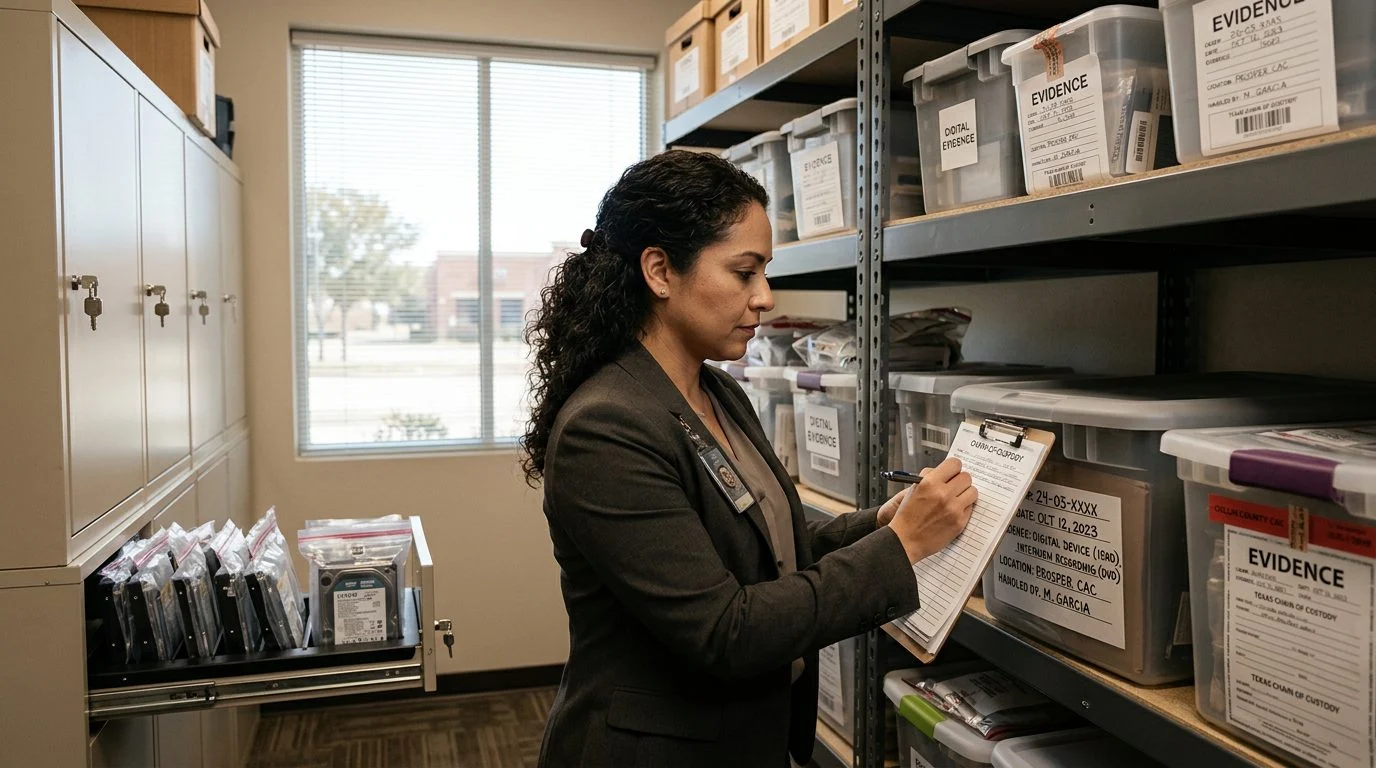
The interview covers the child’s account of what happened. The record can include a recording, the interviewer’s notes and referral papers.
Typical topics include:
- The child’s account of what happened and when.
- The child’s relationships with the accused and with household members.
- When the first disclosure happened, and who the child spoke with before the interview.
- Any phone, computer or online messages the child mentions.
Online conduct adds a federal layer. The Internet Crimes Against Children program supports investigation of technology-facilitated child sexual exploitation (Internet Crimes Against Children program).
Related steps often run beside the interview. A medical exam may document injuries and collect forensic evidence (Texas sexual assault exam guidance). A CPS investigation includes an ongoing child-safety assessment (CPS investigation handbook).
A defense lawyer reviews the recording, the notes, the referral paperwork and the disclosure timeline. Each one can show gaps or conflicts.
How the Process Typically Unfolds in a Texas Child Sex Crime Case
A typical case moves from a report to the interview, then to team review, charging decisions and court. A defense lawyer can take part at each stage.
- Report and referral. A report reaches law enforcement or CPS, which can refer the child for a forensic interview.
- The interview. A trained interviewer speaks with the child in a child-friendly setting.
- Team review. Investigators, prosecutors, CPS and medical staff review the interview and other findings.
- Charging decision. Law enforcement and the prosecutor decide whether to file charges.
- Court dates and bond. If charges are filed, the case moves to court, where bond and early hearings are set.
- Protective order hearing. In a hearing on an application for a protective order under this subchapter, a statement made by a child younger than 14 years of age who is the victim of an offense under Section 21.02, 21.11, 22.011, 22.012, or 22.021, Penal Code, and that describes the offense committed against the child, is admissible as evidence in the same manner that a child’s statement regarding alleged abuse against the child is admissible under Section 104.006, Family Code, in a suit affecting the parent-child relationship (Code of Criminal Procedure art. 7B.004).
Early contact matters. Early work helps preserve evidence and limits statements made before counsel is involved.
Where a Forensic Interview Can Go Wrong
A forensic interview can lose reliability when questions suggest answers, when the record has gaps, or when outside talk shapes what a child says.
- Suggestive questions. Suggestive or repeated questions can push a child toward an answer. Standards call for open-ended questions instead.
- Gaps in the record. Missing recordings or notes, or a long delay between the first disclosure and the interview, can matter.
- Outside influence. Talks with other adults, school staff or others before the interview can affect what a child says.
- Limits of the interview. The interview records what a child said at one point in time. By itself, it does not establish what happened.
A defense lawyer checks for these issues by reading the recording and paperwork. Then the lawyer decides which questions to raise in the case. Each issue is a question to ask, not a conclusion.
How Barbieri Law Firm Responds After a CAC Interview
Barbieri Law Firm reviews the interview record, explains the charge and your options, and advises the accused person on statements and contact.
- Statements. The accused person should talk with counsel before giving any statement to police or CPS.
- Records. The firm requests and reviews the recording, notes, referral and medical records through discovery.
- Contact limits. A protective order or bond condition can prohibit communication. Breaking that condition can be its own offense under Penal Code 25.07.
- Penalties. Aggravated sexual assault is a first-degree felony (Penal Code 22.021). Under Penal Code 12.32, a first-degree felony is punishable by imprisonment for life or for a term of not more than 99 years or less than 5 years, and a fine not to exceed $10,000 may be added. Certain aggravated sexual assault offenses involving a child victim are subject to a different minimum under Penal Code § 22.021(f), so this range does not apply to every case. Indecency with a child is a second- or third-degree felony, depending on the conduct (indecency with a child statute).
- Family questions. The firm also helps the family with bond and protective-order questions.
No lawyer can assure a result. What the firm does is review the evidence, including the interview itself, and explain your options in plain terms.
Why Families Work With Barbieri Law Firm
Barbieri Law Firm is an all-women criminal defense firm based in Frisco, Texas, that defends people accused of sex crimes and assaultive offenses.
- Lawyers. Our lawyers include Heather Barbieri and Carrie Thomas, supported by office staff. Heather Barbieri leads the firm and is responsible for this page.
- Certification. Heather Jean Barbieri, Board Certified, Criminal Law — Texas Board of Legal Specialization.
- Practice areas. The firm handles child sex crimes, sex crimes, online sex crimes, aggravated sexual assault, aggravated assault and family violence matters.
- Where. The firm defends clients in Collin County, Dallas-Fort Worth and Texas.
Every case turns on its own record, so the review starts with the actual interview.
Not sure what your next step is?
Talk it through with our team — the first consultation is free, confidential, and carries no obligation.
Common Questions About Forensic Interviews and Defense
Short answers to the questions families ask about forensic interviews are below.
Can a defense lawyer get the interview record?
A defense lawyer can review the recording and notes through discovery, once the state provides them.
Does a forensic interview mean charges will be filed?
An interview alone does not decide charges. Law enforcement and prosecutors make that call after team review.
Can a child’s statement be used at a protective-order hearing in Texas?
Should a family member talk to police or CPS before calling a lawyer?
Call a defense lawyer before any statement is given. A lawyer can explain what the accused should and should not say.
What does the free consultation cover?
It is a free, confidential initial consultation with no obligation to continue. You can ask about your loved one’s case and options.
Talk With Barbieri Law Firm About Your Loved One’s Interview
If a child has been interviewed in a case against your loved one, Barbieri Law Firm can review the record with you and explain your options.
Bring what you have, such as charge papers, any bond or protective-order papers, and the dates you know. Call (972) 424-1902 or send your case details for a free, confidential initial consultation, with no obligation to continue.
The firm defends clients in Collin County, Dallas-Fort Worth and Texas, from its base in Frisco.
Attorney responsible for this site: Heather Barbieri, Barbieri Law Firm, Frisco, Texas.
Key terms in a forensic interview case
Forensic interview
A recorded interview of a child, conducted by a trained interviewer, often at a child advocacy center.
Team review
Law enforcement and prosecutors often review the interview with other professionals before deciding whether to file charges.
Discovery
Once the state provides them, a defense lawyer can review the recording and related notes through discovery.
How our team approaches these cases
Reviewing the recording
We will review the interview recording and any notes once they are available, and explain what they show.
Advising you on your options
We will discuss your options, including questions about any interview, based on the facts of your case.
Plain-language communication
We explain each step of the process and answer your questions as your case moves forward.
An all-women firm
Barbieri Law Firm is an all-women firm led by Heather Barbieri, with a team that supports every client.
Frisco office
From our Frisco office, we represent clients in Collin County, Dallas-Fort Worth and across Texas.
Speak with a lawyer before agreeing to an interview
If you or a family member has been asked to take part in a forensic interview, talk with a criminal defense lawyer before agreeing to anything. What is said in an interview can shape a case, so understanding the process first matters.
Call (972) 424-1902 for a free, confidential consultation
Related practice areas
- What Happens After a Child Sex Crime Accusation in Texas? Charges, Process and First Steps
- Aggravated Sexual Assault Defense
Request a Consultation
Fill out the short form and we will take it from there.