

Child Sex Crimes Defense · Collin County and Dallas-Fort Worth, Texas
What DNA and Exam Results Can and Cannot Show in a Texas Child Sexual Assault Case
Lab reports and medical findings often carry more weight than they should. Here is how a defense lawyer reads them.
By Heather Barbieri · Published November 11, 2026
If a child has accused your loved one of sexual assault, you may have heard that no DNA was found or that the medical exam was normal. Those words can sound like good news, and they can also leave you unsure what they change.
If your loved one has been accused of a child sexual assault in Texas, a missing DNA result or a normal exam does not decide the case. This page explains what each piece of evidence can and cannot show.
The short answer: missing DNA and a normal exam do not settle the case
A missing DNA result or a normal exam does not end the question of what happened. The Texas sexual assault statute does not list DNA as part of the offense. Texas Penal Code § 22.011 describes conduct, and it defines a child as anyone younger than 17.
That matters because a case is built from several kinds of proof. These can include what the child says, what other witnesses saw or heard, and the physical and forensic results. Each result is one piece of that picture. A defense lawyer looks at how each piece fits with the others.
Many families hear words like “normal” or “no DNA detected” and assume the case is over. Those words describe a test or an exam. They do not say who was involved, what happened, or when. The sections below take each result in turn.
If your loved one was told the DNA came back negative or the exam was normal, you don't have to work out what those results mean alone. Talk it through with our team — the first consultation is free, confidential, and carries no obligation.

What DNA testing can establish
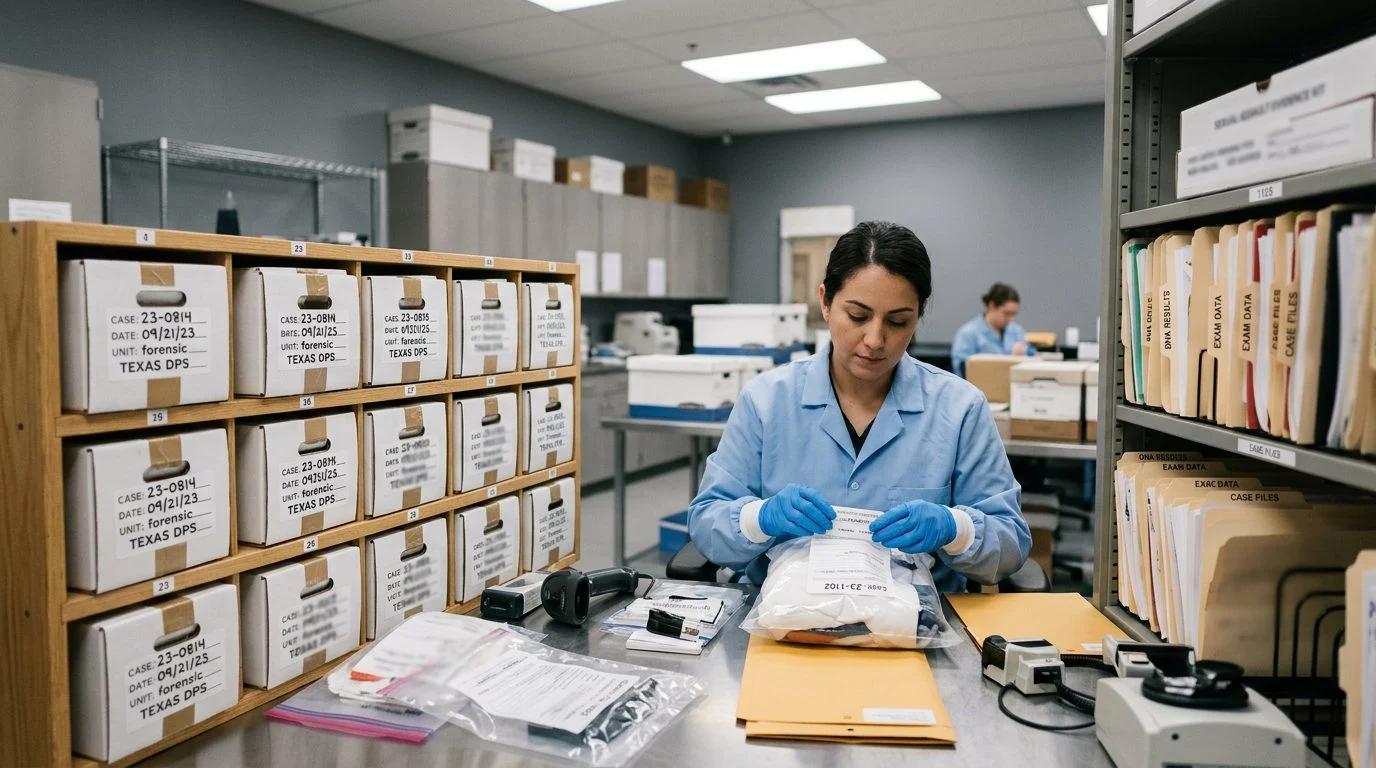
DNA testing can show whether biological material is present and whether it matches a particular person’s profile. That is the full extent of what a match says on its own. A match tells you whose DNA was found in a sample. It does not tell you how the DNA got there, when, or whether any sexual act took place.
In Texas, DNA profiles are compared through the Combined DNA Index System, known as CODIS. The National Institute of Justice notes that a sexual-assault-kit profile can produce a CODIS match only when the suspected person’s profile is already in the database. A database hit is a comparison. It is not a finding about the assault itself.
Samples also follow a path. Someone collects them, labels them, stores them, and sends them to a lab. Each handoff is a point where records matter, so the chain of custody is as important as the result.
What DNA cannot establish
DNA evidence cannot show that a sexual act occurred, that force was used, that consent was missing, or when anything happened. Those questions belong to the whole case, not to a lab report.
DNA can also be present for ordinary reasons. In a shared home, family members, friends, and visitors touch the same bedding, clothing, towels, and furniture. DNA can move from person to person and from object to object. A sample can contain someone’s DNA with no connection to any crime.
Some charges involve touching, not penetration. Under Texas Penal Code § 21.11, indecency with a child covers sexual contact, which means touching done with intent to arouse or gratify sexual desire, such as touching the anus, breast, or any part of the genitals of a child, or touching a child’s body with those parts of another person’s body. In a case built on touching, there may be no DNA to test at all.
The absence of a DNA profile means only that a profile was not produced. It does not prove innocence, and it does not prove guilt.
What a sexual assault medical exam can and cannot show
A sexual assault medical exam records the history a child gives, the examiner’s physical findings, and any samples collected. The findings are written down on the day of the exam, so they capture one moment in time.
A normal result means the examiner recorded no finding that day. It does not prove that abuse happened, and it does not prove that it did not. A finding that is present does not, by itself, name who caused it or when. Both kinds of result need context: the child’s account, the timing of any alleged contact, and what the exam could and could not see.
How physical findings are read: the wording in the records matters
The exact words an examiner uses change what a finding means. “Normal” describes what the examiner saw. “Consistent with” means a finding fits one or more causes, and it does not name one. “Nonspecific” means the finding does not point to a single cause. Reading past these words can lead to a wrong conclusion in either direction.
Gather the full records and bring them to your consultation. That usually means the intake notes, the exam narrative, any lab report, and the date on each page. Bring the complete set, so the wording can be read line by line rather than from a summary someone repeated to you.
Timing matters too. The date of the exam, what was reported and when, and the gap between an alleged event and the exam all affect how a finding should be read. A record that looks clear in a summary can read differently in full.
How the defense tests the forensic evidence
A defense lawyer tests forensic evidence by asking how it was collected, who handled it, and how the lab analyzed it. Those questions come before any question about what a result means.
Forensic lab evidence can be reviewed in detail. We can request the underlying lab data and handling records, not just the final report, so that the testing can be examined in full.
We will review the lab data and records behind any forensic conclusion in your loved one’s case and explain what they show. An independent forensic reviewer can examine those records for contamination, transfer, gaps in documentation, or a conclusion that goes further than the data supports. Whether any of these issues appears depends on the facts of the case.
For a Texas defense lawyer, the goal is to understand the evidence well enough to explain it plainly. The review is about accuracy, not about assuming a result is wrong.
Not sure what your next step is?
Talk it through with our team — the first consultation is free, confidential, and carries no obligation.
Where DNA and medical results fit in the rest of the case
DNA and medical results sit alongside other evidence. That can include the child’s statements, forensic interviews, and testimony from other witnesses. These pieces are weighed together, not in isolation.
Prior-acts evidence follows its own path.
The stakes are serious. Aggravated sexual assault is a first-degree felony under Texas Penal Code § 22.021.
Case paths also vary. One county’s monthly sexual assault unit report shows that cases may be accepted, declined, referred, or still under investigation, according to the Travis County District Attorney report. Those are categories in one county’s reporting, not a prediction for any case.

Talk through your loved one’s situation with Barbieri Law Firm
You can have DNA and exam results explained in plain words before you decide what to do next. If your loved one was told the results were negative or normal, the next step is to look at the full records, not just the summary.
Barbieri Law Firm is based in Frisco, Texas, and defends people accused of child sex crimes in Collin County and across Texas. Call (972) 424-1902, or send your case details through our contact page, to talk through the DNA, medical, and physical findings in your loved one’s case. The first consultation is free, confidential, and carries no obligation to continue.
Does a child sexual assault case in Texas need DNA evidence?
No. The statute describes conduct and does not list a DNA result as part of the offense.
Does a normal medical exam mean the child was not abused?
No. A normal exam means the examiner recorded no finding that day. It does not prove either outcome.
What does a CODIS match prove?
A CODIS match shows that a profile in the database matches a sample. It does not show when or how any contact happened.
Attorney responsible for this site: Heather Barbieri, Barbieri Law Firm, Frisco, Texas.
How we review the science in your case
Complete lab files
We request and review the full DNA file, including bench notes, chain-of-custody records and the statistical reports behind any conclusion.
Medical exam records
We compare the examiner's findings with the underlying notes and explain what was recorded, what was not, and what the findings do and do not show.
Database matches
We look at how any profile was generated, whether a database hit was confirmed, and whether the lab reported its own limits.
Plain-language explanations
We walk you through each result in everyday language so you understand the evidence before making decisions about your case.
Who reviews your file
Heather Jean Barbieri, Board Certified, Criminal Law — Texas Board of Legal Specialization, leads the firm's criminal defense work, including child sex crimes cases.
A normal exam is not the same as a finding that nothing happened
A normal medical exam records what the examiner saw on that day. It does not, by itself, prove or disprove abuse. Reviewing the full lab and medical file with a lawyer is the first step toward understanding what the evidence actually shows.
Common questions about DNA and exam evidence
Lab results need context
A DNA match, a partial profile or a mixed sample must be read alongside how it was collected, handled and tested.
Exams are not proof either way
Physical findings are often absent in child cases. We review what was recorded, what was left out and why it matters.
A database hit is not the end of the analysis
We examine how any match was generated and whether the lab's reported limits were respected.
Private, confidential answers
Call (972) 424-1902 or send your case details. The first consultation is free, confidential and comes with no obligation to continue.
Have questions about the DNA or exam results in your case? Talk with our team.
Related practice areas
- What Happens After a Child Sex Crime Accusation in Texas? Charges, Process and First Steps
- Child Sexual Abuse Case Timeline in Collin County, TX
- Texas Sex Crime Defense: Can You Refuse a Police Interview?
Request a Consultation
Fill out the short form and we will take it from there.