

Criminal Defense | Collin County and Dallas-Fort Worth
Accused of Child Abuse in a Texas Divorce or Custody Case?
A criminal charge can arrive while your family case is still open. Get criminal defense advice early, before you speak with investigators about the allegations.
By Heather Barbieri · Published November 23, 2026
Being accused of child abuse during a divorce or custody fight can feel like everything is at risk at once. Your freedom, your children and your reputation may all feel on the line.
The criminal case is its own court process. It has its own charges, evidence rules and possible punishments, even when a divorce or custody case runs at the same time.
If you are facing this accusation during a divorce or custody fight
The criminal case and the custody dispute move on separate tracks, but what happens in one can affect the other. A criminal court handles the charge. A family court handles custody. Each has its own filings, deadlines and orders.
Statements and orders in one place can show up in the other. A custody filing, a CPS interview or a message to the other parent may all matter later.
This page covers the criminal case, its possible charges and how it can affect your contact with your children. It does not cover the divorce itself.
An accusation is something to test. Testing starts with the facts: who said what, when, where, and what records exist. Assumptions don’t replace evidence.
If an accusation arrived in the middle of your divorce or custody case, you don't have to face the criminal charge alone; we invite you to reach out for a confidential talk. Talk it through with our team — the first consultation is free, confidential, and carries no obligation.

What Texas charges can apply to a child abuse accusation?
Several Texas offenses can follow a child-related accusation. The charge depends on the specific allegation.
- Indecency with a child. This applies to a child younger than 17. Sexual contact, meaning touching done with intent to arouse or gratify sexual desire, is a second-degree felony, and exposure done with that intent is a third-degree felony. Texas law sets out affirmative defenses to this offense in subsections (b) and (b-1). One applies only when several listed conditions are met. The other applies if the actor was the child’s spouse at the time of the offense.
- Sexual assault. This is generally a second-degree felony. It is a first-degree felony in certain listed situations (Penal Code § 22.011).
- Aggravated sexual assault. This is a first-degree felony (Penal Code § 22.021).
- Continuous sexual abuse of a young child. This requires two or more acts over a period of 30 days or more, committed when the actor is 17 or older, against a child younger than 14 or a disabled individual. It is a first-degree felony punishable by life in prison or by a term of not less than 25 and not more than 99 years (§ 21.02).
- Injury to a child. For a child 14 or younger, causing serious bodily injury intentionally or knowingly is a first-degree felony (§ 22.04).
Texas also defines certain “sexually violent offenses” in Code of Criminal Procedure art. 62.001. Some of the offenses above fall in that group when a person 17 or older commits them. Whether registration applies depends on the offense and how the case ends.
A report can also start a separate state process.
How a criminal defense tests the accusation
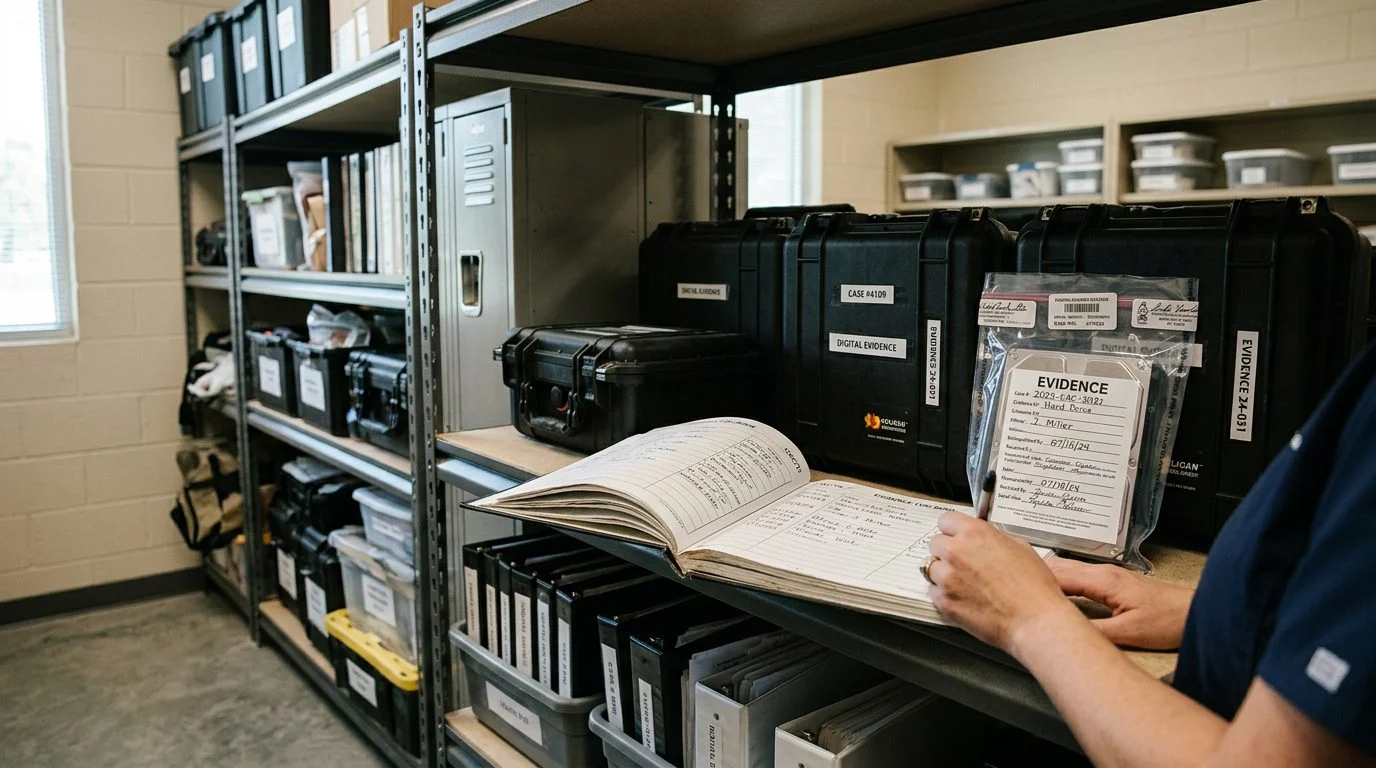
A defense tests each part of the accusation against the evidence. It starts with what the state must share.
Child sexual material is handled differently. A court must deny a request to copy it when the state makes it reasonably available for inspection (art. 39.15). Review happens in person, not by copy.
Review usually covers the child’s statements, any forensic interview recording, medical reports, school or daycare records, texts, emails and phone data. Police generally need a warrant to search a cell phone seized in an arrest, though case-specific exceptions can apply (Riley v. California).
The defense also checks timelines. It asks where you were, who had access to the child and whether the account fits the dates. In a divorce or custody setting, it asks when the accusation first surfaced, such as near a custody filing or a visitation change.
How the criminal case affects contact, orders and statements
The criminal case can limit your contact with your children. What you say in other settings can matter later.
Bond conditions, protective orders and no-contact orders can restrict contact with the child or the accuser. Review these papers right away.
The Fifth Amendment protects you from being compelled to be a witness against yourself in a criminal case (U.S. Constitution, Fifth Amendment). Miranda warnings tell a suspect that anything he says can be used against him in a court of law (Dickerson v. United States).
When a statement’s voluntariness is challenged, the judge must make an independent finding outside the jury’s presence (art. 38.22). Still, the timing and wording of any answer deserve advice first.
What to expect from the first call through the case
The case moves in steps, starting with a call and a review of your paperwork.
- First call or contact form. Have ready the charging papers, bond paperwork, any protective or no-contact order, CPS letters and the dates in the accusation.
- Early review. We review bond conditions, orders that limit contact and any court deadlines.
- Investigation and motions. We look for gaps, interview witnesses where appropriate and challenge evidence through motions.
- Resolution or trial preparation. We explain the options the evidence supports, including negotiation or trial. We decide with you at each stage.
Timelines vary with the court calendar, the evidence and the charge. No one can fix a timeline at the first call. No lawyer can assure a particular result.
Why Barbieri Law Firm for a child-related accusation
Barbieri Law Firm is an all-women criminal defense firm in Frisco, Texas. It defends people accused of sex crimes and assaultive offenses across Collin County, Dallas-Fort Worth and Texas.
Heather Jean Barbieri, Board Certified, Criminal Law — Texas Board of Legal Specialization.
Our lawyers are Heather Barbieri and Carrie Thomas. Our team reviews the evidence, tests the accusation, explains your options and keeps you informed at each step.
Our focus is what the evidence shows and what it does not show. We explain each option in plain terms so you can make decisions with full information.
Not sure what your next step is?
Talk it through with our team — the first consultation is free, confidential, and carries no obligation.
Questions people in your position ask first
Most people in this position ask about custody, CPS and prison time first.
Will I lose my children?
A family court decides custody in the divorce or custody case, separate from the criminal court.
Do I have to talk to CPS?
You can get legal advice before you answer questions from CPS or anyone else. Review the timing and wording of any statement first.
Can I see my children while the charge is pending?
Bond conditions and court orders control contact. Have those papers reviewed right away.
Does a first-degree felony mean life is over?
In Texas, the punishment range for a first-degree felony runs from 5 to 99 years or life in prison, and a fine of up to $10,000 may be added. When an aggravated sexual assault charge involves a young child, § 22.021(f) can raise the minimum prison term to 25 years, depending on the child’s age and how the offense is alleged to have been committed. The outcome turns on the evidence in your case.
Can a lawyer assure a result?
No lawyer can assure a particular result. We review the evidence and explain your options.
Is the first consultation free?
The first consultation is free, confidential and carries no obligation to continue.

Take the next step on your case
If an accusation arrived in the middle of your divorce or custody case, you don’t have to sort out the criminal charge by yourself. Contact Barbieri Law Firm to talk through your case: schedule a consultation, call (972) 424-1902, or send your case details.
Attorney responsible for this site: Heather Barbieri, Barbieri Law Firm, Frisco, Texas.
How Barbieri Law Firm approaches these cases
Criminal defense focus
Barbieri Law Firm defends the criminal charge.
Review of the evidence
We will review the evidence, including reports, interview records and any recordings, and explain your options.
Early contact
Reaching out early gives us the chance to review what has been said so far and plan the next steps with you.
Coordination with your family lawyer
If you already have a family law attorney, we can keep them informed with your permission.
Before you give a statement
Police, CPS investigators or others may question you about allegations involving your child, and their questions may be part of a criminal investigation. Speak with a criminal defense lawyer before you answer.
Questions people ask us
Will this affect my case in family court?
We can explain how the two may affect each other and what to watch for.
Do I have to talk to CPS?
You can get legal advice before answering questions from CPS or anyone else. We will review the timing and wording of any statement with you first.
What happens at the first consultation?
Your first consultation is free, confidential and carries no obligation to continue. We will listen to your situation and explain the charge and your options.
Talk with a criminal defense lawyer before you respond to the allegations
Related practice areas
Request a Consultation
Fill out the short form and we will take it from there.