

Sex Crimes Defense | Collin County and Dallas-Fort Worth, Texas
Facing a Public Lewdness Charge in Texas? Start With the Facts
Learn how Texas law defines this offense, what the State must prove, and the questions to bring to your first conversation with a criminal defense lawyer.
By Heather Barbieri · Published November 23, 2026
If you have been accused of, cited for, or are under investigation for public lewdness in Texas, you probably want one answer first. So, what is public lewdness? In Texas, it is knowingly engaging in a sexual act in a public place, such as sexual intercourse, deviate sexual intercourse, or sexual contact. It can also be a knowing sexual act done elsewhere when the person is reckless about whether another person is present who will be offended or alarmed by the act.
What Does Lewdness Mean in Law?
In everyday legal usage, “lewd” describes conduct that is sexual and offends ordinary standards of public decency. Public lewdness under the Texas Penal Code is a Class A misdemeanor, except that it is a felony of the third degree if the person is civilly committed as a sexually violent predator under Chapter 841 of the Health and Safety Code. The state must prove the specific conduct the statute describes. Each element is a fact the state has to show, not a feeling about the situation.
If you have just learned you are under investigation for public lewdness, you don't have to sort out the charge alone. Call us or send your case details to talk it through. Talk it through with our team — the first consultation is free, confidential, and carries no obligation.
The Texas Definition of Public Lewdness
Under § 21.07(a), a person commits public lewdness by knowingly engaging in sexual intercourse, deviate sexual intercourse, or sexual contact in a public place. If the act is not in a public place, the offense still applies when the person is reckless about whether another is present who will be offended or alarmed. Taken together, the act and the setting make up the core of the charge.
The statute’s terms have defined meanings. Under § 21.01, sexual contact means any touching of the anus, breast, or any part of the genitals of another person with intent to arouse or gratify sexual desire. Deviate sexual intercourse covers genital contact with another person’s mouth or anus, and penetration of genitals or anus with an object. Sexual intercourse means penetration of the female sex organ by the male sex organ.
Those definitions matter. The state must prove that the conduct fits one of these definitions, not just that it happened in a public setting. Always check the current statutory text before you rely on any summary, including this one.
What Counts as a Public Place
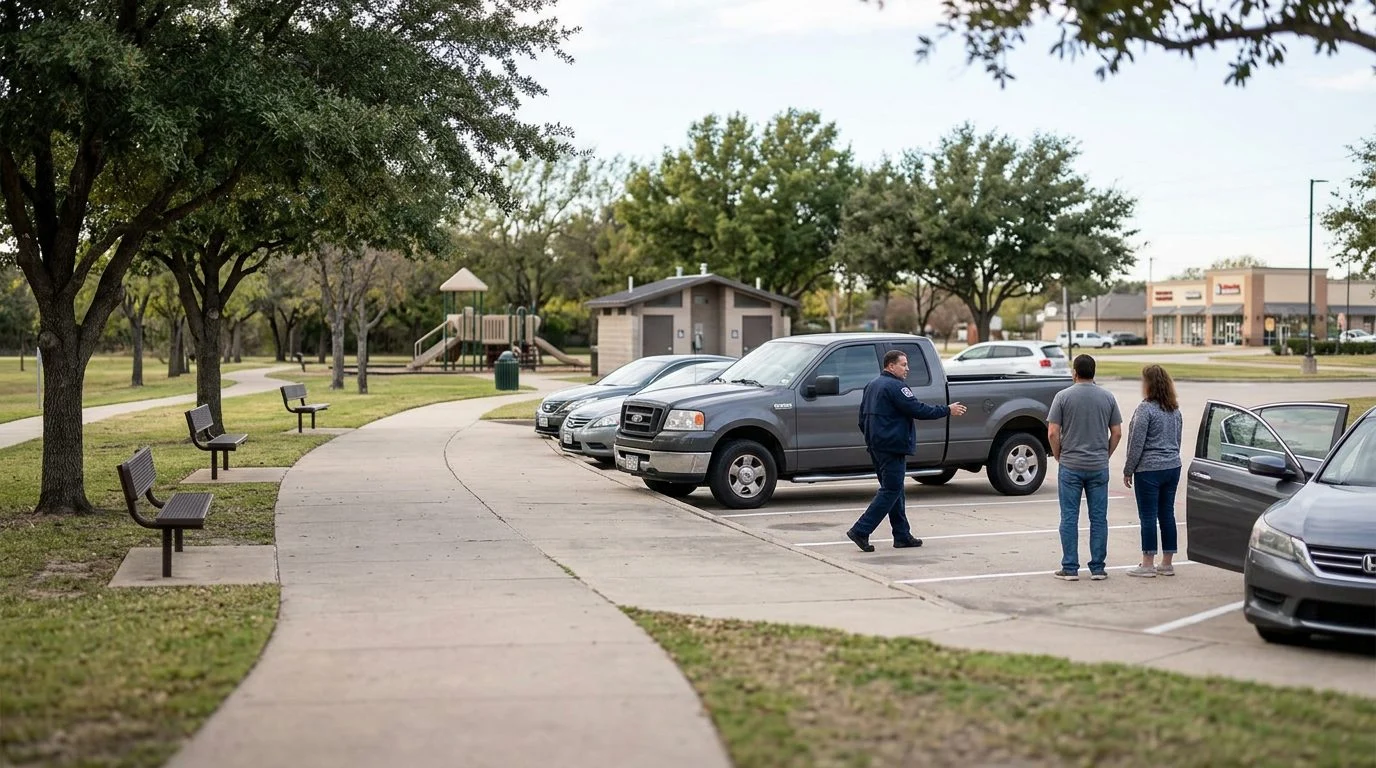
Under Texas Penal Code § 1.07, a public place is any place to which the public or a substantial group of the public has access. The statute’s list includes streets, highways, and the common areas of schools, hospitals, apartment houses, office buildings, transport facilities, and shops. The common areas of an office building are one example on that list. The list also says it is not limited to those places.
The key word is access. Ask whether the public, or a substantial group of the public, could get into the space where the conduct happened. The layout of the location and who could reach it are the details that shape this question. Because access depends on the setting, write down the location, the entrances, and who else could reach the area.
Knowing Conduct and Awareness of Others
Under § 21.07, a person must act knowingly when the act occurs in a public place, which § 1.07 defines as any place to which the public or a substantial group of the public has access. Outside a public place, which § 1.07 defines as any place to which the public or a substantial group of the public has access, § 21.07 requires that you knowingly engage in the act and be reckless about whether someone was present who would be offended or alarmed. The term “knowingly” is defined in Section 6.03 (Culpable Mental States) of the Penal Code. In everyday terms, the question is what you were aware of while it happened.
These two mental states are different, so the state’s proof on each one matters. For the reckless prong, the state will focus on who was nearby, what they could have seen, and what you knew at the time. The state must prove this mental state along with the act itself. The facts about who was present are central to that proof. Keep any details you remember about those moments, including who was close enough to notice.
Public Lewdness vs. Indecent Exposure in Texas
Indecent exposure is a different offense. Under Texas Penal Code § 21.08, it involves exposing the anus or any part of the genitals with intent to arouse or gratify sexual desire, while being reckless about whether another is present who will be offended or alarmed.
The two offenses differ in three ways:
- Conduct: Public lewdness covers sexual intercourse, deviate sexual intercourse, and sexual contact. Indecent exposure covers exposing the anus or any part of the genitals.
- Intent: Indecent exposure requires intent to arouse or gratify sexual desire. Public lewdness turns on knowing conduct in a public place, or recklessness outside one.
- Classification: Indecent exposure is a Class B misdemeanor. It becomes a Class A misdemeanor after one prior conviction under that section, a state jail felony after two or more, and a third-degree felony if the person is civilly committed as a sexually violent predator.
The charge the state files decides which elements it must prove, so read the charging document closely.
Penalties for Public Lewdness in Texas
Public lewdness is generally a Class A misdemeanor under § 21.07(b). The exception is a person civilly committed as a sexually violent predator under Chapter 841, Health and Safety Code, whose offense is a third-degree felony. Under Texas Penal Code § 12.21, a Class A misdemeanor carries a fine of up to $4,000, jail confinement of up to one year, or both. Those are the maximums the statute sets.
Penalties are only part of the picture. According to the Texas DPS criminal history FAQ, deferred-adjudication, conviction, arrest, and probation records may remain publicly accessible. They can affect criminal-history checks relevant to employment or professional licensing. The penalty range applies only if there is a conviction, so how the case is resolved matters. How a case moves forward depends on the facts and any prior record.
Not sure what your next step is?
Talk it through with our team — the first consultation is free, confidential, and carries no obligation.
How the Facts of Your Situation Shape the Analysis
Start with a few questions. Where did the conduct happen? Who was present, and what could they have seen? What did you know at the time? What evidence exists, such as video, witness statements, or a police report? Ask whether any video was recorded, and whether it shows the location and the people nearby.
If police questioned you in custody, your statements are evaluated under the Miranda framework. Under Dickerson v. United States, police warnings are one part of the analysis of whether a statement made during custodial interrogation may be used as evidence. The warnings are the right to remain silent, that anything said can be used in court, the right to the presence of an attorney, and that an attorney will be appointed if you cannot afford one. Miranda rests on the Fifth Amendment privilege not to be compelled to incriminate yourself.
To prepare for a review, gather the charging document, any citation you received, and a written timeline of events while your memory is fresh. A defense is built by reviewing the evidence against the elements the state must prove. No lawyer can promise how a case will end.

Talk Through Your Charge With Barbieri Law Firm
A charge you did not expect can leave you worried about your job, your reputation, and your family. You don’t have to work out the law alone. Barbieri Law Firm is based in Frisco and defends clients across Collin County, Dallas-Fort Worth, and Texas. The firm is led by Heather Jean Barbieri, Board Certified, Criminal Law — Texas Board of Legal Specialization. Our team can review the facts of your case with you in a confidential setting.
Frequently Asked Questions
Is public lewdness a felony in Texas?
Usually not. Texas Penal Code § 21.07 reads: “(b) An offense under this section is a Class A misdemeanor, except that the offense is a felony of the third degree if the actor is civilly committed as a sexually violent predator under Chapter 841, Health and Safety Code.”
Does public lewdness require someone else to be present?
Not for conduct in a public place. Outside one, the statute turns on whether you were reckless about another person being present who would be offended or alarmed.
Can a public lewdness arrest affect a background check?
The Texas DPS FAQ says arrest and deferred-adjudication records may remain publicly accessible and can affect those checks.
If this charge is in front of you now, call (972) 424-1902 or send your case details through the contact page. The initial consultation is free, confidential, and without obligation to continue.
Attorney responsible for this site: Heather Barbieri, Barbieri Law Firm, Frisco, Texas.
How We Approach a Public Lewdness Case
Review the evidence
We review the police report, witness statements, any video and the surrounding circumstances, including where and how the alleged conduct occurred.
Examine each element
We look closely at whether the State can prove every element of the charge, including the intent and the public setting it must establish.
Explain your options
We walk you through the possible paths forward in plain language so you can make informed decisions about your case.
Keep your conversation confidential
What you share with us is protected. Our first consultation is confidential and carries no obligation to continue.
Do Not Assume a Charge Is Minor
A public lewdness accusation can carry consequences beyond the courtroom, including effects on your record, your employment and your reputation. Talk with a criminal defense lawyer before you make statements to police or to anyone else about the incident.
Questions to Bring to Your Consultation
What exactly is the charge?
Ask which section of the Penal Code is cited and what the State must prove under that section.
What does the evidence show?
Bring any notices, paperwork or details you remember, and ask how the evidence will be reviewed.
What are my options?
Ask about the possible approaches to your case and what each would involve.
How will you communicate with me?
Ask how updates will be shared and how your confidential information will be protected.
Talk Confidentially With Barbieri Law Firm
Request a Consultation
Fill out the short form and we will take it from there.