

Online Sex Crimes Defense | Frisco, Texas
Charged Over Messages You Did Not Send?
An account or phone in your name does not show who was typing. Barbieri Law Firm reviews the evidence behind online sex crime charges across Collin County, Dallas-Fort Worth and Texas.
By Heather Barbieri · Published October 19, 2026
A charge can name the account holder even when someone else sent the messages. Ownership alone doesn’t prove who was typing.
This page explains how that happens and what a defense review looks at. If someone else used my phone online sex crime charge Texas is the question you’re facing, these are the points to understand first.
Can a Texas online sex crime charge land on the account holder when someone else used the phone?
Yes, a charge can point to the account holder, because a phone or account is tied to its owner. Investigators often start with that link. But the link shows who holds the account, not who sat at the keyboard.
Common situations look like this:
- A shared family tablet or computer.
- A roommate or partner who knows the passcode or has saved logins.
- A coworker who used a phone or work account.
- A lost or stolen phone.
- An account opened or accessed by someone unknown.
That definition helps explain why shared use matters. For the full overview of these charges, see our online sex crimes defense lawyer guide.
If a phone or account you did not personally use is now tied to a charge against you, we can review the access questions and your options with you. Talk it through with our team — the first consultation is free, confidential, and carries no obligation.
What Texas law covers: online solicitation of a minor and online impersonation
Texas Penal Code § 33.021 addresses online solicitation of a minor. The statute defines a minor as a person younger than 17, or a person the actor believes is younger than 17.
The statute has several parts:
- Subsection (c) covers knowingly soliciting a minor to meet, with intent that the minor engage in sexual contact, sexual intercourse, or deviate sexual intercourse.
The grade depends on the subsection charged. A subsection (b) offense is a third-degree felony, raised to a second-degree felony if the minor is younger than 14 or the actor believes the minor is younger than 14. A subsection (c) offense is a second-degree felony. The statute also raises punishment one level if the offense happened during school hours and the actor knew or should have known the minor was enrolled.
Why a phone or account does not prove who was using it
A password or passcode shows that access was possible. It does not show who used the device.
Many people share access without thinking about it. Common examples include:
- Passcodes known to family members or partners.
- Face or fingerprint unlocks that let another person open a phone.
- Saved logins and open sessions that stay signed in.
- Shared cloud accounts that sync messages across several devices.
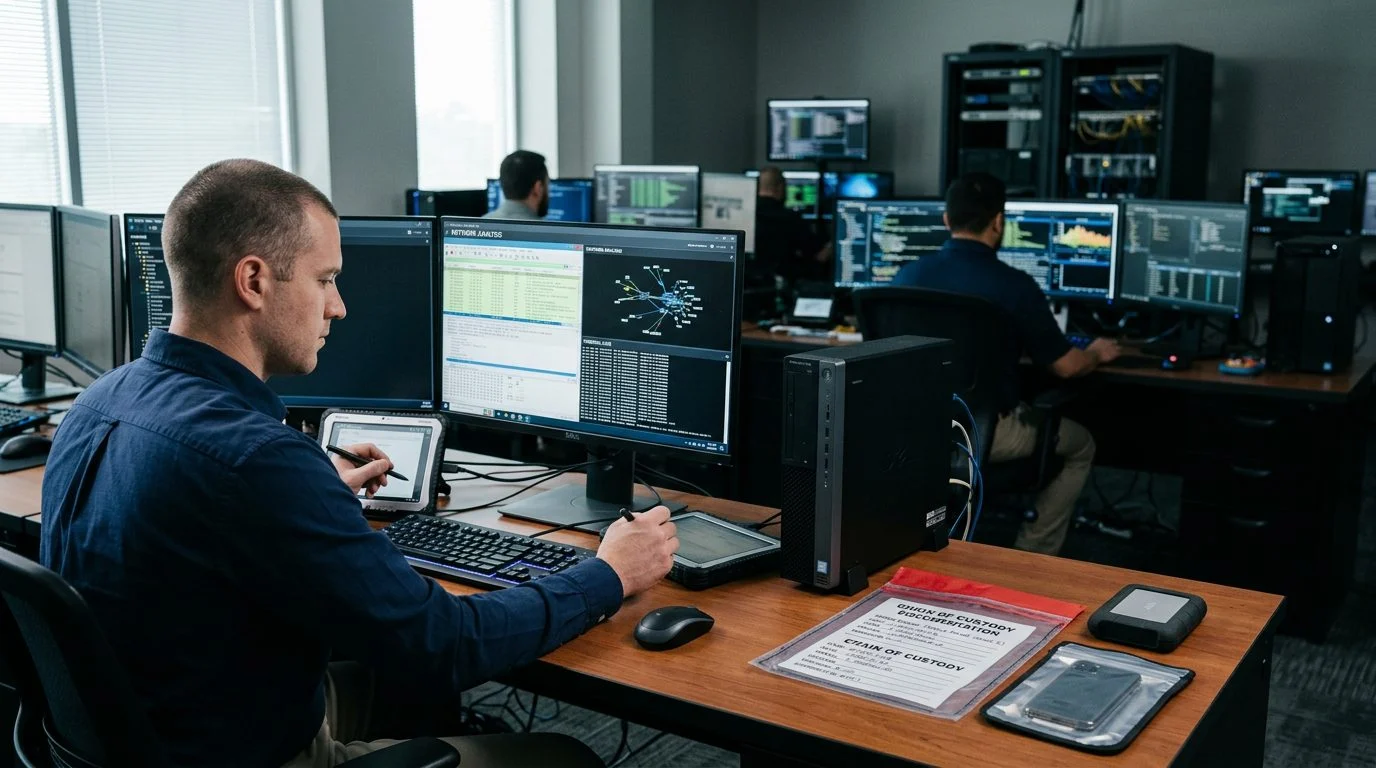
A defense review asks three basic questions. Who had physical access to the device? Who knew the passcode? Which other devices were signed in to the same account? The answers change how the messages should be read.
An account in someone’s name is a starting point for an investigation. It is not proof of who wrote a particular message.
What digital evidence can show, and what it may not show
Digital records show connections, times, and content. They don’t always show the person using the device.
Common records in these cases include:
- IP address logs.
- Timestamps and device identifiers.
- App and platform records.
- Message content and location data.
An IP address generally identifies a connection, such as a home network. It does not identify the person sitting at the keyboard. Timestamps can also be affected by time zones, automatic syncing, and shared use.
Many of these cases begin with a tip. The NCMEC CyberTipline reviews reports of suspected online child exploitation and refers them to law-enforcement agencies for possible investigation. A referral is the start of an inquiry, not a finding.
When the data itself is in question, an independent forensic examination can check how data was created, accessed, and stored. See our page on an independent forensic phone exam.
The intent element: what the state must prove about the messages
The state must prove the required intent, not only that messages were sent. Under § 33.021, intent is part of the offense.
Two points matter here:
- The statute’s definition of a minor includes a person the actor believes is younger than 17. The sender’s belief about age can be central to the case.
- Under subsection (c), it is not a defense that the meeting did not occur.
Subsection (e) lists defenses to a subsection (c) charge: that at the time the conduct was committed, the actor was married to the minor, or the actor was not more than three years older than the minor and the minor consented to the conduct (Texas Penal Code § 33.021). One applies when the actor was married to the minor. The other applies when the actor was not more than three years older than the minor and the minor consented to the conduct. Texas Penal Code § 33.021 reads: “(f) An offense under Subsection (b) is a felony of the third degree, except that the offense is a felony of the second degree if the minor is younger than 14 years of age or is an individual whom the actor believes to be younger than 14 years of age at the time of the commission of the offense.”
Reviewing the full message history, not isolated lines, is how that question is examined. For a fuller discussion, see our page on the intent the state must prove.
How the case is built: discovery and what to preserve
The defense receives the state’s evidence through discovery. That file can include device extraction reports, platform records, and statements. Learn more on our discovery in online sex crime cases page.
Early choices about devices matter. Don’t delete messages, accounts, or apps. Don’t reset a device or change passwords in a way that alters records. Keep the devices as they are until counsel reviews them.
Statements to investigators can become evidence. It is usually wise to speak with counsel before answering questions about messages from a phone or account.
Write down what you know while it’s fresh. Note who had access to each device and account, when they had it, and which accounts were shared. Bring those notes to your lawyer.
Not sure what your next step is?
Talk it through with our team — the first consultation is free, confidential, and carries no obligation.
If your phone or account is part of the charge, contact Barbieri Law Firm
If a phone or account you did not personally use is now connected to a sex crime accusation, the decisions in front of you are happening now. You do not have to sort out the device questions alone.
Barbieri Law Firm offers a free initial consultation. It is confidential and carries no obligation to continue. Call (972) 424-1902, or send your case details through our contact page.
In that conversation, we review the device and account access questions, the digital records, and the charging documents. We then explain your options. We cannot predict how any case will end. No lawyer can promise an outcome.
Heather Jean Barbieri, Board Certified, Criminal Law — Texas Board of Legal Specialization.
Attorney responsible for this site: Heather Barbieri, Barbieri Law Firm, Frisco, Texas.
Frequently asked questions
Can I be charged if someone else used my phone?
A charge can name the account holder. Ownership alone does not show who was typing.
What is online solicitation of a minor in Texas?
It is an offense under Texas Penal Code § 33.021. It covers a person who is 17 or older and, with the intent to commit an offense listed in Article 62.001(5)(A), (B), or (K), Code of Criminal Procedure, communicates in a sexually explicit manner with a minor or distributes sexually explicit material to a minor, over the internet or through an electronic message service or commercial online service. It also covers anyone who knowingly solicits a minor to meet another person, over the internet or through an electronic message service, with the intent that the minor will engage in sexual contact, sexual intercourse, or deviate sexual intercourse.
Does a passcode prove who sent a message?
No. A passcode shows that access was possible, not who used the device.
Why Ownership Is Not the Same as Use
A name on the account is a starting point
A phone, email or social media account being in your name does not show who wrote a message or sent an image.
Evidence needs careful review
Charges often rely on IP addresses, account logs, device extractions and saved messages. Each piece needs to be examined on its own.
Others may have access
Family members, roommates, coworkers and friends may have used a shared phone, computer or password.
Early statements can matter
What you say to investigators can become evidence. Speak with a lawyer before answering questions about the accusation.
Before You Speak With Investigators
Do not delete accounts, messages or devices, and do not post about the accusation online, until you have talked with a lawyer about your situation.
How We Approach Your Case
We review the evidence
We will review the device, account records, messages and how the evidence was gathered, then explain your options.
Confidential and without obligation
Your first consultation is free, confidential and carries no obligation to continue.
Serving Collin County and DFW
We represent clients in Frisco, Plano, McKinney, Prosper, Allen, Celina, Southlake, Dallas and throughout Texas.
An all-women firm
Barbieri Law Firm is an all-women criminal defense firm. Our team supports every client through each step of the case.
Led by Heather Barbieri
Heather Jean Barbieri, Board Certified, Criminal Law — Texas Board of Legal Specialization.
Your first consultation is free, confidential and carries no obligation to continue.
Request a Consultation
Fill out the short form and we will take it from there.