

Online Sex Crimes Defense | Frisco, Texas
Phone Evidence in a Texas Online Sex Crime Case: Can It Be Challenged?
Barbieri Law Firm reviews how your phone was seized, what the warrant allowed, and how the data was searched, then explains the options that may apply to your case.
By Heather Barbieri · Published October 24, 2026
Many people in Texas ask whether they can suppress phone evidence in an online sex crime case. The answer has two parts. A separate challenge asks whether the messages, images, or account records are accurate and complete. This page explains both tools and what to do now.
Short Answer: Phone Evidence Can Be Challenged in Two Different Ways
Phone evidence can be challenged with a motion to suppress or with questions about authenticity and reliability. Authenticity questions ask whether a message, image, or file is what the State says it is. Which tool fits depends on how the phone was obtained and what it shows. The result depends on the specific facts, and no lawyer can promise how a case will turn out.
Not sure what your next step is?
Talk it through with our team — the first consultation is free, confidential, and carries no obligation.

How a Phone Usually Enters an Online Sex Crime Case
Phones usually reach a case through a search warrant, a request for consent, a search connected to an arrest, or records requested from a phone or internet company. Each route raises different questions, so the first review looks at how the device was obtained. Federal investigators also play a role. The Internet Crimes Against Children Task Force Program has a role in investigating technology-facilitated child sexual exploitation. A forensic extraction report is a separate step from taking the phone. It lists what was copied from the device, and it can be one of the most important documents in the file.
Grounds a Texas Motion to Suppress Phone Evidence May Be Built On
The defense reviews the warrant, the affidavit, and the extraction records to see whether the search stayed within its limits. Common grounds include:
- Warrant questions: Did the paperwork support a search of this particular device, and did it describe what could be searched?
- Scope questions: Did officers look at files, date ranges, or apps beyond what was allowed?
- Consent questions: Did the person who agreed to the search have authority over the device, and was the agreement given freely?
- Warrantless search questions: Does any reason the State gives for searching without a warrant fit these facts?
Digital Evidence Challenges That Go Beyond Suppression
Even evidence obtained properly can still be questioned. Authenticity challenges ask whether the content is accurate and complete. Common concerns include:
- Fabricated or altered text messages.
- Cropped or selectively captured screenshots that leave out messages before or after the one shown.
- Altered metadata, such as timestamps.
- Missing context around a message.
- Deepfakes and AI-generated images or video, where the source file and its history matter.
- Evidence pulled from an infected device, which raises questions about what was on it and who put it there.
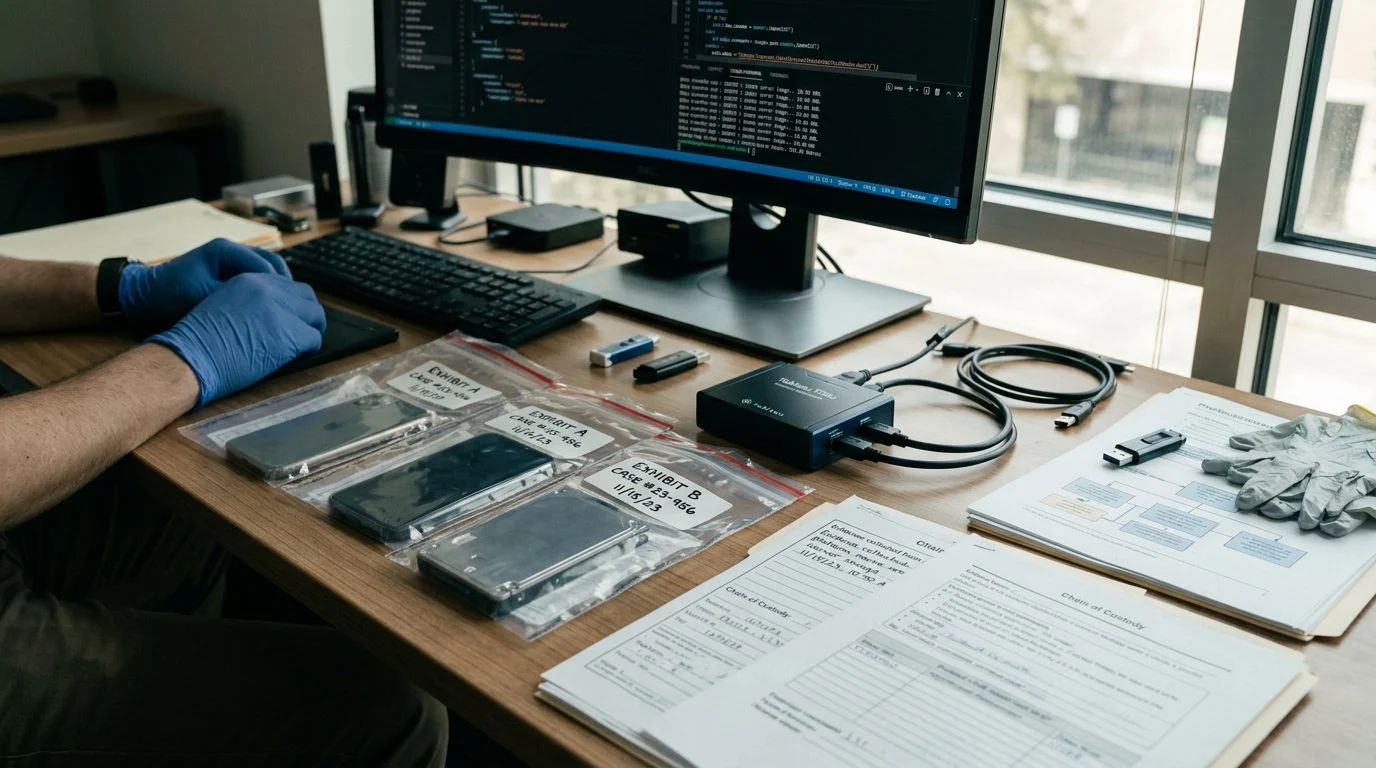
- Chain of custody: who handled the device and data, when, how it was stored, and whether each step is documented.
Each item is a question to test against the records. None of them is a conclusion.
Why the Account on the Phone May Not Show Who Was Using It
A message on a phone does not, by itself, show who typed it. Family members, roommates, or anyone who knew a password or had an unlocked device may have used the phone or account. An IP address shows an internet connection. Several devices or people can share one connection, so tying an address to one person takes more than the address alone. Who was operating an account at a given time is a separate question from whether a message exists on a device. This issue is covered in more detail in when someone else used the account.
Related Questions About Texts, Images, and Proof in These Cases
The charge decides which Texas statute matters, so the same text can mean different things in different cases. Online solicitation under Texas Penal Code § 33.021 includes a person 17 or older who, over the internet or by text or other electronic message, intentionally communicates in a sexually explicit manner with a minor or distributes sexually explicit material to a minor, with intent to commit a listed offense. It also includes knowingly soliciting a minor online to meet for sexual contact.
A separate Texas statute, Penal Code § 43.261, has its own elements and misdemeanor levels, and it applies only to conduct by a person who is a minor. Penal Code § 43.261(b)(1) applies only to a minor who promotes visual material of a minor to another minor.
For how the sexting question affects what messages mean, see how sexting affects message meaning. For the age question, see how prosecutors prove age. For an overview, see the online sex crimes defense overview.
Can phone evidence be suppressed in a Texas online sex crime case?
It can be, depending on how the phone was obtained and searched. No lawyer can promise how a judge will rule.
Are there age-based defenses under Texas law?
For example, § 33.021 has a defense for certain solicitation-to-meet conduct where the actor was not more than three years older than the minor and the minor consented. Texas Penal Code § 33.021 reads: “(f) An offense under Subsection (b) is a felony of the third degree, except that the offense is a felony of the second degree if the minor is younger than 14 years of age or is an individual whom the actor believes to be younger than 14 years of age at the time of the commission of the offense.”
Should I delete messages after a phone search?
No. Don’t delete, reset, or change anything on the device before the case is reviewed.
Not sure what your next step is?
Talk it through with our team — the first consultation is free, confidential, and carries no obligation.
What to Do Now With a Phone That Has Been Seized or Searched
Keep the device unchanged, and keep your own record of what happened. Practical steps include:
- Don’t delete messages, accounts, or files, reset the device, or change its data. The destruction defense in Texas Penal Code § 43.261 applies only to a minor charged with possession under subsection (b)(2), and only if the minor did not produce or solicit the material, received it from another minor, and destroyed it within a reasonable time.
- Keep copies of any warrant, receipt, or property record the officers gave you.
- Write down what was taken, and when, while your memory is fresh.
- Don’t post about the case or discuss its details online. Don’t contact people named in the messages about it.
- A lawyer reviews the warrant, the extraction, and the disclosed records to identify which challenges are available.

Talk Through Your Phone Evidence With Barbieri Law Firm
If a phone was taken, or someone described a search to you, you did not choose this position. You may be looking into this for a partner, a child, or another family member. You don’t have to sort through the warrant, the extraction, and the messages alone. Barbieri Law Firm offers a free, confidential initial consultation with no obligation to continue. Call (972) 424-1902 or send your case details through the contact form. No lawyer can promise how a case will turn out, but a conversation can help you see what the records show.
Attorney responsible for this site: Heather Barbieri, Barbieri Law Firm, Frisco, Texas.
What We Review in Your Phone Evidence
How the phone was obtained
We examine whether the phone was seized during an arrest, a consent request or another police encounter, and what was said and done at that moment.
What the warrant allowed
We compare the scope of any search warrant with what investigators actually searched, including apps, cloud accounts and time periods.
How the data was extracted
We look at the forensic tools, reports and handling of the device, and whether the steps taken can be verified and documented.
What was said online
We review the full message context, including who sent what, when, and from which account, so the evidence is read as a whole.
Before You Speak With Investigators
Do not delete messages, apps or accounts, and do not hand over passwords or answer questions about your phone until you have spoken with a lawyer.
How We Approach Your Case
Review the evidence
We review the stop or contact, the warrant, the device extraction report and any messages or images the state plans to use.
Explain your options
We walk you through the possible challenges to the phone evidence and how each could affect the case, in plain language.
Protect your privacy
Your consultation is confidential. We handle sensitive digital evidence with care and keep you informed at each step.
Plan the next steps
Our team helps you decide how to proceed, so you move forward with a clear picture of your case and your choices.
Talk With Heather Barbieri About Your Phone Evidence. Your Free Initial Consultation Is Confidential and Carries No Obligation.
Request a Consultation
Fill out the short form and we will take it from there.