

Collin County and Dallas-Fort Worth | Online Sex Crimes Defense
Charged Over Discord, Snapchat or Chat Messages? Start With a Clear Review of the Case.
Barbieri Law Firm defends people accused of online sex crimes across Collin County, Dallas-Fort Worth and Texas. We look closely at the messages, the platform records and the stated ages, then explain your options.
By Heather Barbieri · Published October 24, 2026
If you were charged after a Discord or Snapchat chat, the case usually turns on the records. Those records include the full message history, account details, timestamps and whatever the platform sent to investigators. Texas law asks what was said, what the sender believed about the other person’s age, and what the sender intended. This guide explains how a chat becomes a criminal case in Texas and how platform records are read. It also covers what the defense asks for in discovery.
How a Discord, Snapchat or Roblox Chat Becomes a Criminal Case in Texas
A chat usually becomes a case after someone reports it or after police begin looking into the messages. Each starting point shapes what the State has to work with.
The most common path starts with a report. The National Center for Missing & Exploited Children runs the CyberTipline, where suspected online child exploitation can be reported. NCMEC says it reviews tips and refers them to appropriate law enforcement agencies for possible investigation. A parent, teacher or school can also make a report. In other cases, an officer uses an online account to talk with a person, and the chat is the investigation from the start.
A chat that looks like ordinary gaming or social talk can still lead to a charge. The State must prove the required intent, so the tone of a chat alone does not decide the case.
Being reported is not the same as being charged. Many people first learn of a report through a police contact. The key questions are what legal process police used and which records each one produced.
If police contacted you about messages you sent on Discord, Snapchat or Roblox, we can review those records with you in a free initial consultation. Talk it through with our team — the first consultation is free, confidential, and carries no obligation.

The Platform Records That Usually Anchor the Case
Platform records are often the core evidence, because they hold the messages and the account data behind them.
Investigators usually get platform records through legal process, such as a subpoena or court order. The defense asks for each return and the paperwork that produced it. Without that paperwork, no one can tell what was requested or what came back.
Account metadata matters as much as the messages. Look for registration details, login IP addresses, device identifiers, timestamps and time zones. These show which devices logged in and when. They do not show who was holding the phone.
Preserved content has limits too. A returned file may show messages sent from an account. It may not show who typed each one. A login record can point to a device, and a device can be used by more than one person.
Platform reports are a starting point, not proof. A report tells investigators what was flagged. By itself, it does not show what the sender meant or believed. Read the report side by side with the full records.
How a Chat Is Read in Context
A single message means little until you read the full conversation around it.
A short line pulled from a long thread can change meaning. Read the replies before and after it. Check who asked what, who changed the subject, and when any stated age came up.
Group chats and server channels add another layer. Many users can see and post in the same channel. Shared accounts used by family members or friends raise the question of who was typing.
Gaming and messaging language is often playful. Players use slang, emoji, jokes and role-play characters. Those words can look very different to a jury unless someone explains them in context.
Timing matters too. Ask whether messages were sent in the same session, from the same device, and at times the account holder could have been online. A timeline built from metadata can show gaps that a short excerpt hides. This is where a complete export matters most.
Age, Identity and Intent: What the State Must Prove
Intent and age sit at the center. Texas law defines a minor as a person younger than 17, and also someone the actor believes is younger than 17 (Texas Penal Code § 33.021).
Under subsection (c), the State must show the sender, over the Internet, by electronic mail or text message or other electronic message service or system, or through a commercial online service, knowingly solicited a minor to meet another person, including the actor, with intent that the minor engage in sexual contact, sexual intercourse or deviate sexual intercourse. The statute says it is not a defense that the meeting did not occur. It is a defense to prosecution under this section, for conduct described in Subsection (c), that the actor was married to the minor, or the actor was not more than three years older than the minor and the minor consented to the conduct. Texas Penal Code § 33.021 reads: “(f) An offense under Subsection (b) is a felony of the third degree, except that the offense is a felony of the second degree if the minor is younger than 14 years of age or is an individual whom the actor believes to be younger than 14 years of age at the time of the commission of the offense.”
Stated ages, profile photos and claims of being an adult appear in the records. The defense checks what the other account claimed, when it claimed it, and whether the sender had reason to believe it. Look at any verification steps the platform recorded, too.
Undercover accounts raise a separate question. Entrapment is a defense when a law enforcement agent induces the conduct through persuasion or other means likely to cause the offense. Giving someone an opportunity to offend is not entrapment (Texas Penal Code § 8.06). The records show how the contact began and who pushed it forward.
What the Defense Requests in Discovery
Discovery is how the defense obtains the State’s evidence before trial. The defense should ask for the complete file, not only the pieces police chose to share.
Requests that matter most in a chat case include:
- The full platform returns, not only screenshots or excerpts.
- Search warrant affidavits, subpoena requests and each piece of legal process used to get records.
- Preservation requests and chain-of-custody notes for every file, screenshot and device.
- Messages, metadata and logs in their original format, so the full conversation can be read.
- Forensic extraction reports for every device.
Why does format matter? A screenshot shows only what someone chose to capture. A native file shows the full thread, the timestamps and the account data. Ask whether any record is missing or was never produced.
Digital Forensics on the Phone, Tablet or Computer
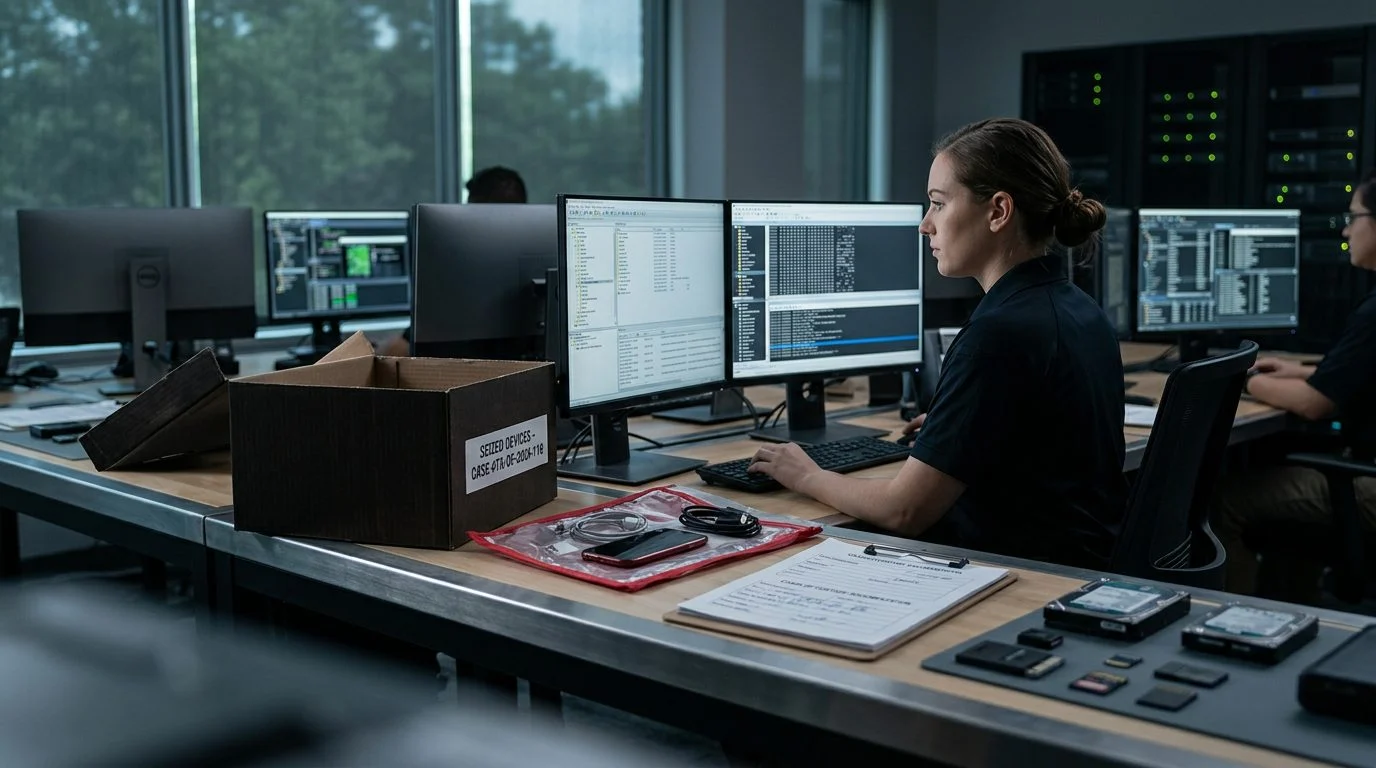
A device extraction report shows what software pulled from a phone, tablet or computer and what it found. The report should say what was recovered and what was deleted or could not be recovered.
Timing questions matter. Timestamps, sync between devices and app caches can show when content was received or viewed on a device. They do not automatically show who sent it. Ask whether the examiner separated sending from viewing.
Access questions matter just as much. So the question is who held and controlled the device and account. Family members, roommates and shared gaming setups all count.
Ask who knew the password, who used the family computer that night, and whether the account was signed in on more than one device. The answers change how the timestamps read.
Not sure what your next step is?
Talk it through with our team — the first consultation is free, confidential, and carries no obligation.
What Typically Happens After the Charge
After a charge, a case usually moves through arrest or summons, bond, discovery, motions and hearings. Early review of the records shapes the next steps.
Read any bond paperwork closely, including conditions on contact and devices. Ask about any limit on phone or platform use before you act on it.
Punishment depends on the offense level. A solicitation charge under subsection (c) is a second-degree felony. Texas sets a second-degree felony at 2 to 20 years in prison, plus a fine of up to $10,000 (Texas Penal Code § 12.33). Under subsection (b), the offense is a third-degree felony. It rises to second degree when the minor is younger than 14. A third-degree felony carries 2 to 10 years and a fine of up to $10,000 (Texas Penal Code § 12.34). The offense also moves up one category if it happened during regular school hours and the actor knew or should have known the minor was enrolled (Texas Penal Code § 33.021). These ranges describe what the law allows. They are not a forecast.
What comes first depends on the facts of each case.

Have Your Discord, Snapchat or Roblox Records Reviewed
If police contacted you about messages on Discord, Snapchat or Roblox, the records now need a full read. A notice or charge does not mean the excerpt tells the whole story.
Heather Jean Barbieri, Board Certified, Criminal Law — Texas Board of Legal Specialization, leads Barbieri Law Firm in Frisco, Texas. The firm reviews platform records, device evidence and the full conversation for clients in Collin County and across Texas.
Your first consultation is free, confidential and carries no obligation to continue. Call (972) 424-1902 or use the contact form to begin.
Frequently asked questions
Can a chat charge depend on what the sender believed about age?
Yes. Texas law reaches a person the actor believes is younger than 17, so the records of stated ages matter.
Does a platform report to NCMEC mean a case has started?
A report is a starting point. NCMEC refers tips to law enforcement agencies for possible investigation.
What should I ask about first?
Ask which records police hold and how each one was obtained.
Attorney responsible for this site: Heather Barbieri, Barbieri Law Firm, Frisco, Texas.
How we review a chat-based charge
The full message history
We review the complete conversation, not isolated screenshots, so the context of every message is clear.
Timestamps and account activity
We examine when messages were sent, from which accounts and devices, and whether the timeline matches the State's claims.
Stated ages and what was believed
We look at what was actually said about age, what the sender could reasonably have known, and what the records show.
Platform reports and police files
We review how any report was generated and handled, and what the investigation did and did not establish.
Your questions, answered directly
We explain the charges, the evidence and your options in plain language, so you can make informed decisions.
Protect what you have, and say less
Do not delete messages, accounts or devices, and do not contact the other person about the case. Avoid posting about the matter on social media. Speak with a lawyer before answering questions from investigators.
Questions people ask about these cases
Can a chat charge depend on what the sender believed about age?
Texas law can reach conduct directed at a person the actor believes is younger than 17, so the records of stated ages and the context around them matter.
Does a platform report mean a case has started?
A platform report is a starting point. NCMEC refers tips to law enforcement agencies for possible investigation, and what happens next depends on the facts.
What about undercover or sting operations?
Some charges arise from online operations in which the person on the other end is an officer or investigator. We review how the contact began and how it was conducted.
What happens to my phone and accounts?
Devices and accounts may be seized or searched. We look at the warrant, its scope and what was collected, and explain what those steps mean for your case.
Your first consultation is free, confidential and comes with no obligation to continue.
Related practice areas
- Online Sex Crimes Defense Lawyer | Collin County & Texas
- Online Sex Crimes Defense Lawyer in Collin County
- Sex Crimes Defense Lawyer in Prosper
- Online Sex Crimes Defense Lawyer in McKinney
Request a Consultation
Fill out the short form and we will take it from there.