

Online sex crimes defense | Frisco, Texas
What the State Must Prove in a Texas Online Solicitation Case
A charge built on screen names, messages and timestamps raises hard questions about who wrote what, what was meant and how the evidence was gathered. Here is how we approach them.
About Barbieri Law Firm
All-women
Criminal defense firm based in Frisco, Texas
Collin County
Defending clients across Collin County, Dallas-Fort Worth and Texas
By Heather Barbieri · Published November 17, 2026
Learning that you’re under investigation for online solicitation of a minor is frightening. You may be reading this after a sting, a phone call from police or an arrest, and you need to know what the State has to prove. Under Texas Penal Code § 33.021, an offense can involve communicating in a sexually explicit manner with a minor or distributing sexually explicit material to a minor, with intent to commit a listed offense, or knowingly soliciting a minor to meet another person for sexual contact, sexual intercourse, or deviate sexual intercourse, in each case sent over the Internet, by electronic mail or text message, or through a commercial online service.
This page takes each part in turn. If you’re asking whether an online solicitation of a minor case can be dismissed, the review starts with these same points.
What the State Must Prove in a Texas Online Solicitation Case
Think of the charge as a checklist. Did the communication use an electronic channel? Did the accused knowingly solicit a minor to meet? Did the accused intend sexual contact or intercourse with that minor? The State must also show the person was a minor, or that the accused believed so.
Each question needs its own proof. Many people first learn about these cases from a single screenshot or a call from an investigator. A checklist turns that shock into questions you can actually review.
Defense review starts by taking each element on its own. Then the evidence is tested against it, one piece at a time. The rest of this page follows that method.
If you're trying to make sense of messages or records in your own case, our team will review them with you. Talk it through with our team — the first consultation is free, confidential, and carries no obligation.

The Statute Behind the Charge
Texas Penal Code § 33.021 is the state’s online solicitation of a minor statute. It covers conduct done over the internet, by email, by text message, or through a commercial online service.
Subsection (b) covers a person 17 or older who, intending to commit a listed offense, communicates in a sexually explicit manner with a minor or distributes sexually explicit material to one. Subsection (c) covers solicitation to meet. That offense occurs when a person knowingly asks a minor to meet another person, including the actor, with intent that the minor engage in sexual contact, sexual intercourse, or deviate sexual intercourse.
The statute targets the electronic solicitation itself. Under subsection (d), it is not a defense to a subsection (c) charge that the meeting did not occur. The grade changes with the subsection charged.
Subsection (g) adds that the same conduct can violate another law. The State may prosecute under this section, the other law, or both. Read your charging papers closely, because the section and grade shape what the State must prove.
Element One: Use of the Internet or Another Electronic Means
The State must show the communication went through the internet, email, text message, another electronic message service, or a commercial online service. This sounds like a simple question. In practice, it is a records question. Investigators try to tie a conversation to a device and an account. They use message logs, account information, device data and metadata such as timestamps and app names.
Look closely at what those records prove. A log can show that an account sent a message. It may not show who was holding the phone. Accounts and devices can be shared, so a review asks whether the records link the specific messages to the accused.
Phones add another layer. Under Texas Code of Criminal Procedure art. 18.0215, a peace officer may not search a phone seized in a lawful arrest without a warrant under that article. The article lists exceptions, including owner consent. In Riley v. California, the U.S. Supreme Court said police generally need a warrant to search a phone, even one taken from an arrested person. In Riley v. California, the U.S. Supreme Court said that information on a cell phone is not immune from search, but that officers generally need a warrant before searching a phone, even when it was seized during an arrest. Riley v. California, 573 U.S. 373, 401 (2014) Whether a search was proper shapes which records the State can use.
Element Two: A Knowing Solicitation of a Minor
The State must prove the accused knowingly solicited a minor to meet. The question is what was asked, and by whom.
The full message thread matters most here. Read one line alone and it can look like an invitation. Read the thread in order and it may be a reply, a joke, or a response to something the other person wrote. Context is how a reviewer tells these apart.
The State must also link the accused to the messages. A screen name or a profile photo alone does not answer who typed the words. When the record leaves that link open, the gap belongs in the review.
Many people assume the State’s reading of a message is the only reading. A careful review compares that reading with the whole record.
Element Three: Intent That the Minor Engage in Sexual Conduct
The State must prove the accused intended that the minor engage in sexual contact, sexual intercourse or deviate sexual intercourse. Intent is a state of mind. The State usually proves it from what was said and done, which means the full conversation.
Prosecutors point to messages about meeting, timing, location and what would happen once they met. A review asks a different question. Does the whole conversation support that intent, or does another reading fit the words just as well?
Every message in the thread belongs in the analysis. Earlier messages can show what a later one meant. Later messages can show whether a plan ever formed.
The Age Question: Actual Age and the Belief Held by the Accused
The State must show the person was a minor. Under § 33.021, a minor is someone younger than 17, or someone the actor believes to be younger than 17. That second part is why the accused’s belief matters: a minor includes an individual whom the actor believes to be younger than 17 years of age.
Stings make this question sharp. In a sting, the person on the other end is often a law enforcement officer or a volunteer acting under police instructions. Texas Penal Code § 8.06 says entrapment is a defense when a law enforcement agent induces the conduct using persuasion or other means likely to cause persons to commit the offense. Giving a person an opportunity to commit an offense is not entrapment. The statute also covers any person acting under an agent’s instructions.
Subsection (e) gives two defenses to the solicitation-to-meet offense. Under Texas Penal Code § 33.021(e)(1), one defense is that the actor was married to the minor at the time the conduct was committed. The other is that the accused was not more than three years older than the minor and the minor consented. These defenses turn on age and relationship facts, which the records should show.
The State proves what you believed from messages, profile details, and what was said about age. Those same records can help or hurt.
Not sure what your next step is?
Talk it through with our team — the first consultation is free, confidential, and carries no obligation.
Evidence the State Uses Against Each Element and How It Is Reviewed
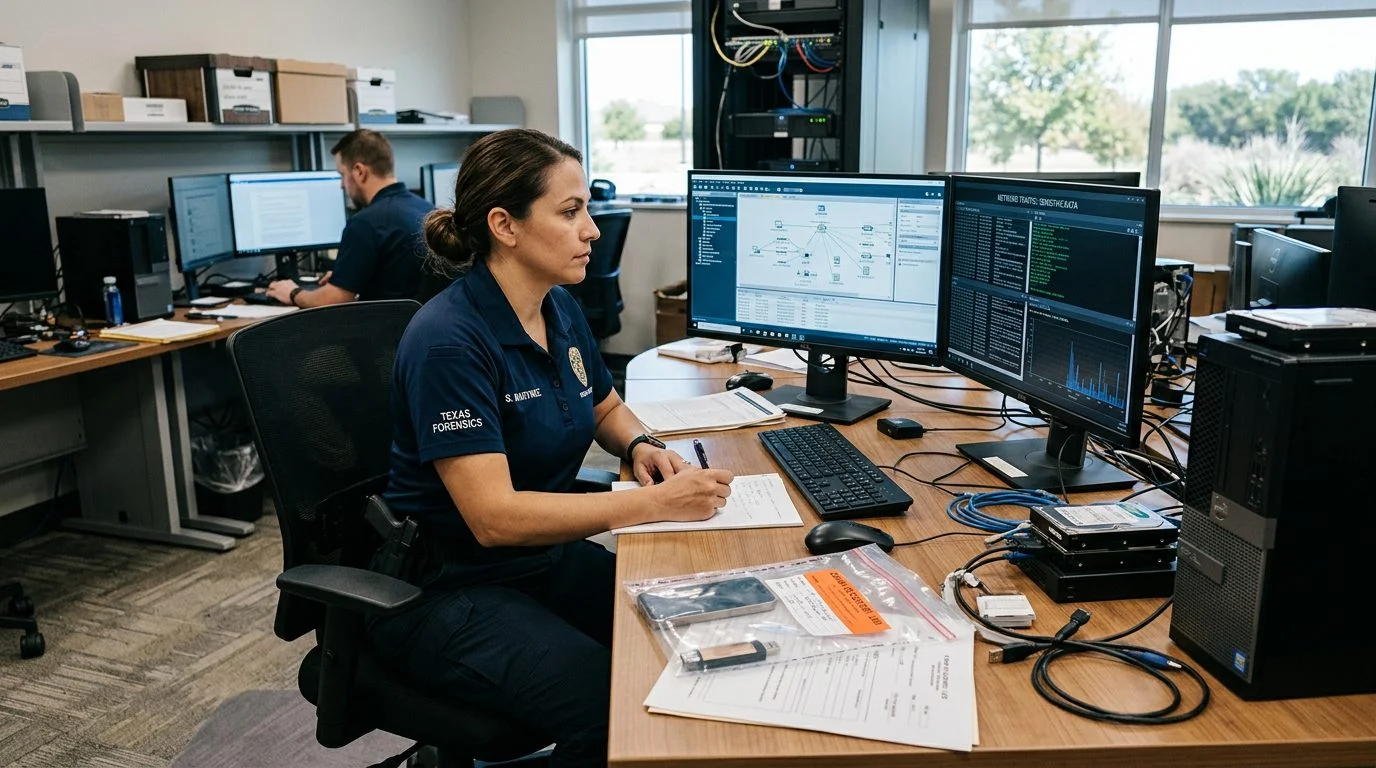
Chat logs, screenshots, account and phone records, device extractions and recorded interviews are the usual evidence. A review tests each one against the elements, and it asks how the evidence was gathered.
Texas has rules on that. Under Texas Code of Criminal Procedure art. 38.23, evidence obtained in violation of the Texas or U.S. Constitution or laws may not be admitted against the accused. Subsection (b) makes an exception to subsection (a) for evidence obtained by a law enforcement officer in objective good faith reliance on a warrant issued by a neutral magistrate based on probable cause.
Interviews matter too. Under Texas Code of Criminal Procedure art. 38.23, evidence obtained in violation of the Texas or U.S. Constitution or laws may not be admitted against the accused; whether a custodial statement was given after Miranda warnings is a separate question addressed in Dickerson v. United States. Under art. 38.22, every electronic recording of such a statement must be preserved until the conviction is final, appeals are exhausted, or prosecution is barred.
Certain material depicting minors is handled differently. Under art. 39.15, for property or material described in subsection (a), which covers child pornography as described by Penal Code § 43.26(a-1)(1) or (a-2)(2), material whose promotion or possession is prohibited under Penal Code § 43.261, and material described by sections 2 or 5 of art. 38.071, a court shall deny a defendant’s request to copy, photograph, duplicate, or otherwise reproduce that material if the State makes it reasonably available, such as by providing ample opportunity to view it at a State-controlled facility.
Many of these cases start with a report. The NCMEC CyberTipline says suspected online enticement may be reported, and NCMEC refers tips to law enforcement for possible investigation. If a child was interviewed, OJJDP child interview standards call for avoiding repeated questioning and using open-ended questions.
A review asks whether each element holds up on the evidence. It checks whether the identity behind the account is established and whether the context supports the State’s reading.

Questions Often Confused With This Charge: Criminal Solicitation and Sexting
Criminal solicitation and sexting are different subjects from online solicitation of a minor. The charge on your paperwork decides which statute applies.
Sexting cases usually involve images rather than requests to meet. Texas has separate statutes for those. Under Texas Penal Code § 21.19, knowingly sending sexually explicit visual material by electronic means, when the recipient did not request it or consent, is a Class C misdemeanor. Texas Penal Code § 43.261 covers a minor who, by electronic means, promotes to another minor visual material depicting a minor, including the actor, engaging in sexual conduct, if the actor produced it or knows another minor did, and a minor who possesses in an electronic format visual material depicting another minor engaging in sexual conduct under the same production condition, with its own grades.
Is sexting a felony in Texas?
Under § 21.19, the sending offense is a Class C misdemeanor. This guide describes the offenses in Penal Code §§ 21.19 and 43.261, but they are not the only laws that may apply. Under § 21.19(d), the same conduct may be prosecuted under another law, and a person 17 or older who intentionally sends sexually explicit material to a minor over the Internet, by text message or another electronic message service, with the intent to commit an offense listed in Article 62.001(5)(A), (B), or (K), Code of Criminal Procedure, may face a charge under Penal Code § 33.021(b).
Can an online solicitation of a minor case be dismissed?
Whether a case is dismissed turns on how each element holds up on the evidence. No lawyer can say how a case will end.
If you’re facing this charge or an investigation, you don’t have to work through the messages and records alone. Barbieri Law Firm, based in Frisco, Texas, defends clients across Collin County, Dallas-Fort Worth and Texas. The initial consultation is free, confidential, and carries no obligation to continue. Call (972) 424-1902 or send your case details through the contact page.
Attorney responsible for this site: Heather Barbieri, Barbieri Law Firm, Frisco, Texas.
How we review an online solicitation case
We review the full record
We examine the charging documents, the messages in their complete context, and any account, device or subscriber records the State relies on.
We look at who was on the other end
We investigate whether the identity, age and intent attributed to each party are supported by the evidence, including undercover or sting operations.
We build a timeline
We compare when messages were sent with when police acted, and check whether the evidence is consistent with how the case is being presented.
We explain your options
After reviewing the evidence, we explain what the State must prove, the defenses that may apply and the choices available to you.
Before you speak with anyone about the case
Messages, posts and statements made about the case can become evidence. Do not delete messages or accounts, and do not answer police questions about the case until you have talked with a lawyer.
Questions the State has to answer
Who controlled the account?
Sharing a device, an app or a login can make it unclear who sent a given message.
What did the messages actually say?
Context, tone and the full conversation often change how a single message reads in court.
Who was the other party?
Cases involving a claimed minor or an officer posing as one depend heavily on how that identity was established.
How was the evidence gathered?
We review whether the investigation, warrants and digital records were obtained and handled properly.
Talk with Heather Barbieri about your case. The first consultation is free, confidential and carries no obligation to continue.
Related practice areas
Request a Consultation
Fill out the short form and we will take it from there.