

Online Sex Crimes Defense | Frisco, Texas
Charged After Someone Else Used the Family Computer? Start With a Careful Review.
Barbieri Law Firm defends people accused of online sex crimes across Collin County and Dallas-Fort Worth.
By Heather Barbieri · Published November 18, 2026
Someone in your home used the family computer, and now you face an online sex crime charge. That is a frightening place to be, especially if you did not know what was on the device.
A shared computer does not, by itself, prove who sent a message. A defense review tests that connection, one record at a time.
What a Shared-Computer Charge Means for You
A shared-computer charge means the State says a device or account connected to your home was used for an online offense.
The exact charge depends on what your papers allege. Online solicitation of a minor is defined in Texas Penal Code § 33.021. Under Section 33.021(c) of the Texas Penal Code, a person commits an offense if, over the Internet, by electronic mail or text message or other electronic message service or system, or through a commercial online service, the person knowingly solicits a minor to meet another person with the intent that the minor will engage in sexual contact, sexual intercourse, or deviate sexual intercourse. Section 33.021 does provide a defense if the accused was married to the minor, or was not more than three years older than the minor and the minor consented.
Other online offenses appear in other sections. So the first step is reading your charging papers closely.
An arrest or charge is an accusation, not a finding of guilt.
If the records point to a computer or account that someone else in your home used, we can review that evidence with you and explain your options. Talk it through with our team — the first consultation is free, confidential, and carries no obligation.
How These Investigations Usually Begin
These cases often start with a report, then a records request that ties an internet address to an account at a home on a specific date and time.
Reports of suspected online child exploitation can go to the NCMEC CyberTipline. NCMEC reviews tips and refers them to law enforcement agencies for possible investigation. Investigators then ask internet providers for subscriber records tied to an IP address.
An IP address points to an internet connection, not to the person typing. That link is a starting point for investigators. It is not proof of who was at the keyboard.
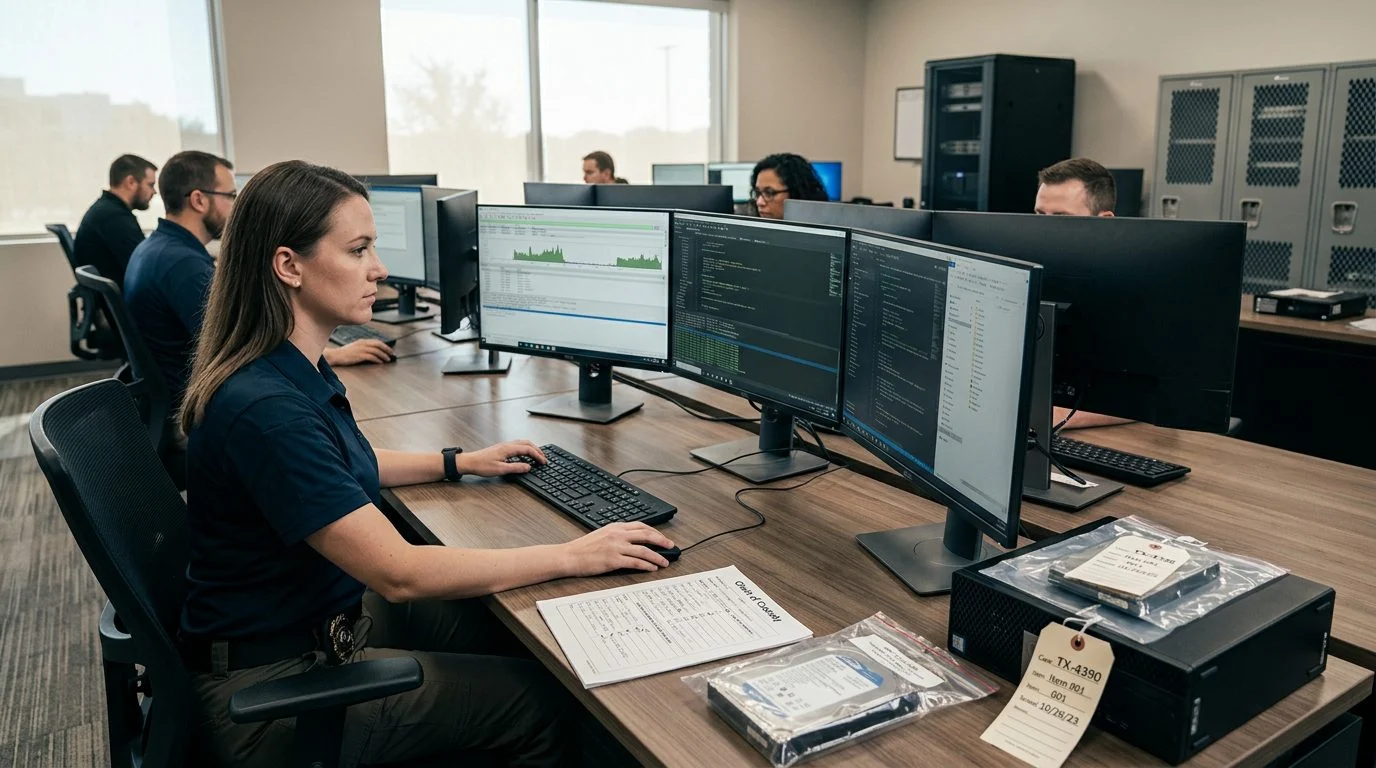
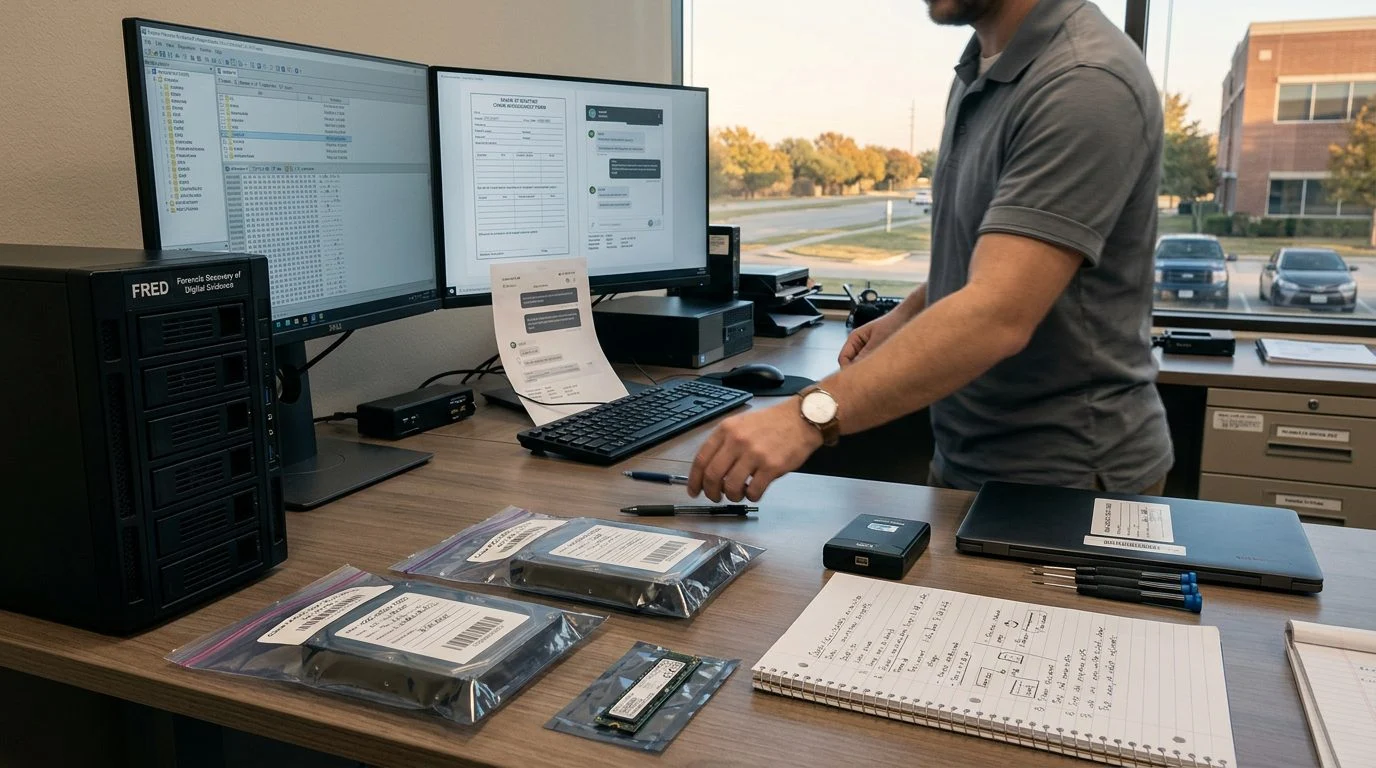
Investigators then examine phones, computers, and storage devices. They look for browser history, saved files, app activity, and login records.
A defense review starts with the timeline. It checks each recorded date and time against household schedules, work logs, and who else had access that day.
The Attribution Question: Who Was Using the Device
The central question is often not whether a device was used. It is which person was using it at the time in question.
Family computers often have several user profiles, saved passwords, and accounts that stay logged in. A record can show an account or device without showing the person who used it.
Hacked or taken-over accounts raise the same question. A review asks whether someone else could have reached the account, and whether the login times fit the people in the home.
Texas evidence rules require proof that an item is what the State says it is. The Texas rule on authenticating evidence requires the party offering an item of evidence to produce evidence sufficient to support a finding that the item is what that party claims it is.
What a Defense Review Covers
A defense review checks each allegation against the charging papers, the warrant, the records, and the forensic work.
- Charging papers and probable-cause affidavit: each fact alleged, and whether the records support it.
- Search warrant: what it allowed officers to search and seize, and whether the search stayed within that scope.
- Forensic reports: the examiner’s notes, tools, and methods, checked for gaps and for conclusions that go beyond the data.
- Files and metadata: chat logs and files, including creation, modification, and access dates.
- Statements: any recorded interview, compared against the documents.
Evidence obtained in violation of the Texas or United States Constitution or laws is not admitted under Texas Code of Criminal Procedure art. 38.23. That article includes an exception for evidence obtained by a law enforcement officer in objective good faith reliance upon a warrant issued by a neutral magistrate based on probable cause.
Your Devices and Your Position While the Case Is Open
Police may take your devices. The most useful steps are to change nothing and to speak with your lawyer before you say anything.
Texas Code of Criminal Procedure art. 18.0215 says an officer may not search a cell phone or other wireless device after a lawful arrest without a warrant, unless a listed situation applies, such as consent. That article covers wireless devices. It does not, by its terms, address a home desktop computer.
In Riley v. California, the U.S. Supreme Court said police generally need a warrant before searching digital information on a cell phone, even one taken from an arrested person.
- Do not delete, wipe, reset, or change any device or account. Changes can be presented as evidence against you.
- Do not discuss the allegations with the family member who used the device, with children, or on social media.
- Write down who had access to each device and account, and when.
- Keep records you already have, such as work schedules and travel records.
The Fifth Amendment provides that no person shall be compelled in any criminal case to be a witness against himself. Under Dickerson v. United States, Miranda and later Supreme Court decisions govern whether statements made during custodial interrogation are admissible in state and federal courts. Speak with your lawyer before any interview. If a divorce, custody, or child protective services matter is also open, talk to your lawyer before you make any statement there.
How the Process Works From First Call to Case Review
The process starts with a consultation. It then moves through the charging papers, discovery, the device review, and a written explanation of your options.
- First contact. The initial consultation is free, confidential, and carries no obligation to continue.
- Gather your papers. Collect your charging papers, bond conditions, and a list of every device and account connected to the case.
- Review discovery. Go through what the State has produced, and identify what has not been produced and should be requested.
- Review the devices and records. Build the attribution questions and the timeline. Under Texas Code of Criminal Procedure art. 39.15, a court must deny a request to copy child-exploitation material if the State makes it reasonably available at a state facility. So the device review may happen there, not on a copy you keep.
- Explain your options. You receive a written explanation of your options and next steps, reviewed with you in plain language.
How long this takes depends on the facts, including how quickly the State produces its discovery.
Not sure what your next step is?
Talk it through with our team — the first consultation is free, confidential, and carries no obligation.
Why Barbieri Law Firm for This Matter
Barbieri Law Firm is an all-women criminal defense firm in Frisco, Texas. It defends people accused of sex crimes and assaultive offenses in Collin County, Dallas-Fort Worth, and across Texas.
Our lawyers, Heather Barbieri and Carrie Thomas, review the digital evidence and charging papers with you. Our team explains what each record does and does not show.
Heather Jean Barbieri, Board Certified, Criminal Law — Texas Board of Legal Specialization.
No lawyer can predict or assure a particular outcome in your case.
Questions You May Be Asking
Can I be charged just because my computer or account was used?
A charge is an accusation. Your review tests whether the State can tie the device or account to you.
We review that request with you as part of your case.
Will this lead to registration?
Registration depends on the specific offense charged. We review that against your charging papers.
Should I talk to investigators?
Speak with your lawyer first. Under Texas Code of Criminal Procedure art. 38.22, a written statement an accused makes as a result of custodial interrogation is not admissible unless the statement shows on its face that he was told he has the right to remain silent, that anything he says may be used against him, that he has the right to have a lawyer present (appointed if he cannot afford one) before and during questioning, and that he may end the interview at any time.
Talk Through Your Shared-Computer Charge With Us
If you face this charge because someone else in your home used a shared device, you do not have to work through the records alone.
You may be worried about your children, your custody or divorce case, or your name. Those worries are heavy. Call (972) 424-1902 to schedule a consultation, or send your case details through our contact page.
Attorney responsible for this site: Heather Barbieri, Barbieri Law Firm, Frisco, Texas.
How We Review an Online Sex Crime Charge
Who Had Access
We look at who used the device or account, when, and whether the State can connect that activity to you.
Your Charging Papers
We review the exact offense charged, since that determines what the case involves and what questions come next.
The Digital Evidence
We examine how the files, logs and accounts were collected and whether that process holds up.
Plain-Language Options
We explain what we find and walk you through your options in terms you can follow.
Before You Speak With Investigators
Talk with a lawyer before answering questions about a device, an account or a file.
Questions to Bring to Your Consultation
Whose Device Was It?
Tell us who else had access to the computer, phone, router or online account.
What Are the Charges?
Bring any paperwork you received, including the charging documents and any bond papers.
What About Registration?
Ask how the specific offense charged may affect registration, and we will review it against your charging papers.
What Happens Next?
Ask what the review involves and what your next steps would be.
Your first consultation is free, confidential and carries no obligation to continue. Call (972) 424-1902 or send us your case details.
Related practice areas
- Online Sex Crimes Defense Lawyer
- Sex Crimes Defense Lawyer in Collin County
- Sex Crimes Defense Lawyer in Prosper
Request a Consultation
Fill out the short form and we will take it from there.