

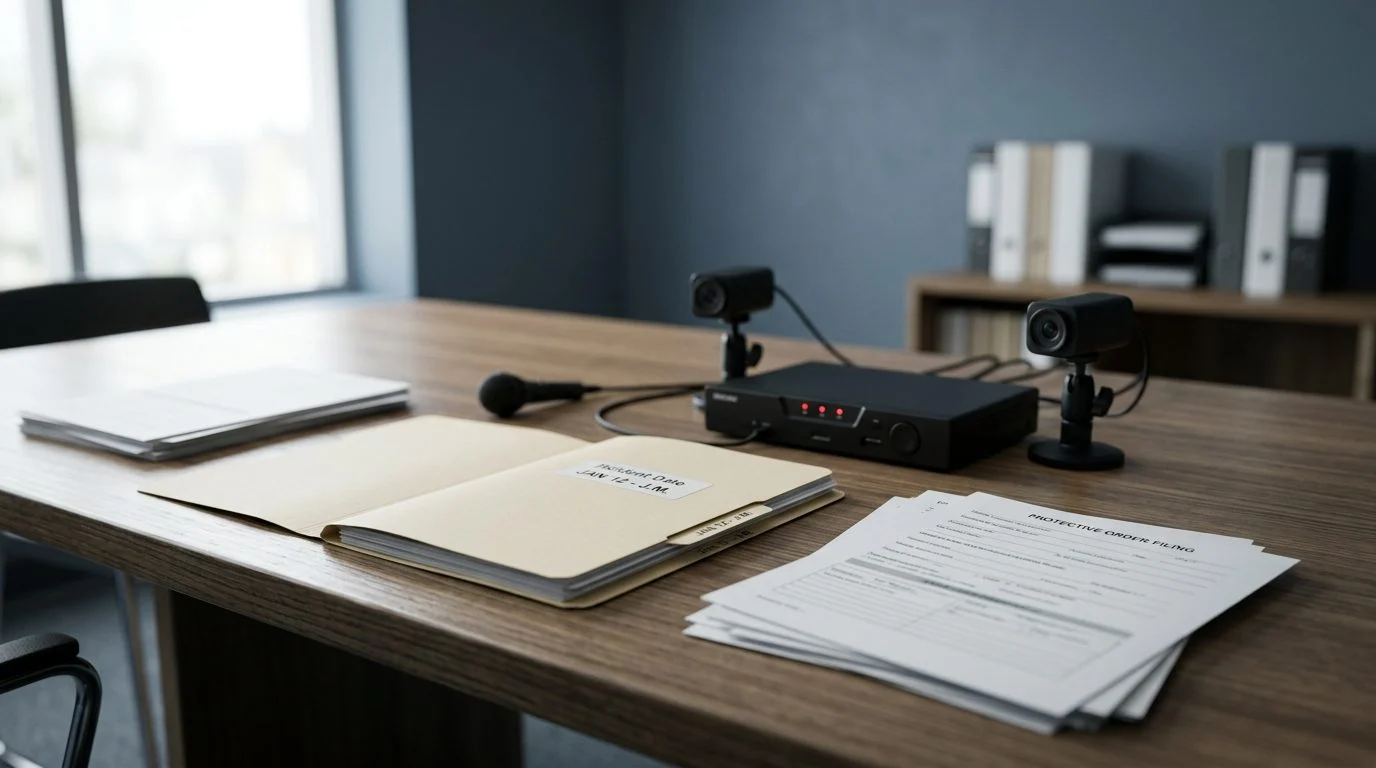
Sex Crimes Defense | Collin County and Dallas-Fort Worth
Charged with Invasive Visual Recording in Texas? Talk to a Defense Lawyer First.
Call (972) 424-1902 for a free initial consultation with no obligation to continue.
By Heather Barbieri · Published October 14, 2026
An invasive visual recording charge in Texas means the State accuses someone of secretly photographing or recording another person without consent, to invade that person’s privacy. If you need an invasive visual recording charge Texas lawyer, the first step is understanding what the State must prove and how the evidence is tested.
What an Invasive Visual Recording Charge Is and Who It Affects
An invasive visual recording charge is a hidden-camera offense. It involves recording or photographing someone without consent, in a setting where that person expects privacy.
Penal Code § 21.15(b)(2) refers to a bathroom or changing room. The law also covers recordings of private body areas, such as the genitals, buttocks, or female breast.
These cases can come up in many places. A device may be hidden in a rental unit, a workplace restroom, a school locker room, or a home. Sometimes the device is found during a search for something else.
The people who search this topic are often not the accused. Parents, partners, and family members look for answers on someone else’s behalf. Professionals and students worry about licenses, jobs, and school discipline.
If you’re reading this after a charge or an investigation, you may not have expected it. You probably have urgent questions about what comes next.
A hidden-camera charge can arrive without warning, and you don't have to sort out the next steps alone; call (972) 424-1902 or send your case details to talk through your situation. Talk it through with our team — the first consultation is free, confidential, and carries no obligation.
What the State Must Prove Under Penal Code 21.15
Each element is a point the defense can examine.
Under Texas Penal Code § 21.15, it is an offense, without the other person’s consent and with intent to invade the privacy of the other person, to photograph, record, broadcast, or transmit a visual image in the circumstances the statute lists, or to promote such an image.
- Recording an intimate area. The person acts without consent and with intent to invade privacy. The other person must reasonably expect that the intimate area is not subject to public view.
- Recording in a private place. The person photographs or records a visual image of another person in a bathroom or changing room, or broadcasts or transmits such an image.
- Promoting a recording. The person knows the character and content of the recording and promotes it.
The statute defines “intimate area” to include the naked or clothed genitals, pubic area, anus, buttocks, or female breast.
Consent is another key issue. Under Texas Penal Code § 1.07, consent means assent in fact, whether express or apparent. A posted sign saying a person is being recorded is not enough to establish consent in a private place, under § 21.15.
How they apply depends on the facts of each case.
Penalties, Enhancements, and Collateral Consequences
An invasive visual recording offense is a state jail felony. Under Texas Penal Code § 12.35, a person found guilty may face confinement in a state jail for up to two years, but not less than 180 days. A fine of up to $10,000 may also apply.
The level can rise. Section 12.35 makes a state jail felony a third-degree felony if a deadly weapon was used or exhibited, or if the person has certain prior final felony convictions. A third-degree felony carries up to 10 years in prison under § 12.34.
Prior records matter in other ways too. Under § 12.42, a prior felony conviction other than a state jail felony can increase the punishment. Section 12.42 also contains harsher life provisions for certain repeat sex offenses, so each case must be checked against that section. Under § 12.46, using a conviction for enhancement does not stop it from being used again later.
The State may also charge related conduct. Under § 21.15, the same conduct can be prosecuted under this section or another law. The separate disclosure offense in § 21.16 is also a state jail felony. For that offense, it is not a defense that the depicted person created the material or sent it voluntarily.
Collateral consequences can follow a conviction. Under Texas Code of Criminal Procedure art. 62.001, the registration definitions set out which convictions are reportable. Whether registration applies depends on those definitions, the disposition, and the facts.
Defense Issues That Often Shape These Cases
The defense starts with the proof. The key questions are who made the recording, where it happened, and whether the privacy element can be met.
Common issues include:
- Identity and access. Can the State prove the accused made or placed the recording? Who else had access to the device or location?
- Consent. What was the scope of any consent? Was the recording made for another lawful purpose?
- Privacy. Was the area one where privacy was reasonably expected? The lighting, camera angle, and layout all matter.
- Digital evidence. Device forensics, metadata, and chain of custody show how files were made, stored, and moved. Gaps in these records can matter.
- Searches. Was the warrant valid, and was the search within its scope?
Some mistakes make these cases harder. Do not delete, alter, or wipe any device or account. Contact with the other person, or posts about the case, can also create new problems.
No outcome can be predicted in advance. The defense works by testing each element and each piece of evidence.
How the Defense Is Built, Step by Step
The process starts with a free initial consultation, which carries no obligation to continue. The timeline varies by county and by case, so each step is explained as it arrives.
- Initial consultation. You describe the charge, the timeline, and any documents you have. The lawyer explains the options.
- Evidence preservation and discovery. The defense requests the police report, warrants, and any recordings or digital material the State holds.
- Warrant and device review. The lawyer reviews search warrants and device searches.
- Negotiation and pretrial motions. The defense may negotiate with the prosecution and file motions that test the State’s proof.
- Client decisions. Plea options and trial are explained in full. You make the decision after you understand the risks and the options.
Related Charges to Know About
Some cases overlap with other charges. The facts decide which statute applies.
- Sextortion. Images used to demand money or other conduct can lead to different charges.
- Adult sexting. Consensual images between adults differ from a hidden-camera recording, and the facts control.
- Phone searches. In online sex crime cases, police device searches are often central to the proof.
- Child cases. When a minor is involved, different and more serious charges may apply. Barbieri Law Firm handles child sex crimes defense.
The firm also handles sex crimes defense and online sex crimes defense more broadly. Ask about your specific facts, because one incident can lead to more than one charge.
Not sure what your next step is?
Talk it through with our team — the first consultation is free, confidential, and carries no obligation.
Why Barbieri Law Firm Handles This Work
Barbieri Law Firm is an all-women criminal defense firm in Frisco, Texas. It defends people charged with sex crimes and assaultive offenses across Collin County, Dallas-Fort Worth, and Texas.
Heather Jean Barbieri, Board Certified, Criminal Law — Texas Board of Legal Specialization, is the founding attorney. Our team includes support staff who assist with office and client work.
The firm offers a free initial consultation, with no obligation to continue. The firm handles criminal defense matters only.
Attorney responsible for this site: Heather Barbieri, Barbieri Law Firm, Frisco, Texas.

Frequently Asked Questions About Invasive Visual Recording Charges
Is a hidden camera recording always a felony in Texas?
Under Texas law, the offense is a state jail felony, and it can rise to a third-degree felony in some cases.
Does a charge automatically lead to sex offender registration?
No. Registration depends on the offense, the disposition, and the facts, so it must be checked in each case.
Does this firm handle civil lawsuits over recordings?
No. Barbieri Law Firm handles criminal defense only.
What should I do before the first consultation?
Gather every document you have about the charge. Tell the lawyer everything about the situation, including facts that seem unhelpful.
A hidden-camera charge is often discovered at the worst moment, and it is not a situation you chose. You can call (972) 424-1902, schedule a free initial consultation, or send your case details to start the conversation.
What We Review in an Invasive Visual Recording Case
The recording and how it was made
We examine the device, the files, the metadata and how any image was created, stored or transmitted.
The location and privacy
We look at whether the place falls within the locations the statute covers and what expectation of privacy applied there.
Consent and intent
We review whether the other person consented and what evidence bears on the intent element that applies to the charge.
Prior record and penalty
We check prior convictions and any sentencing enhancements that could change the potential penalty, including whether sex offender registration is at issue.
How Barbieri Law Firm Approaches These Charges
Focused on sex crimes defense
Our practice centers on defending professionals and others accused of sex crimes and assaultive offenses across Collin County, Dallas-Fort Worth and Texas. Heather Jean Barbieri, Board Certified, Criminal Law — Texas Board of Legal Specialization, founded the firm.
A review of the evidence
We review the recording, the device, the location, the timeline and any statements, so you understand what the State can and cannot prove.
Clear explanation of your options
We explain the charge, the possible outcomes in general terms and the steps ahead, without promising any particular result.
A free first consultation
Call (972) 424-1902 for a free initial consultation with no obligation to continue. You can also send us your case details through our website.
Before You Post or Reach Out
Talk with a defense lawyer before you post about the allegation online, contact the other person or discuss the matter with anyone who may be a witness. Early advice helps protect your position.
Talk with Heather Barbieri about your invasive visual recording charge.
Related practice areas
- Online Sex Crimes Defense Lawyer | Collin County & Texas
- Sextortion and Threat-Based Online Sex Charges in Texas: What Prosecutors Must Prove
Request a Consultation
Fill out the short form and we will take it from there.