

Criminal Defense Guide | Frisco, Texas
Is a Lie Detector Test Admissible in Texas?
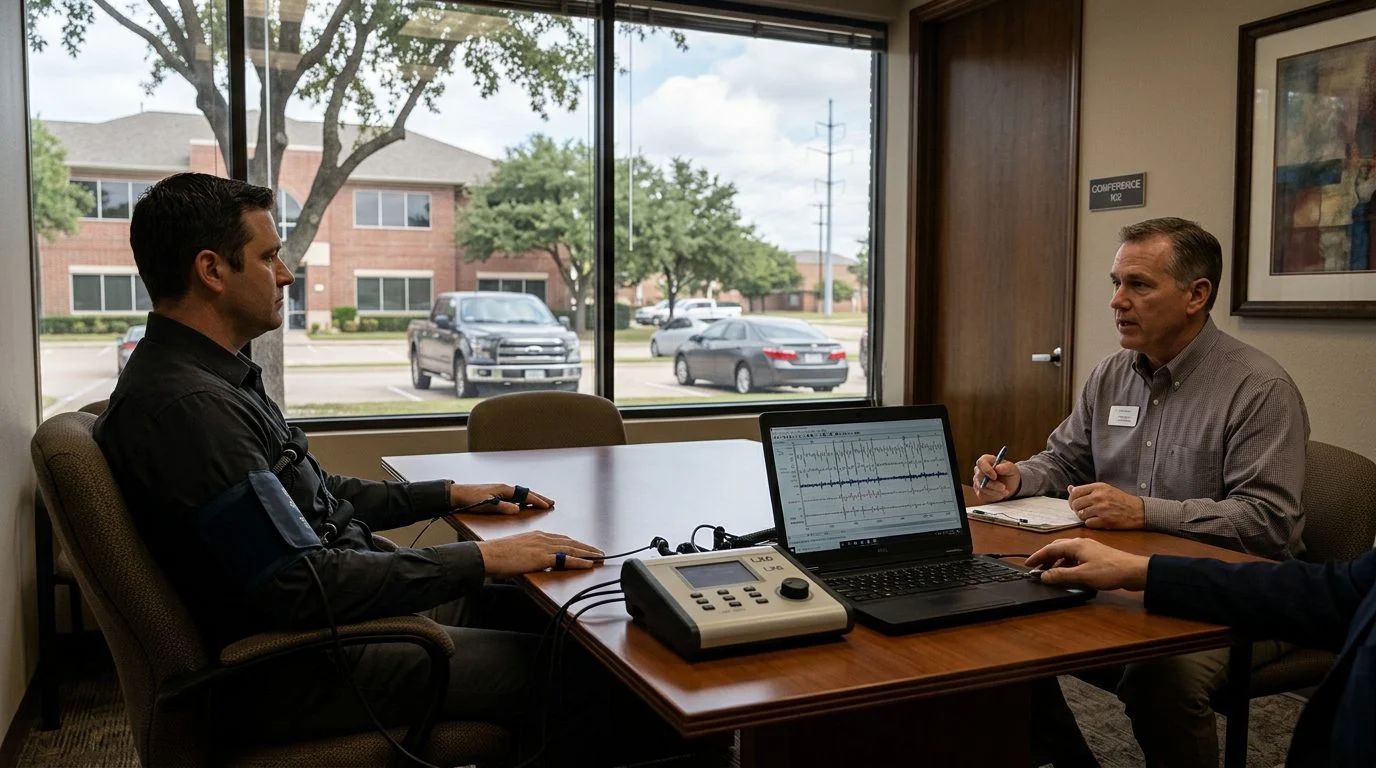
A polygraph can shape an investigation long before any courtroom question arises. Here is how to think through a request to take one.
By Heather Barbieri · Published November 22, 2026
You may have been asked to take a lie detector test, or you’ve heard it could help or hurt your case. Before you answer, you want a straight answer on whether the result can be used against you.
Is a lie detector test admissible at trial in Texas?
A polygraph can come up in a case long before anyone reaches a courtroom. Prosecutors and defense lawyers may talk about a test while they weigh their options. A result can also shape what the state decides to do next. The jury may never hear the score, yet the test can still move the case. So the real question is how a test fits into the whole picture, not only whether a judge lets it in on one day. Keep in mind that the test doesn’t stand alone. Messages, devices, timelines and the exact charge all sit beside it.
If a test request has you wondering what it could mean for your case, our team is glad to talk through your situation with you. Talk it through with our team — the first consultation is free, confidential, and carries no obligation.

When both sides agree: stipulations and plea talks
A stipulation is a written agreement in which both sides agree on how a test and its result may be used. Read those terms closely before you sign anything.
Plea talks are a different setting. Whether a test helps or hurts depends on the exam, the examiner and the other evidence in the case. A lawyer can compare what the test shows with the messages, records and timeline the state already has. That comparison is where you and your lawyer can weigh your choices. Don’t agree to a test, or to any stipulation, until you understand what you’re agreeing to and how the results would be used.
Polygraph during an online sex crime investigation
A voluntary test and a test presented as required are different situations, so ask which one you face. Before you agree to anything, ask whether the test is voluntary.
The Fifth Amendment says no one may be compelled in a criminal case to be a witness against himself (Fifth Amendment text). The Sixth Amendment gives the accused the right to the assistance of counsel for a defense (Sixth Amendment text).
Art. 38.22 governs electronic recordings of statements made as a result of custodial interrogation. It requires that such a recording be preserved until the defendant’s conviction for any offense relating to it is final, all direct appeals are exhausted, or prosecution is barred by law (art. 38.22). Evidence obtained in violation of Texas or U.S. law is generally not admitted against the accused at trial, but an exception applies to evidence obtained by a law enforcement officer in objective good faith reliance upon a warrant issued by a neutral magistrate based on probable cause (art. 38.23).
For online cases, the charge itself matters. Under Penal Code § 33.021, a minor is someone younger than 17 or someone the actor believes to be younger than 17. Subsection (c) makes it an offense to knowingly solicit a minor, over the internet, to meet with intent that the minor engage in sexual contact, sexual intercourse, or deviate sexual intercourse. Subsection (b) applies only to a person who is 17 or older. Subsection (e) provides a defense, for conduct described by subsection (c), if the actor was married to the minor, or was not more than three years older than the minor and the minor consented. An offense under subsection (c) is a felony of the second degree. A minor is someone under 17, or someone the actor believes is under 17. Talk with a lawyer before you answer questions about messages or a test.
Polygraph as a bond or community supervision condition
Bond and supervision conditions are written in a court order, so that order is the document to read closely. For a misdemeanor, the maximum supervision period is two years. Under art. 42A.053, the maximum community supervision period for most felonies is 10 years, but it is five years for certain third-degree felonies under Title 7 of the Penal Code and Chapter 481 of the Health and Safety Code, and a judge may extend the maximum as provided by art. 42A.753 or 42A.757.
A test used to check compliance with a condition is a different setting from a trial, and the rules for it can differ. Read every condition in the order, including any that mention testing. Ask what happens if you cannot meet one.
How a polygraph fits with digital and other evidence
In online sex crime cases, messages, devices and accounts often carry more weight than any single test. Under Riley, officers who have arrested someone generally must obtain a warrant before searching the digital contents of that person’s cell phone, even when the phone was lawfully seized (Riley v. California, 573 U.S. 373, 403 (2014)).
A polygraph does not replace a review of the actual digital evidence, the timeline and the charging language. A lawyer looks at what the state can prove. That includes when messages were sent, which device or account was used, and how a test question fits that picture.

Talking through your situation with Barbieri Law Firm
A test request can arrive before you’ve had time to prepare. Questions about messages, devices and a test can feel overwhelming all at once, especially when you’re dealing with them alone.
Barbieri Law Firm is an all-women criminal defense firm in Frisco, Texas, led by Heather Barbieri. The firm handles sex crimes and assaultive offense cases in Collin County, the Dallas-Fort Worth area and across Texas. The first consultation costs nothing, stays confidential, and does not oblige you to continue. To talk through the polygraph question in the context of your own case, call (972) 424-1902 or send your case details.
You can read our Collin County page for more about this area.
Common questions
Ask a lawyer how that rule applies to your case.
Can I refuse a polygraph during an investigation?
Whether a polygraph examination during an investigation is something you should agree to depends on the facts of your situation. Before you agree, talk with a lawyer about how the test could be used and how to respond.
How long can community supervision last in Texas?
For a misdemeanor, the maximum is two years. For most felonies, the maximum community supervision period is 10 years, but certain third-degree felonies carry a five-year maximum, and a judge may extend the maximum as provided by law (art. 42A.053).
Attorney responsible for this site: Heather Barbieri, Barbieri Law Firm, Frisco, Texas.
How Barbieri Law Firm approaches a polygraph request
Reviewing the facts
We look at the allegation, the stage of the investigation, and what has already been said, so you can understand what a test could mean for your case.
Protecting your position
We explain how results, refusals and statements may be used, and help you decide how to respond before you commit to anything.
Explaining your options
We walk you through the choices available in your situation in plain language, with no pressure to act before you are ready.
Keeping it confidential
What you share with us in a consultation stays confidential. We handle sensitive matters with discretion from the first call.
Talk with a lawyer before you agree
Before you agree to a polygraph or give a recorded statement to investigators, speak with a criminal defense lawyer about how the results could be used.
Questions to bring to your consultation
Where is the investigation now?
Tell us whether you are a witness, a person of interest, or have been charged, and what has been asked of you so far.
What was requested?
Bring any written notice, text messages, or paperwork you received about a test, interview, or follow-up meeting.
Who is asking?
Note which agency or person contacted you and when, so we can review the timing and the details of the request.
What could happen next?
We will explain how an agreement, a refusal, or a statement could affect the rest of the case and what your choices look like.
Have a polygraph request or a pending allegation? The initial consultation is free, confidential and carries no obligation to continue.
Related practice areas
- Online Sex Crimes Defense Lawyer
- Accused of Sexual Assault at Work
- Sex Crimes Defense Lawyer in Collin County
Request a Consultation
Fill out the short form and we will take it from there.