

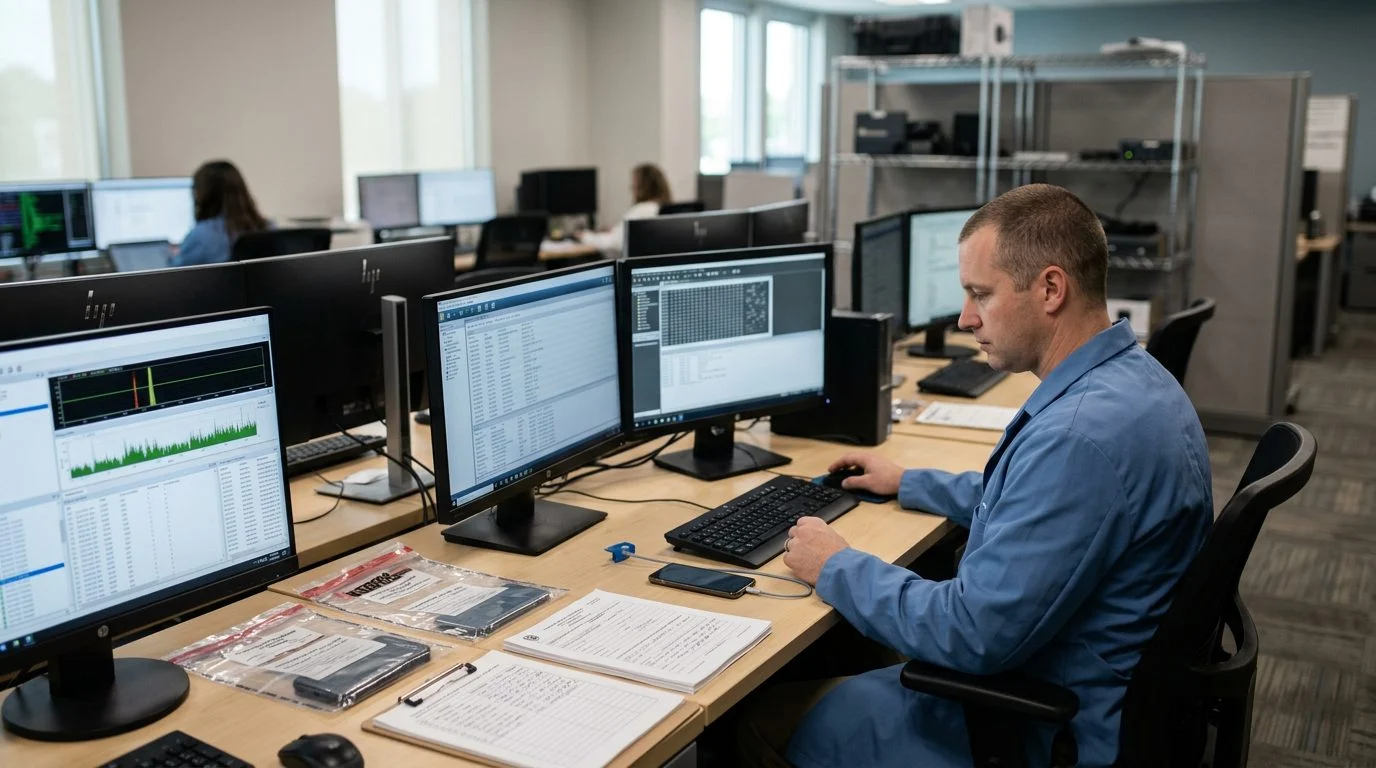
Phone Evidence in Texas Sex Crime Cases
Your Phone Evidence, Reviewed Independently
A phone can tell many stories. We help clients in Collin County, Dallas-Fort Worth and across Texas test the state's version against the device itself.
By Heather Barbieri · Published November 8, 2026
If investigators have taken your loved one’s phone, you may wonder what the data on it shows. A separate review of that data, done for the defense rather than the state, is one option to discuss with a lawyer. In an online sex crime case in Texas, it helps show what a phone holds, who used it, and what a summary report leaves out.
What a forensic phone examination actually does
A forensic phone examination copies data from a phone and organizes it into a report that investigators can read. Examiners usually work from that copy rather than the phone itself.
The data usually falls into a few groups: messages, call logs, contacts, app data, photos, location records and metadata. Metadata is information about a file, such as when it was created, sent or changed.
Recovery of deleted items depends on the device, the software and whether the storage space was later overwritten. Some deleted items can be recovered and some cannot. That is a technical limit of the process, and it cuts both ways.
The examination produces raw data. A person still has to interpret it. Reading the data means deciding which records matter and how they fit together, and two people can organize the same extraction in different ways. That reading is where most questions start.
If a phone report has you worried about what it says about you or a family member, you don't have to sort through that data alone. We're glad to talk it through in a free, confidential first consultation. Talk it through with our team — the first consultation is free, confidential, and carries no obligation.

What the state’s extraction report can leave out
A summary report reflects choices the examiner made about what to include. Those choices include which categories were selected and which filters were applied. A report can be accurate and still be incomplete.
Timestamps depend on time zone and device settings. A time printed in a report should be checked against the underlying data before anyone relies on it.
Full message threads, attachments and app-level records may not appear in a short excerpt. One line pulled from a long conversation can read very differently with the lines around it.
Reviewing the complete extraction, not only the printed summary, is how a reader sees what the report includes and what it leaves out. Ask early, because the summary is often the first thing a person sees. The defense can request the full extraction and the underlying files.
Why an independent review matters in an online sex crime case
Who held or controlled the phone at a given time is often a central question. Texas law defines possession as “actual care, custody, control, or management” (Texas Penal Code § 1.07). That matters when a phone was shared, borrowed or kept in a common space.
Age is another key point. Under Texas Penal Code § 33.021, a “minor” is someone younger than 17, or someone the actor believes to be younger than 17. So what the messages say about age, and when they say it, is part of the review.
The full message timeline shows how a conversation began, what each person wrote and in what order. Short excerpts may not show that order, and the order can change how a single message reads.
An independent review is a separate analysis of the same data, done for the defense. It can confirm what the state’s report says, or raise questions about it. It does not predict how a case will end.
Deleted messages, deleted apps and what timing can show
Deleted messages can sometimes be recovered from device storage. Recovered items carry their own metadata, which can show when they were created or changed.
Examiners look at when an item was deleted or created. That time can differ from when a message was sent or received, so the two should not be treated as the same event.
Deleting a message from the screen does not always remove it from storage. It also does not always leave the item intact. Whether anything can be recovered depends on the device and how it was used.
Questions about deletion are fact-specific. Answers depend on the device, the software and the timeline of use. A missing message does not by itself show that a conversation never happened. A recovered one does not by itself show who wrote it. A separate guide on deleted messages after an online sex crime accusation covers how these questions come up in Texas cases.
Warrants, consent, chain of custody and how the phone was handled
Every search question depends on the specific facts, so we review the circumstances of your loved one’s case with you. The defense can ask whether the extraction stayed within that scope, and whether the examiner’s work matched the authority given.
Chain of custody records show who took possession of the phone, when, and how it was stored. Gaps or unexplained handoffs in those records are worth noting.
Documentation of the copying process can include verification values, such as hash values, recorded for the copy. Those values let a reviewer check the copy against the source data.
These records are part of discovery, the evidence the state and the defense exchange before trial. The defense reviews them alongside the extraction report, because a report is only as reliable as the handling behind it.
How this review fits into a Collin County case
An independent forensic phone exam is built around the facts of each device. That holds whether the case is in Collin County, Dallas County or somewhere else in Texas.
Phone data often arrives in stages. The defense may need to request the full extraction and underlying files rather than the summary alone. Each stage can change what the defense needs to ask next.
Timing matters. Early review helps the defense understand the state’s evidence before key decisions are made.
Many online cases begin with a report to authorities. The NCMEC CyberTipline accepts reports of suspected online child exploitation and refers them to law enforcement for possible investigation. A referral is not a charge, and a tip alone does not show that a crime occurred. The federal Internet Crimes Against Children Task Force Program, described by the Office of Juvenile Justice and Delinquency Prevention, addresses technology-facilitated child sexual exploitation.
Not sure what your next step is?
Talk it through with our team — the first consultation is free, confidential, and carries no obligation.
Talking through your device evidence with Barbieri Law Firm
If you have received a phone report, are waiting for one, or are trying to understand what a family member’s device shows, this is an unsettling place to be. You don’t have to make sense of the data alone.
Barbieri Law Firm is an all-women criminal defense firm in Frisco, Texas. Call (972) 424-1902, or send your case details through the firm’s contact page. The free initial consultation is confidential and carries no obligation to continue.
Attorney responsible for this site: Heather Barbieri, Barbieri Law Firm, Frisco, Texas.

Frequently Asked Questions
What is an independent forensic phone exam in an online sex crime case?
An independent forensic phone exam is a review of a phone’s data by an examiner hired by the defense, separate from the police or prosecution’s review. It can check messages, images, app activity, and timestamps against what the state’s reports claim.
Can my lawyer get the phone data the state collected?
Phone extractions and police reports are often central evidence that we review with you when we explain your loved one’s options. What is available depends on the case, so your lawyer reviews what the state has provided.
Should I delete messages or reset my phone while my case is pending?
No. Deleting, wiping, or resetting your loved one’s phone or its accounts can harm their defense. Keep the device as it is and talk with a lawyer before making any changes.
How do I start a free consultation about my phone evidence?
Call (972) 424-1902 to schedule a free, confidential initial consultation with no obligation to continue. You can also send your case details through our contact form, and we will discuss how a phone exam might fit your situation.
How Barbieri Law Firm Approaches Phone Evidence
We Review the State's Extraction
We request and examine the data the police or prosecution collected, including the reports, the extraction files and the search warrant details.
We Protect Your Privacy
Your phone holds personal and family information. We explain what can be shared, what should be limited and how to keep your own data safe.
We Explain Your Options
After the review, we walk you through what the data shows, what it does not show and the choices available in your case.
We Treat Your Case with Care
Sex crime charges are personal and stressful. Our team handles every step with discretion and respect for your situation.
Before You Speak to Investigators
Do not delete messages, apps or accounts from your phone, and do not give anyone your passcode or consent to a phone search until you have talked with a lawyer.
What an Independent Phone Review Can Examine
Messages and Conversations
Text, app and social media threads can be reviewed in full context, including who sent what, when and from which device.
Images and Files
Photos, videos and downloads can be checked for creation dates, edit history and where they were stored.
Timestamps and Activity
Time zones, sync settings and device logs can be compared against the timeline in the state's reports.
Accounts and Apps
Account logins, app use and storage locations can show whether the state's description of the device matches what the data actually records.
Talk With Barbieri Law Firm About Your Phone Evidence. The First Consultation Is Free, Confidential and Comes With No Obligation to Continue. Call (972) 424-1902 or send us your case details.
Related practice areas
- Online Sex Crimes Defense Lawyer
- Should I Delete Messages or Change My Devices After an Online Sex Crime Accusation in Texas?
- Online Sex Crimes Defense Lawyer in Collin County
Request a Consultation
Fill out the short form and we will take it from there.