

Online Sex Crimes Defense | Frisco, Texas
Disputed Devices? Get a Frisco Lawyer Who Reviews Every Digital Detail
Barbieri Law Firm, an all-women criminal defense firm led by Heather Barbieri, defends people accused of online sex crimes in Collin County, Dallas-Fort Worth and across Texas. We review how your phone, computer or account was searched and explain your options.
By Heather Barbieri · Published October 19, 2026
Online Sex Crime Cases When the Device or Account Is Disputed in Texas
When a phone, computer or online account sits at the center of an online sex crime charge, the central question is often who was using it, and when. An online sex crime device seized Texas lawyer starts there, not with the penalty. This page explains how the state links a device or message to a person, what a careful review examines, and how Barbieri Law Firm approaches these cases in Frisco and across Collin County, Dallas-Fort Worth and Texas.
If the phone, computer or account in your case is now disputed, we would be glad to talk with you about what the evidence does and does not show. Talk it through with our team — the first consultation is free, confidential, and carries no obligation.

What a disputed online sex crime case means in Texas
A disputed case is one where the state relies on a device or account, and the accused says the evidence does not show who did what. Some online charges turn on what was said. Others turn on who said it.
Texas makes it an offense to knowingly solicit a minor to meet another person, including the actor, over the Internet, by email, text or a commercial online service, with the intent that the minor will engage in sexual contact, sexual intercourse, or deviate sexual intercourse with the actor or another person (Penal Code § 33.021). A “minor” is someone younger than 17, or someone the actor believes is younger than 17.
Possession charges carry their own question. The offense requires that the person intentionally or knowingly possesses, or intentionally or knowingly accesses with intent to view, visual material showing a child engaging in sexual conduct, and knows or should have known the depiction is of a child younger than 18 when the image was made (Penal Code § 43.26). That knowledge question often sits inside the device review.
Early choices matter. What you say to investigators, and how you handle devices and accounts, can shape how the record reads later.
This page is for the person charged, and for a family member who learned a device was taken or that messages were tied to a particular account. For the full range of charges we defend, see our online sex crimes defense page. The Texas Attorney General cyber safety initiative also describes online solicitation of minors in Texas.
How the state tries to tie a device or account to you
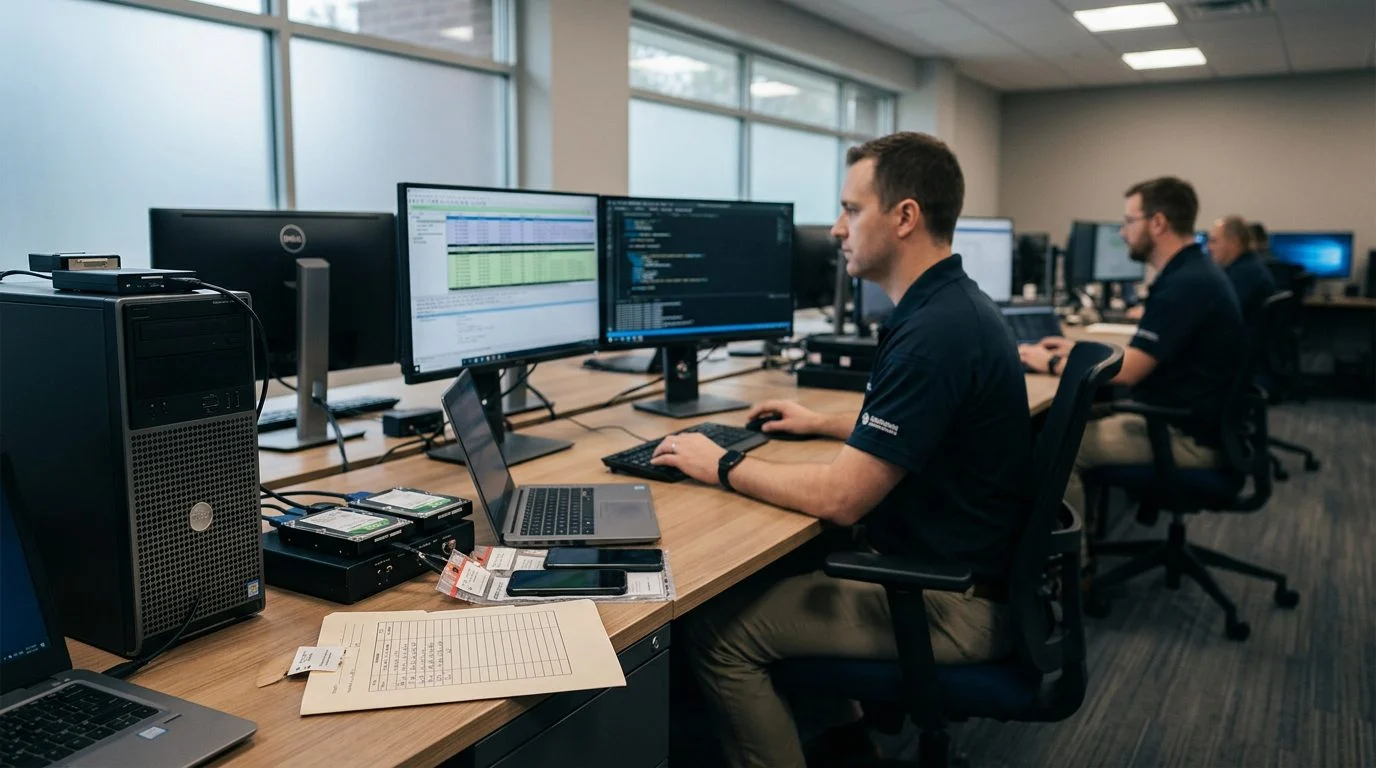
The state connects a device or account to a person through the device itself, a forensic extraction and provider records. Each link needs its own proof.
- Seizure. Police often take a phone or computer and examine it later. Owning a device and using it are separate questions.
- Forensic extraction. An examiner copies device data and reports messages, timestamps, saved files and app data. The report shows what the device held. It does not, by itself, show who typed each message.
- Account records. Provider records can show that an account exists and how it was set up. Linking that account to one person is a separate step.
- Time settings. Clock and time-zone settings can change how a sequence of events reads.
- Who controlled a shared device is a real question.
A seized device is the start of the review, not the end of it.
Many cases begin with a tip. The NCMEC CyberTipline reviews reports of suspected online child exploitation and refers them to law enforcement agencies for possible investigation. The Internet Crimes Against Children Task Force Program describes its role in investigating technology-facilitated child sexual exploitation.
What we review when the device or account is disputed
We review the complete forensic material, the account records and the full message context. We do not stop at the summary the state presents.
- The full forensic report and the underlying extraction data.
- Login history, shared devices, household accounts and saved passwords.
- Full message threads, not excerpts, including everyone in the conversation.
- Deleted messages: what was recovered, what was overwritten, and how that changes the timeline.
- Chain of custody, from seizure through examination.
- The other person in the conversation. Texas defines a minor partly by what the actor believes, so how that person was presented in the chat matters.
- Entrapment. It is a defense when a law enforcement agent induces the conduct using persuasion or other means likely to cause a person to commit the offense. Giving someone an opportunity to offend is not entrapment (Penal Code § 8.06).
We will review the evidence, including the device or account records, the messages and the timeline, and explain your options.
How the process works, step by step
The process starts with a consultation and moves through documents, discovery, review and a discussion of your options. Each step builds on the last, so the early paperwork matters.
- Consultation. You talk with Heather Barbieri about the charge, the device or account, and what you already know.
- Documents. You gather the charging papers, warrant paperwork, notices and any extraction report you have.
- Discovery. We request and review the complete forensic material the state holds.
- Digital review. We examine access, attribution and the timeline, one question at a time.
- Options. We explain the options at each stage and what each one involves.
- Ongoing contact. You receive updates on court settings and decisions that belong to you.
How long each stage takes depends on the facts of the case and how quickly discovery arrives.
Why Barbieri Law Firm for disputed digital evidence
Barbieri Law Firm is an all-women criminal defense firm in Frisco, Texas, led by Heather Barbieri.
- The lawyer. Heather Jean Barbieri, Board Certified, Criminal Law — Texas Board of Legal Specialization.
- Who handles your case. Heather Barbieri is the lawyer on every matter. Our team handles scheduling and office work.
- What we do. We defend people accused of sex crimes and assaultive offenses, including online sex crimes and aggravated assault.
- Where we work. Collin County, Dallas-Fort Worth and Texas.
- No predictions. No lawyer can know how a case will end. We explain your options instead of predicting one.
Not sure what your next step is?
Talk it through with our team — the first consultation is free, confidential, and carries no obligation.
Common questions about disputed devices and accounts
Most of these questions come down to who controlled the device and what the records show.
Can police search my phone?
Every case depends on its own facts, including how police obtained the device. We will review those facts and explain your options. We review that question with the paperwork you have.
Does a deleted message still count as evidence?
Deleted messages may be recovered, overwritten or incomplete. We review what the report shows and what it leaves out.
Can someone else have used my account or device?
Yes. Shared devices, household accounts and saved logins are questions we review.
Do I have to explain the messages to investigators?
Talk with us before you answer questions about your devices or accounts.
What does the consultation involve?
Free initial consultation, confidential, with no obligation to continue.
Does the firm handle cases outside Frisco?
Yes. The firm handles matters across Collin County, Dallas-Fort Worth and Texas.

Talk with Heather Barbieri about your device or account
If a device was taken from you, or a message thread was presented as coming from your account, the questions come quickly. You have a right to understand what the evidence shows, and what it does not show.
If the phone, computer or account in your case is now disputed, a Texas lawyer can help you work through it. Call (972) 424-1902 or send your case details through our contact form to schedule a consultation.
Attorney responsible for this site: Heather Barbieri, Barbieri Law Firm, Frisco, Texas.
Why Clients Contact Barbieri Law Firm
An All-Women Firm
Heather Barbieri leads a firm staffed by women, serving clients in Frisco, Plano, McKinney, Allen and throughout Collin County.
Device Evidence Reviewed Closely
We examine search warrants, forensic reports, extraction files and chain-of-custody records to understand what the state claims and how it was obtained.
Defense Focused on Sex Crime Charges
Our practice concentrates on sex crimes, online sex crimes, child-related allegations and assaultive offenses, so your case is handled by a team that works in these areas every day.
Plain-Language Guidance
We explain the charges, the evidence and your options in terms you can follow, so you can make informed decisions about your case.
Free, Confidential First Consultation
Your first consultation is free, confidential and carries no obligation to continue.
Talk to a Lawyer Before You Respond
Questions about a device search, a forensic report or a request for passwords are important. Speaking with a criminal defense lawyer about the specific facts can help you understand the situation before you respond to investigators.
How We Review a Digital Evidence Case
1. Review the Search
We look at the warrant, the affidavit and how police seized and searched your devices or accounts to identify any questions about scope or procedure.
2. Examine the Forensic Evidence
We review extraction reports, deleted-file recovery, timestamps and metadata, because what a report shows and what it means are not always the same.
3. Identify Who Had Access
We look at shared devices, accounts, networks and login records to understand who used the device and when, and what the records can and cannot show.
4. Explain Your Options
After reviewing the evidence with you, we explain the possible paths forward and what each one would involve, so you can decide with full information.
Schedule a Free, Confidential Consultation
Related practice areas
- Online Sex Crimes Defense Lawyer | Collin County & Texas
Request a Consultation
Fill out the short form and we will take it from there.