


Criminal Defense | Frisco, Texas
Text Messages Can Be Evidence. Here Is How Texas Courts Look at Them.
Barbieri Law Firm reviews what a message says, who wrote it and how it fits the rest of the case.
By Heather Barbieri · Published October 26, 2026
Short Answer: Texts Can Be Admitted, But Not Automatically
Do text messages hold up in court in Texas? Courts ask what the message says, who wrote it, and whether it fits the rest of the case. Texts often matter in sex crime, online sex crime, assault and family violence cases, so these questions are worth understanding early. Some messages can also be a charge in their own right. Under Texas Penal Code § 33.021, a person 17 or older can commit an offense. That offense requires intent to commit a listed offense and intentionally communicating in a sexually explicit manner with a minor, or distributing sexually explicit material to a minor, by text or other electronic message. The exact result in any case turns on the facts.
If a screenshot or message is weighing on you, or on someone you love, you don't have to face it alone. We can talk through your situation. Talk it through with our team — the first consultation is free, confidential, and carries no obligation.
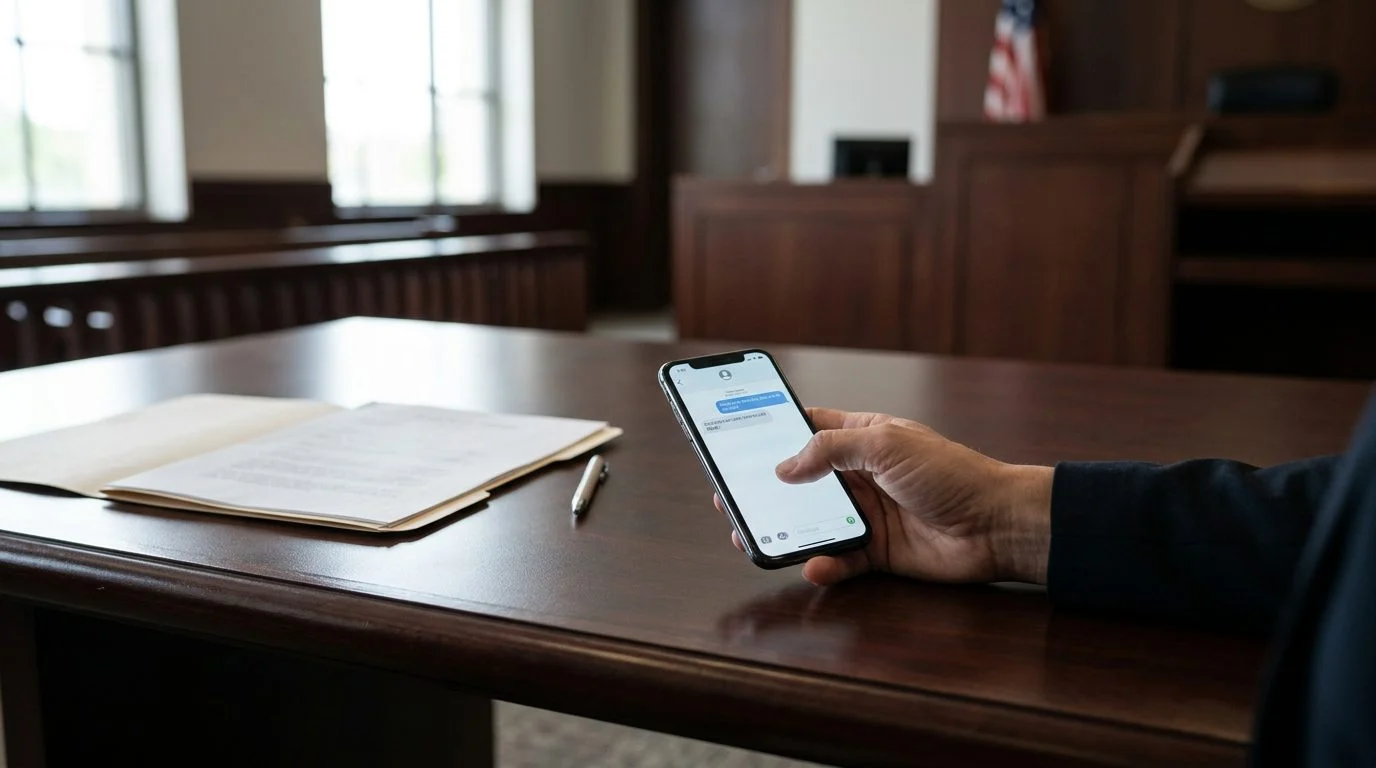
How Texas Courts Check That a Text Is Authentic
That proof can come in several forms.
- Testimony from the sender or recipient who wrote or received the message.
- Details only the two people would know, such as a saved contact name or a shared nickname.
- Phone or account records showing messages passed between two numbers on certain dates.
- Timing and context that fit the rest of the story.
Courts usually weigh several details together rather than one alone. Shared phones and family accounts can cause confusion, so the number and account history matter. A witness who knows the device can often explain how messages were sent and received.
Screenshots get challenged often. Someone can ask who typed the words, whether the picture was cropped or edited, and whether the date and time stamps are complete. A screenshot can help, but the original phone and account are harder to challenge than a picture of them.
Hearsay: Whose Words Are on the Screen
Whose words are on the screen matters because a text is often treated as hearsay. Messages from a complainant, a family member or a third party can raise separate questions when someone offers them for their truth.
Sender identity is the first thing to check. Next, look at why the message is offered, such as to show a threat, a request or a reply to something said earlier. Consider a simple case. A message written by the accused may be used differently than a message written by the complainant. The same text can raise different questions depending on who wrote it and why it’s offered.
Discovery and Deleted Messages
Discovery, the exchange of evidence between the two sides, can reach text messages. Deleted messages are not always gone. Recovery varies with the device, cloud backups and how the messages were stored, and a forensic examiner may recover some of them.
Deleted texts can matter in both directions. A missing message is not proof of anything by itself, and a recovered one still needs the same checks.
Sex crime cases add another layer. That is why older messages about a person’s history raise their own questions.
Context, Completeness and Misread Messages
A single text pulled from a long thread can change meaning. The full exchange shows tone, what came before and how the other person replied. Imagine a screenshot that shows only “I’ll be there tonight.” Earlier messages may show the plan had changed, or that the line answered a question. Context can change the meaning completely.
Short replies, emojis, abbreviations and autocorrect errors can be read differently by a judge, jury or investigator than by the people who wrote them. Timestamps and time zones can also shift the order of events. A sequence that looks clear in a screenshot may not match the phone’s full record.
Context can also decide whether a statute applies at all. Under Texas Penal Code § 43.261, an affirmative defense is available only if the visual material depicted only the actor or another minor within the age and relationship limits of Section 43.261(e), and was promoted or received only between the actor and that minor. Under Texas Penal Code § 43.261(e), it is an affirmative defense to prosecution that the visual material depicted only the actor or another minor who is not more than two years older or younger than the actor and with whom the actor had a dating relationship at the time of the offense (or who was the actor’s spouse at that time), and that it was promoted or received only to or from the actor and the other minor.

Phones, Privacy and Bond Conditions
A message on a phone can reach investigators in several ways. These include a search warrant, a consent search or a person who shows it to police. Privacy on a phone is more limited than it feels.
A text can also be its own problem. Under Texas Penal Code § 25.07, a person commits an offense by knowingly or intentionally violating certain protective orders, or a bond condition in a family violence, sexual assault or related case that is related to the safety of a victim or the community, in ways the statute lists. Contacting a protected person in a threatening or harassing way counts. So does any contact when the order bars communication, except through the person’s attorney or a court-appointed person. Under § 25.07(e), a peace officer investigating a possible violation may not arrest the protected person for violating that order.
Whether texts fit a family violence charge turns on the relationship. Under Texas Family Code § 71.004, family violence covers an act by a family or household member against another member of the family or household intended to cause physical harm, bodily injury, assault or sexual assault. It also covers a threat that reasonably places someone in fear of imminent harm. Defensive measures to protect oneself are excluded. Under Texas Family Code § 71.0021, a dating relationship is a continuing relationship of a romantic or intimate nature, judged by its length, its nature, and the frequency and type of interaction between the persons involved. A casual acquaintance does not qualify.
Does deleting a text erase it? Not always, because a forensic examiner may recover some deleted messages.
If you’re reading this because someone showed you a screenshot, or because a message you love someone sent or received now worries you, you don’t have to sort it out alone. Barbieri Law Firm offers a free, confidential initial consultation with no obligation to continue. Contact us to talk through how these rules may apply to your situation.
Attorney responsible for this site: Heather Barbieri, Barbieri Law Firm, Frisco, Texas.
What a Defense Review of Text Messages Covers
Exact wording and context
We read the full message, the messages before and after it, and the conversation it belongs to.
Who sent and received it
We look at who had access to each phone and account, and whether the sender can be tied to the message.
Timing and full thread
We compare dates, times and the complete exchange against screenshots or excerpts offered as evidence.
How the evidence was obtained
We review how the messages were collected, preserved and turned over to the State.
How it fits the whole case
We explain what the messages may mean alongside the other evidence, and walk you through your options.
Deleted Does Not Always Mean Gone
A deleted message may still exist on a phone, in a cloud backup or in carrier records. Before you delete anything, replace a phone or log out of an account, talk with a criminal defense lawyer.
Common Questions About Text Messages in Criminal Cases
Who wrote the message?
Shared phones, shared accounts and saved passwords can all make authorship a real question worth examining.
Is the screenshot complete?
Excerpts can leave out the context that changes what a message means. We compare what was offered against the full conversation.
Can a message be the charge?
In some situations, the message itself is the conduct alleged. Those cases require a close look at the exact words and intent involved.
What about the rest of the evidence?
Texts are rarely reviewed alone. We look at how they line up with the other evidence in your case.
Talk With Heather Barbieri About Your Messages
Related practice areas
- Online Sex Crimes Defense Lawyer | Collin County & Texas
Request a Consultation
Fill out the short form and we will take it from there.