

Criminal Defense | Frisco, Texas
Can You Ask the Judge to Drop Charges in Texas?
Here is how dismissal works, what can affect it, and how to protect your position while the case is pending.
By Heather Barbieri · Published October 28, 2026
If you’re asking, “Can you ask the judge to drop charges?”, the short answer is that a judge usually won’t end a case just because someone asks. This guide explains who controls dismissal, what a defense lawyer can file, and what to gather if you’re researching a case for someone else. It is general information, not a prediction for any case.
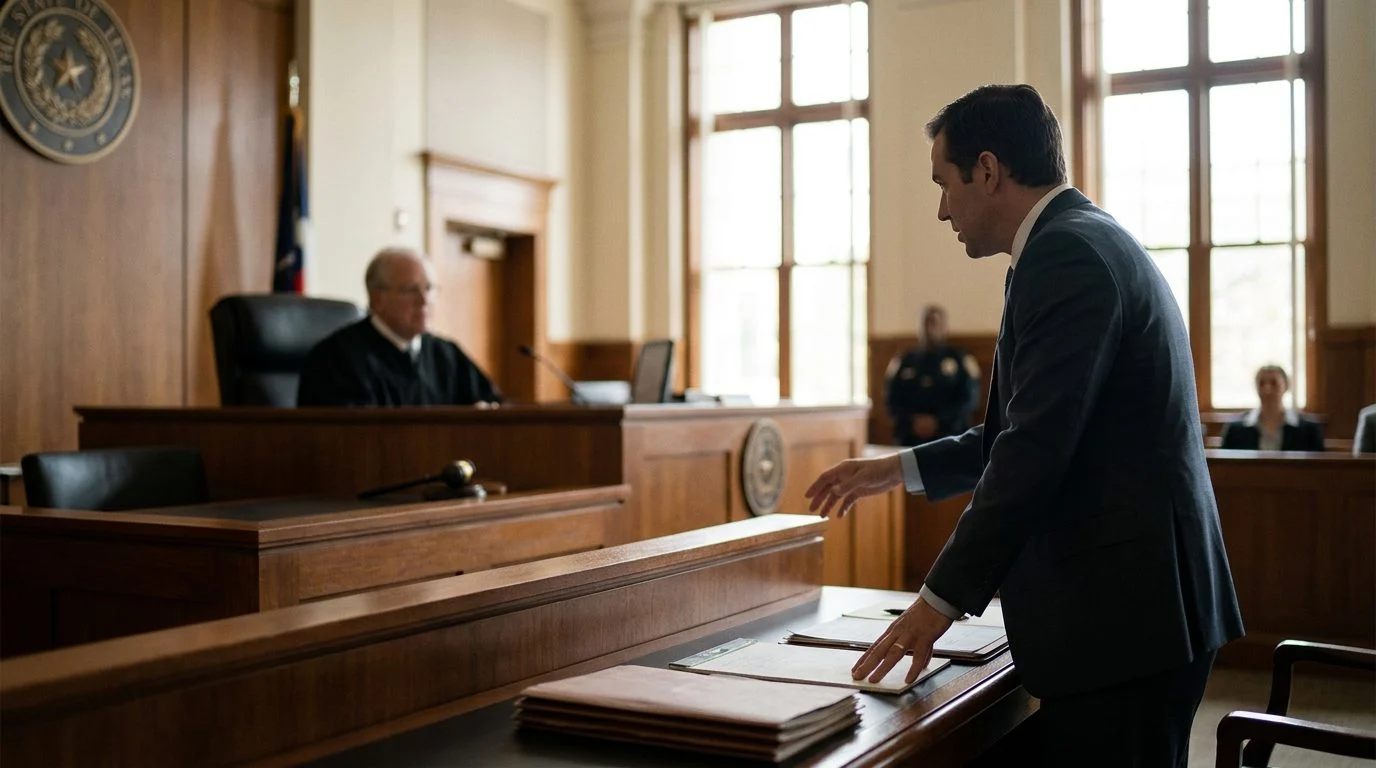
A Judge Usually Cannot Drop a Charge Just Because Someone Asks
Dismissal is a court step that usually follows a prosecutor’s decision or a ruling on a motion.
The case belongs to the State.
A defense lawyer can’t drop a case alone, either. A lawyer can request a dismissal, negotiate with the prosecutor, and file motions that ask the judge to act. Each path runs through the prosecutor or the court.
Timing matters too. Asking early, before anyone has reviewed the file, can leave out key facts. Gather the paperwork first, and then decide what to say and when.
If someone you care about is facing a charge, you don't have to sort out the court process alone. Send us your case details and we'll talk through your options. Talk it through with our team — the first consultation is free, confidential, and carries no obligation.
Can the Judge Dismiss the Case on Their Own or on Request?
A judge can dismiss a case in some situations, but only through the court’s legal process, not as a favor. The judge runs the courtroom, decides legal questions, and rules on motions. Judges don’t usually step in to end a case the State is prosecuting on their own.
Texas law gives judges dismissal paths tied to deferred adjudication. If a person finishes the deferred period and the judge has not moved to an adjudication of guilt, the judge must dismiss the case and discharge the person (Art. 42A.111). A judge may also dismiss early if the judge believes it serves society and the defendant, except that the judge may not dismiss early a defendant charged with an offense requiring the defendant to register as a sex offender under Chapter 62 (Art. 42A.111).
There is a firm limit. The judge may not dismiss early a defendant charged with an offense that requires registration as a sex offender under Chapter 62 (Art. 42A.111). That limit applies to many online and child-related charges. Check it early, with the charging papers in hand.
Can the Complaining Witness or Victim Ask to Drop the Charges?
The prosecutor may consider the request. It is one factor, not the final word, because the State files and carries the case.
People change their minds for many reasons. They may feel pressure from family, fear the court process, want the matter over, or worry about safety or money. Whatever the reason, a wish to stop a case is not the same as a legal end to it.
Witness cooperation still matters in practice. If a complaining witness won’t testify, the prosecutor may weigh whether the case can be proven without that testimony. The prosecutor also weighs how available other witnesses and evidence are.
Protective orders add a separate layer. A Texas protective order is issued by a judge. It may impose no-contact or other limits, including in sexual-assault cases, according to Travis County’s protective order guidance.
How Do Prosecutors Decide Whether to Dismiss a Case?
This is called prosecutorial discretion (the prosecutor’s power to choose how to use the case). Several common reasons can lead to a dismissal or a decision not to proceed:
- Weak or missing evidence.
- A witness who is reluctant or unavailable.
- Exculpatory evidence (evidence that helps the accused) that comes to light.
- Problems with how the evidence was gathered.
General signs that a case may be weak include missing physical or digital evidence, accounts that don’t match, and unclear proof of a key part of the charge. These are examples only. They don’t predict how any single case will end.
Some online cases begin with a task force investigation. The Texas Attorney General’s ICAC page says the Southern Texas ICAC Task Force covers 134 Texas counties and investigates online child exploitation, including sexual solicitation. The OJJDP’s ICAC program page describes how federal law applies alongside Texas law. Evidence questions in these cases depend on the facts, and our page on solicitation proof issues covers them in more detail.
Which Motions Can Lead to Dismissal?
A defense lawyer can file motions that ask the judge to limit or end the case. A motion is a written request that asks the judge to make a ruling. Two common motions matter here.
The defense often files it when evidence may have been gathered in a way that broke the rules. If key evidence is excluded, the State may have a harder time proving the charge. That can lead to a dismissal, but it doesn’t always.
A motion to dismiss asks the judge to end the case for a legal reason, such as a defect in the charging papers. The judge decides it based on the facts and the law.
Results vary. Each case turns on its own record, and a motion can be denied. The lawyer’s job is to judge how strong a motion is and explain the options.
Dismissal, Plea Bargain, and Acquittal: What’s the Difference?
Dismissal ends the charge without a verdict. A plea bargain resolves the case by agreement. These three outcomes are often mixed up, and they have different effects.
A dismissal ends the charge. In a deferred case, it happens after the supervision period ends and the judge has not adjudicated guilt, as explained above.
A plea bargain involves an agreement with the State, and that agreement can carry conditions. For charges under Penal Code Sections 21.11, 22.011, or 22.021, or a felony described by Article 42A.453(b), the judge must also find in open court that deferred adjudication is in the best interest of the victim (Art. 42A.102(a)). For charges under Penal Code Sections 21.11, 22.011, or 22.021, or a felony described by Article 42A.453(b), the judge must also find in open court that deferred adjudication is in the best interest of the victim (Art. 42A.102(a)).
A dismissal can also lead to expunction in some cases, such as when the indictment was dismissed because of mistake or absence of probable cause (Art. 55A.053).
No one can drop a case alone. A defense lawyer reviews the evidence, talks with the prosecutor, and files motions.
Not sure what your next step is?
Talk it through with our team — the first consultation is free, confidential, and carries no obligation.
What Should You Gather If You’re Researching a Case for Someone Else?
Gather the official papers first: charging papers, bond conditions, court dates, and any letters from the court. Accurate facts help any lawyer give useful advice. Collect these items before you discuss the case:
- Charging papers and any notices from the court.
- Bond conditions and any protective order.
- Court dates and the name of the court.
- Any letters or records about supervision or deferred terms.
Keep the details exactly as written. Don’t rebuild them from memory.
Two cautions matter. First, avoid discussing the allegations on social media or with the complaining witness. Statements can later be used in court. Second, watch for contact limits. A protective order may restrict contact even when both people want to talk.
The person facing the charge makes the decisions in the case. Your role can be to gather information and help that person decide what to do next. Advice depends on the facts of that person’s own case, not on general rules alone.
Key Takeaways
- A judge generally does not drop charges on request. The prosecutor usually controls dismissal, and the judge rules on motions.
- A complaining witness’s wish to stop a case is a factor, not a final decision.
- Dismissal, plea bargaining, and acquittal are different outcomes with different consequences.
Can a victim drop charges in Texas?
A victim’s request does not end the case by itself. The prosecutor decides how to proceed, and the court handles the case from there.
Can a judge dismiss a sex offense case early in Texas?
Not when the charge requires registration as a sex offender under Chapter 62. The judge may not dismiss early in that situation.
Is dismissal the same as acquittal?
No. Dismissal ends the charge without a verdict.
If someone you care about is facing one of these charges, you don’t have to sort out the court process alone. Send us your case details or call (972) 424-1902 for a free, confidential initial consultation, with no obligation to continue.
Attorney responsible for this site: Heather Barbieri, Barbieri Law Firm, Frisco, Texas.
Why Clients Call Barbieri Law Firm
Defense Focused on Your Side
We defend people accused of sex crimes, aggravated sexual assault, online sex crimes, aggravated assault, family violence and theft matters for students and non-citizens.
An All-Women Firm
Led by Heather Barbieri, our team handles every case with discretion and careful attention to your personal and professional life.
Serving Collin County and Beyond
From our Frisco office we represent clients in Collin County, Dallas-Fort Worth and across Texas.
A Clear Review of Your Case
We review the evidence, the charging documents and the complainant's statements, then explain your options in plain language.
Do Not Assume the Case Is Over
Do not contact the complainant, do not post about the matter, and do not miss a court date. Speak with a lawyer before you respond to anyone about the charge.
What to Bring to Your Consultation
The Charge and Paperwork
Bring any complaint, bond papers, citations or court notices you have received, including the cause number and the court dates listed.
Your Account of Events
Write down what happened while it is fresh, but do not share it with the complainant or on social media. We will review it with you in confidence.
Evidence and Witnesses
Tell us about texts, messages, photos, video, phone records and people who saw what happened. We will explain how each item may matter.
Your Questions
Ask how the case could proceed, what the next steps are and what your options look like. We will explain them clearly and honestly.
Talk With Our Team About Your Charge. Your First Consultation Is Free, Confidential and Carries No Obligation.
Related practice areas
Request a Consultation
Fill out the short form and we will take it from there.