

Criminal Defense | Frisco, Texas
Assault Charges Filed Days Later? Understand Your Options in Texas
A complaint can surface well after an incident, and a case can still move forward. Here is how a Frisco defense team reviews what the state has and what it may not.
By Heather Barbieri · Published November 10, 2026
Can you file assault charges days later? Yes, in many cases. In Texas, an assault charge can be filed days, weeks or even years after an incident, as long as the time limit for that offense has not run out. This guide explains how those limits work for assault, aggravated assault and family violence, and how a delay can affect evidence, bond conditions and protective orders.
Yes, assault charges can be filed days after an incident
Yes, a charge can be filed days after an incident if the legal deadline for that offense is still open. Under CCP Art. 12.04, the day the offense was committed is excluded from the computation of time. If an incident happened on a Friday and was reported the next Tuesday, Friday is excluded under Art. 12.04, so counting begins on Saturday. Texas Penal Code § 12.04 classifies felonies into five categories by the relative seriousness of the offense; it does not say how time is counted. The offense and its class decide how much time the State has. A simple misdemeanor assault and an aggravated assault do not share the same deadline. That is why the first step in any timing question is naming the exact offense.
If an assault complaint about something that happened days or weeks ago has reached you, we can talk through the timing and your options with you. Talk it through with our team — the first consultation is free, confidential, and carries no obligation.

How Texas sets the deadline: limitations periods explained
For most misdemeanors, the State has two years to present a charge. For most felonies, the general period is three years. These are starting points, because the law sets different periods for certain assault offenses. For Class A and Class B misdemeanors, the two-year rule applies under article 12.02. An assault against a family or household member that is a misdemeanor may be presented within three years under the same article. Article 12.01 sets the limitations periods for felonies: three years from the date of the commission of the offense for all other felonies under subdivision (11), with shorter or longer periods for specific offenses listed in the article. The five-year period for aggravated assault under Section 22.02, Penal Code, is set by Code of Criminal Procedure Art. 12.01(4)(I). For a felony indictment for assault under Section 22.01, Penal Code, against a family or household member as described in the Family Code, Code of Criminal Procedure Art. 12.01(4)(G) sets a five-year period from the date of the commission of the offense. Time while the accused is absent from the state does not count. Time while an indictment, information or complaint is pending also does not count (article 12.05).
Reporting, investigation and the filing decision
A report to police usually starts an investigation. An investigation can take days, weeks or longer. The timing of the report does not decide whether charges are filed. Many people believe the person who was hurt can simply drop charges. Charges may follow an arrest. They may also come later, after investigators finish their work. Either way, the timeline still runs from the offense date.
Family violence and assault charges after a delay
Family violence cases often surface after a delay, because a report may follow a separation, a dispute or a court date. Texas defines family violence as an act by a member of a family or household against another member of the family or household that is intended to result in physical harm, bodily injury, assault or sexual assault, and also includes certain abuse of a child in the household and dating violence. It also covers a threat that reasonably places someone in fear of imminent harm. Defensive measures to protect oneself are excluded (Texas Family Code § 71.004). A delayed report can lead to bond conditions or a protective order. These conditions are separate from the criminal case. Violating a bond condition or protective order is its own offense (Texas Penal Code § 25.07). When the violation involves committing an assault or stalking, it can be a third-degree felony. Reconciliation between the people involved does not cancel the order. A delay alone does not show that a case is weak or will go away.
How the passage of time affects the evidence
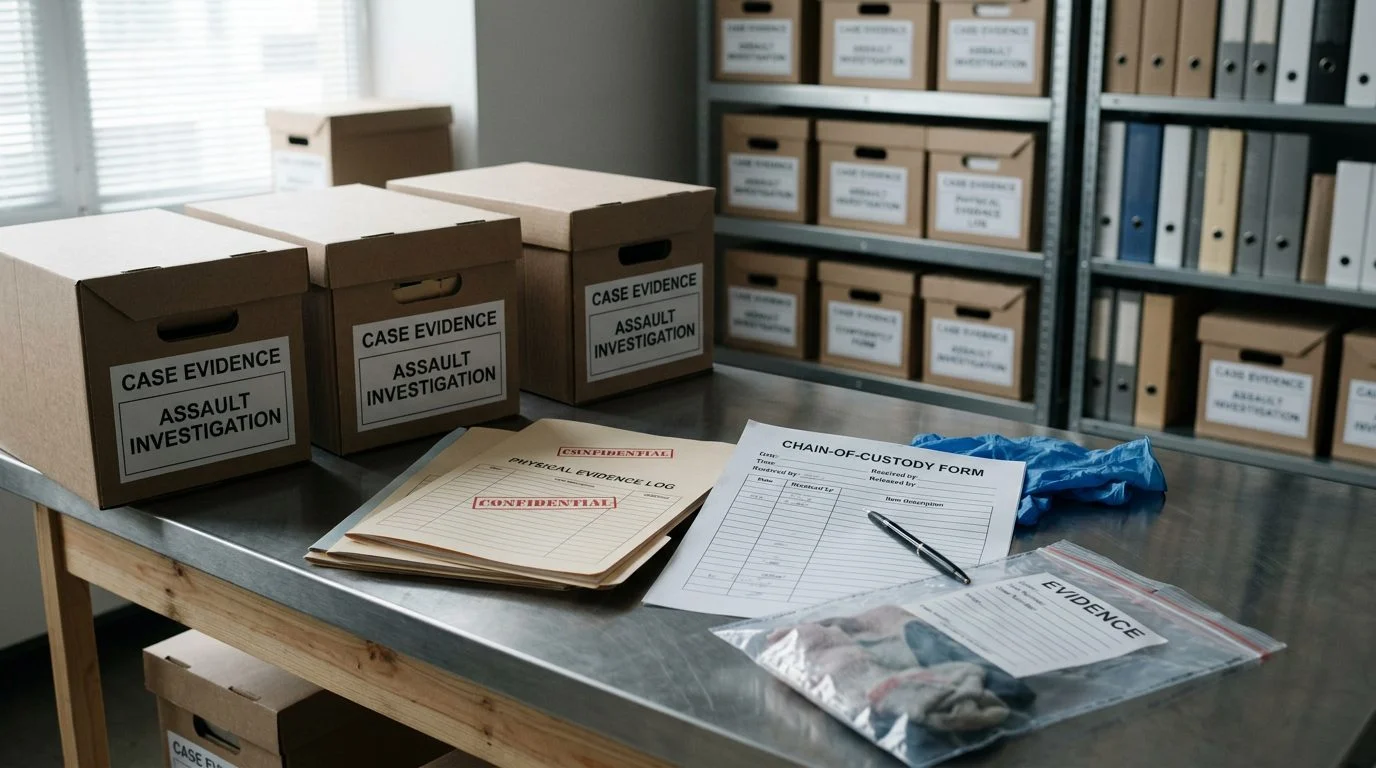
Time can change the evidence in both directions. Witnesses may recall events differently, and some records are kept for only limited periods. Useful evidence often includes text messages, call logs, photos, social media posts, medical records, video and statements from people who were present. Court records are kept by the clerk. A review usually starts with the timeline, the police reports and the evidence the State has shared. That early review helps show what exists and what may be missing.
If you learn a complaint has been made against your loved one
If you learn a complaint has been made, avoid contact with the complainant and keep every record you already have. Do not contact the complainant, their family or witnesses to explain or apologize. A bond or protective order may ban contact outright, and a violation can create a new charge (Texas Penal Code § 25.07). Keep messages, calendars, photos and receipts, and do not delete or edit anything. Write down what you remember of the timeline while your memory is fresh, and keep your notes private. Avoid posting about the allegation online. Be careful about what you tell coworkers or family, since they may be asked about it later. Read every page your loved one receives, including bond papers, summons and protective order papers. Note the court and the dates listed.
Not sure what your next step is?
Talk it through with our team — the first consultation is free, confidential, and carries no obligation.
Common questions about assault charges after a delay
Can you file assault charges days later?
Yes, if the time limit for that offense has not run out. The offense and its class set the deadline.
Can you go to jail for assault if they don’t press charges?
A complainant’s wishes matter, but a criminal case does not automatically end because the complainant changes their mind.
How long after an incident can you be charged?
It depends on the offense. Most misdemeanors have a two-year period and most felonies have three years, with longer periods for some assaults, including aggravated assault.
Is it worth pressing charges for assault?
That is a personal choice for the person who was hurt. A lawyer can explain how the process works for both sides.

Talk with a Texas criminal defense lawyer about your situation
If an allegation about an incident from days or weeks ago has reached your loved one, you don’t have to sort out the timing alone. Heather Barbieri and the firm’s lawyers at Barbieri Law Firm review the offense, the time limit that applies, the reports, any bond conditions and the evidence the State has shared. Then they explain your options in plain terms. The firm defends people accused of assault, aggravated assault, family violence and sex crimes across Collin County, Dallas-Fort Worth and Texas. Your first consultation is free, confidential and carries no obligation to continue. You can call (972) 424-1902 or send your case details through the contact form. You can also read more about family violence defense in Texas and aggravated assault defense in Texas.
Heather Jean Barbieri, Board Certified, Criminal Law — Texas Board of Legal Specialization
Attorney responsible for this site: Heather Barbieri, Barbieri Law Firm, Frisco, Texas.
Why people choose Barbieri Law Firm
An all-women criminal defense firm
Heather Barbieri leads a team that defends people accused of assaultive offenses and sex crimes in Collin County, Dallas-Fort Worth and across Texas.
Defense of assault and family violence charges
We handle aggravated assault, family violence and related assaultive offense cases, including matters that arise after a complaint is made later.
A careful review of the evidence
We look at the charging papers, statements, messages, photos, medical records and any other evidence, then explain what it means for your case.
Confidential, no-obligation first step
Your first consultation is free, confidential and carries no obligation to continue.
Important
Reading about Texas law is not the same as advice about your own case.
What we review in a late-filed assault case
The charge itself
We identify the exact offense, how it is classified, and what the state must prove.
The timeline
We reconstruct when the incident happened, when it was reported and what happened in between.
Statements and messages
We review written statements, texts, social media posts and recorded calls for consistency and context.
Your options
We explain the possible paths forward and what each would involve, so you can decide with full information.
Talk with Barbieri Law Firm about the charge you face
Related practice areas
- Online Sex Crimes Defense Lawyer
- Online Sex Crimes Defense Lawyer for Professionals Charged in Collin County
- Online Sex Crime Charge Defense Plan
- Felony Online Sex Crime Defense
Request a Consultation
Fill out the short form and we will take it from there.