

Child sex crimes defense | Collin County and Dallas-Fort Worth
Your Phone Was Seized Under a Warrant. What Happens to the Data Now?
A phone or cloud account can hold years of messages, photos and location history. Here is how that data is usually obtained, and what a defense lawyer reviews first.
By Heather Barbieri · Published November 22, 2026
If police took your phone or computer in a child sex crime investigation, you probably want to know what they can search and what they can keep. In short, police generally need a warrant signed by a judge before they search the data on a device, and that warrant sets the limits. This page walks through how those limits work and what a defense reviews.
Each step below is a question to review with a lawyer, not a prediction of how your situation will turn out. For the wider picture, read our online sex crimes defense guide.
What a Search Warrant for Your Phone or Computer Authorizes
A search warrant lets officers search only the device and data a judge approved, based on sworn facts. Texas law starts from a clear rule.
The U.S. Supreme Court reached a similar result in Riley v. California. It held that police generally need a warrant before searching the digital information on a cell phone, even one seized during an arrest. The Court also said phone data is not immune from search. A warrant is the usual path.
The Fourth Amendment sets the baseline. A warrant requires probable cause, supported by oath or affirmation, and must describe the place to be searched and the things to be seized.
Before a judge signs, a sworn affidavit must set out substantial facts establishing probable cause. Except as otherwise provided by the code, the Art. 18.01 affidavit becomes public information once the warrant is executed. For a device, the affidavit should connect that phone or computer to the conduct alleged. If it does not, that gap is worth reviewing.
If police took your phone or computer under a warrant tied to a child or online accusation, our team can review those papers with you in a free, confidential first consultation. Talk it through with our team — the first consultation is free, confidential, and carries no obligation.

Why the Warrant’s Scope Limits Matter
A warrant limits officers to the items it describes, so any search past that description is a key point to review. Texas law says that, for an evidence warrant, only the specifically described property or items may be seized, along with certain other property, items or contraband the code lists separately.
Scope is where device searches often get tested. A warrant can name a phone but say little about dates, file types or accounts. A broad description can leave officers room to look at far more than the offense requires. Compare what the warrant names with what was actually opened.
Art. 38.23 The Supreme Court has also treated digital records with care. In Carpenter v. United States, it held that the government generally needs a warrant for a person’s historical cell-site location records. It called that decision narrow.
How Your Device Is Seized and Copied
Texas law requires the inventory to be endorsed with the officer’s name and a copy given to the owner or the person in possession. Art. 18.06 If no one is present, the officer leaves a copy of the warrant and the inventory at the place.
The officer must return the executed warrant to the magistrate within three whole days. Art. 18.10 The statute also says a late return or a missing inventory does not, by itself, bar the evidence.
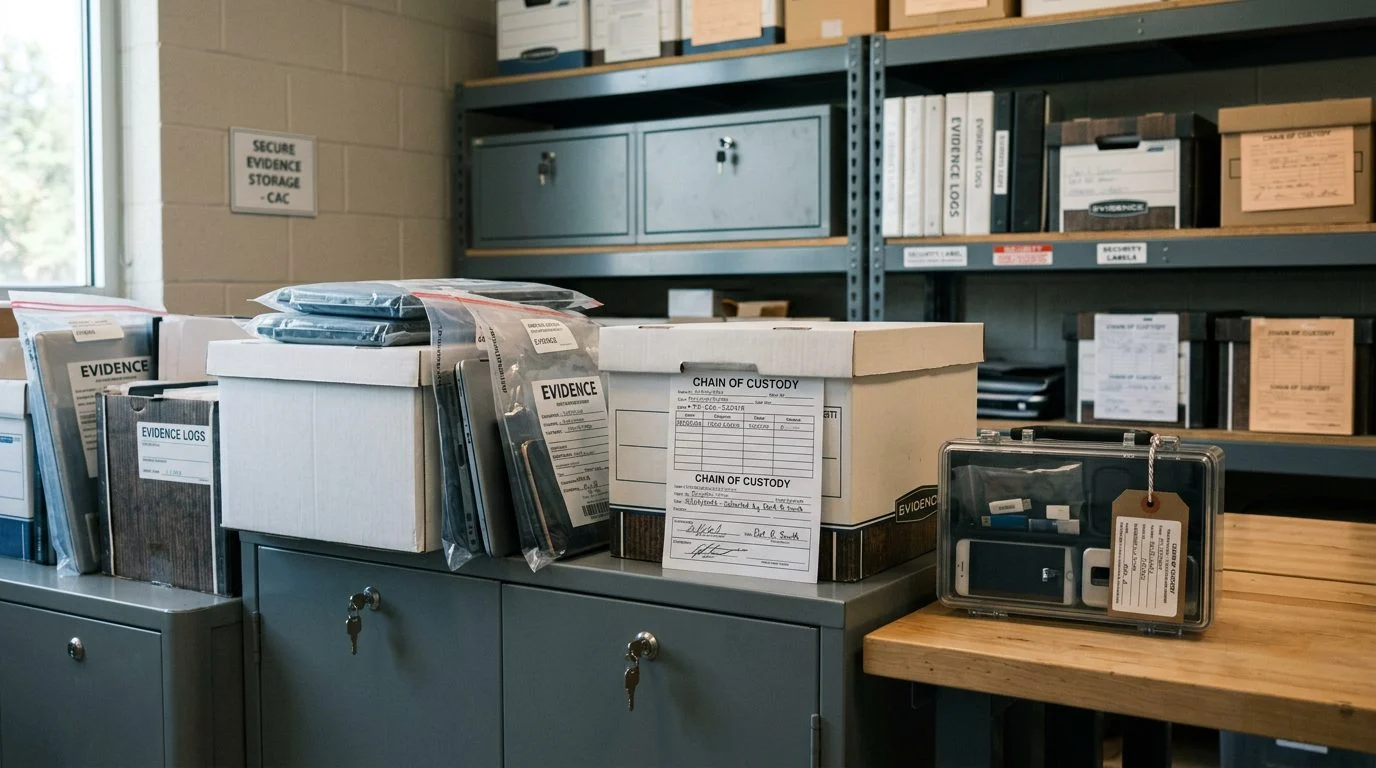
If officers seize a device before the warrant period ends, they may analyze its data later. Art. 18.07 That is why the date of seizure matters. Chain of custody is the written record of who held the device, when and where. A defense asks whether the copy matches the original.
Reading the Affidavit Behind the Warrant
The affidavit is the sworn account that justifies the warrant, so its facts are the first thing to test. For evidence, the affidavit must show a specific offense, that the items are evidence of it, and that the items are located at the place to be searched. Art. 18.01
When you review an affidavit, compare each fact with the records it cites. Ask where the information came from. Ask whether it describes your device or only the accusation. Ask whether it relies on a tip, a report or an earlier search.
Some investigations reach across counties. A tip can travel through a task force before it reaches a local warrant.
What an Extraction Report Shows and How It Is Reviewed
An extraction report is the State’s summary of what was pulled from a device, and it is only a summary. A report usually lists the software and version used, the items extracted, recovered deleted files, keyword hits and account data.
A reviewer compares each category with the warrant’s scope. Does any item fall outside the date range, file type or account the warrant named? The tool and its settings matter, because the version used can affect what the report shows.
A summary can leave out what the full data holds. That is why a defense often asks for the full forensic image and the tool logs. On a timely request, the state must produce offense reports and tangible items material to the case, subject to the restrictions of Section 264.408, Family Code, and Article 39.15 of this code. Art. 39.14
Covered child-sexual-conduct material follows a narrower path, as the statute defines it. Under Art. 39.15, material is reasonably available to the defendant if, at a facility under the control of the state, the state provides ample opportunity for the inspection, viewing, and examination of it by the defendant, the defendant’s attorney, and any individual the defendant seeks to qualify to give testimony at trial based on specialized knowledge. Art. 39.15
How Timestamps and Metadata Are Tested
Timestamps show when a file was created or changed, but the device clock, time-zone settings and syncing can all shift what they show. Metadata is the data about a file. It includes created dates, last-modified dates and last-opened times.
Several things can make those dates misleading. A device clock can be wrong. A time-zone setting can move a timestamp by hours. Cloud syncing can copy a file onto a second device, so the date on that copy may not show who made it or when.
Shared devices add another layer. More than one person may use the same phone, computer or login. Login records and account activity can show which user was signed in, but only when they are read closely.
Whether any timestamp matters depends on the facts of your device and the accusation. A reviewer checks metadata against other records, such as messages and account history. No lawyer can tell you in advance what those times will prove.
Not sure what your next step is?
Talk it through with our team — the first consultation is free, confidential, and carries no obligation.
Options to Raise About the Phone or Computer Evidence
The main option is a motion to suppress, which asks the court to keep out evidence obtained through an unlawful search. Texas law bars evidence obtained in violation of state or federal law, unless the officer acted in objective good faith reliance upon a warrant issued by a neutral magistrate based on probable cause. Art. 38.23
Texas also has a good-faith exception. Evidence can still come in if an officer relied in objective good faith on a warrant issued by a neutral magistrate based on probable cause. Art. 38.23(b) So the questions are often whether the warrant itself was sound and whether officers stayed inside it.
Practical steps help from the start. Keep the warrant copy and the inventory you were given. Do not consent to a search without talking to a lawyer first, because a warrantless search is allowed when the owner or possessor consents. Art. 18.0215 Do not delete, reset or change any account or device. Do not discuss what the devices contain with investigators or anyone else before you speak with counsel.
For more on this challenge, read challenging an online sex crime search warrant. No lawyer can say in advance how a judge will rule on a warrant challenge.

Bring Your Warrant Papers and Talk With Barbieri Law Firm
The warrant, the inventory and the affidavit are the first papers to review with a lawyer after police take your device. Those papers show what a judge allowed, what was taken and what the officer swore to.
If police took your phone or computer under a warrant tied to a child or online solicitation accusation, gather those papers and keep them safe. Write down when you received each one.
Barbieri Law Firm is an all-women criminal defense firm in Frisco, Texas. It defends people accused of sex crimes and assaultive offenses across Collin County, Dallas-Fort Worth and Texas. The first consultation is free, confidential and carries no obligation to continue.
Call (972) 424-1902 or send your case details through the contact form.
Quick Answers
Can police search my phone without a warrant in Texas?
Generally, no. Texas law bars a phone search after a lawful arrest without a warrant, but limited exceptions exist, such as the owner’s consent.
Can I get a copy of the data police took from my computer?
Not always. For covered child-sexual-conduct material, a court must deny copies when the state makes the material reasonably available for inspection.
Can evidence from a phone search be thrown out in Texas?
Texas law bars evidence obtained in violation of state or federal law, but a good-faith exception applies in some cases.
Attorney responsible for this site: Heather Barbieri, Barbieri Law Firm, Frisco, Texas.
What Barbieri Law Firm reviews in phone data cases
The warrant and its affidavit
We read what the warrant authorizes, which devices and accounts it names, and what the officer swore to in support of it.
How the data was collected
We look at whether the device was searched within the warrant's scope and how the extraction tool copied, stored and labeled the information.
Copies, access and protective orders
We examine what copies the defense has, how the evidence is being handled, and what protections apply to sensitive material.
Your options, explained plainly
We walk you through the evidence and your options in terms you can act on, so you understand each step before deciding.
Before you talk about the case
Statements you make to police, family, friends or online can become evidence. Consider speaking with a lawyer before you answer questions about your devices or accounts.
Common questions about phone data in these cases
Does a warrant cover my whole phone?
Warrants usually describe specific devices, accounts and categories of information. We compare the warrant's wording with what was actually searched.
What about cloud accounts?
Messages, photos and backups may be stored online rather than on the phone itself. We review whether the warrant reaches those accounts and how they were accessed.
Can I get a copy of the data?
Access to copies of seized material in child-related cases is governed by specific statutes and court orders. We review what has been provided and what remains in dispute.
Who reviews the evidence?
Our team reviews the extraction reports, timelines and metadata so that questions about accuracy, context and chain of custody are raised early.
Talk with Barbieri Law Firm about your phone data and your case. The first consultation is free, confidential and comes with no obligation to continue.
Related practice areas
Request a Consultation
Fill out the short form and we will take it from there.