

Accused over explicit pictures sent to a minor? Talk with a Texas defense lawyer first.
Heather Barbieri defends people charged in connection with sexually explicit images and online messages across Collin County, Dallas-Fort Worth and Texas. We will review the evidence and explain your options.
About Barbieri Law Firm
Frisco, Texas
Criminal defense firm serving Collin County, Dallas-Fort Worth and Texas
All-women
Criminal defense firm led by Heather Barbieri
Free
Confidential first consultation, with no obligation to continue
By Heather Barbieri · Published October 18, 2026
Charged with sending explicit pictures to a minor in Texas? The charge may fall under more than one law. This page explains both laws, who gets charged, what the State must prove, and what the first steps look like.
What Texas Law Treats as Sending Sexual Material to a Minor
Texas covers this conduct in two main ways. One is a general offense for sending sexual images without consent. The other targets people who reach out to minors online with sexual material.
The general electronic transmission offense
Under Texas Penal Code § 21.19, a person commits an offense by knowingly sending visual material by electronic means. The material must show sexual conduct or exposed intimate parts. The offense applies when the recipient did not request the material or give express consent. It is a Class C misdemeanor.
The online offense aimed at minors
Sending sexually explicit material to a minor is addressed in Texas Penal Code § 33.021, Online Solicitation of a Minor. The sender must act with intent to commit a listed offense. The statute uses the phrase “over the Internet, by electronic mail or text message,” as well as commercial online services.
A minor, under this section, is someone younger than 17. It also includes someone the sender believes is younger than 17. The base offense is a third-degree felony. It becomes a second-degree felony if the minor is younger than 14.
A separate offense for soliciting a minor to meet for sexual contact is also found in Texas Penal Code § 33.021. That is a different charge. You can read about it on our online sex crimes defense page.
Where the evidence usually lives
Texts, images, videos, apps, and social media accounts often hold the key evidence. Many of these cases start with a report or an online investigation. Federal and state task forces handle many technology-facilitated cases. The Internet Crimes Against Children Task Force Program describes that work. Evidence can come from several agencies, so the file may be larger than a single phone.
If police have asked about messages on your phone, you don't have to sort it out alone; our team can set up a free, confidential consultation with Heather Jean Barbieri. Talk it through with our team — the first consultation is free, confidential, and carries no obligation.
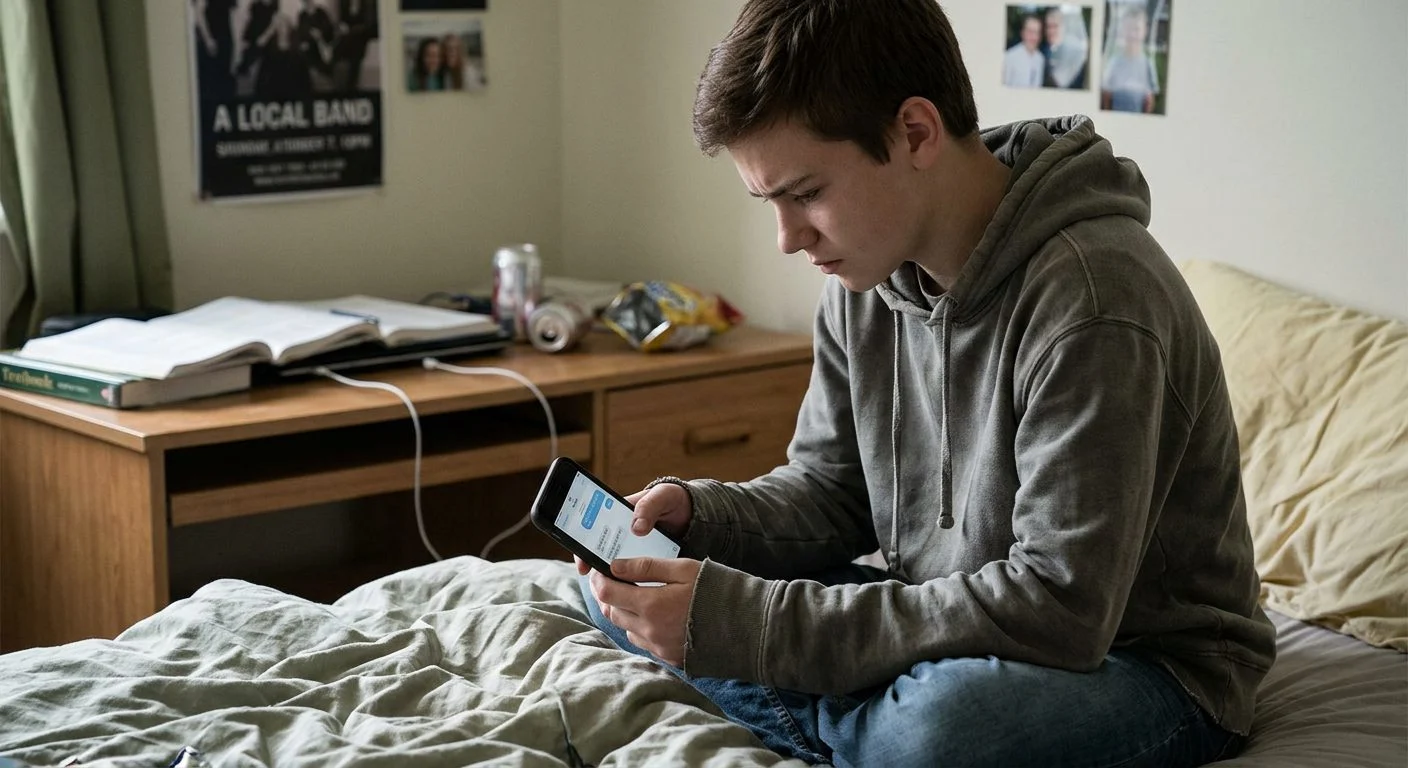
Minors Can Be Charged Too
Whether a teen faces a criminal charge in Texas depends on the facts of each case. Section 21.19 says “a person” commits the offense. It does not limit the offense to adults, so age alone does not take a teen outside the statute.
Texas Penal Code § 21.16 covers disclosing or promoting intimate visual material of another person without that person’s consent, under the conditions the statute sets; a teen sending an image of themselves falls under other provisions, such as Texas Penal Code § 43.261. That point often surprises young people.
Indecent exposure is another offense that can come up. Under Texas Penal Code § 21.08, indecent exposure is a Class B misdemeanor. It requires intent to arouse or gratify sexual desire, and recklessness about whether someone is present who will be offended or alarmed. The penalty rises after prior convictions under that section.
A case involving a minor can move through a different process than an adult case. The family should ask early what that means for court dates, records, and school. A juvenile charge can still affect school and records. Barbieri Law Firm’s practice is criminal defense. During a consultation, the lawyer will explain what the firm can handle in a juvenile matter.
What the State Must Prove in These Cases
Prosecutors usually build their case around four parts.
- Age. For § 33.021, the minor’s age, or what the sender believed it to be, matters.
- Transmission. For § 21.19, the State must show that the material was sent by electronic means.
- Consent. For § 21.19, the recipient’s request or express consent is a central fact.
- Sexual nature. Texas Penal Code § 21.16 defines “visual material” and “sexual conduct” for its own offense, unlawful disclosure or promotion of intimate visual material (Texas Penal Code § 21.16).
Prosecutors often rely on phone and account records, forensic copies of devices, screenshots, cloud backups, and witness statements. A screenshot may show only part of a conversation. Intent, what the sender believed about age, what was actually sent, and who sent it are often disputed. These facts get close review.
Other image laws can apply too. Possessing or accessing images of a child in sexual conduct falls under Texas Penal Code § 43.26. The grade depends on factors the statute lists, such as the number of images and prior convictions. AI-made or altered images can lead to charges under Texas Penal Code § 21.165. A disclaimer or label saying the image is not real is not a defense under that section.
How a Defense Review Looks at the Evidence
A defense review starts with the full conversation, the devices, the accounts, and what was said to police. Each piece can change how the facts read. Context matters more than a single message.
- The full message history, in order, not only the parts police highlighted.
- Who could access the phone, the account, or shared cloud storage.
- How each image was created, stored, forwarded, or deleted.
- Whether police obtained devices and accounts in a lawful way, since search questions can arise.
- What the person said to police, and when they said it.
A common mistake is deleting messages or apps after learning of an investigation. That step can make the evidence harder to explain later.
In some cases, the court may grant deferred adjudication, which requires the defendant to plead guilty or no contest and then complete community supervision. A dismissal at the end of that supervision is not treated as a conviction, but for a Chapter 62 reportable offense, such as Penal Code § 33.021, sex-offender registration can still be required. Under Texas Code of Criminal Procedure art. 42A.111, a judge may dismiss and discharge a defendant early in some cases. The judge may not do that early for a defendant charged with an offense that requires registration under Chapter 62. The dismissal is generally not treated as a conviction, with an exception the article names. Whether any of these paths is open depends on the specific charge.
Possible defenses depend on the facts, the evidence, and the charge. The lawyer walks through the options after reviewing the evidence.
What to Expect: Steps and Timeline
The process moves from a first meeting to a records review, then to options and court settings. The timeline depends on the court’s schedule and how the case develops.
- First consultation. You explain what happened and what police have said. The meeting is confidential and has no obligation to continue.
- Records review. The lawyer reviews the charge, bond conditions, device and account evidence, and any no-contact or protective order terms.
- Explaining options. The lawyer covers court dates, possible talks with the prosecutor, pretrial steps, and the possibility of trial. You make decisions after you hear the advice.
- Court settings. The lawyer represents you at each court setting as the case moves forward.
Before you talk with police, victims, or others about the case, it can help to talk with a lawyer first. That gives you time to understand what the evidence shows and what your choices are.
Why Barbieri Law Firm
Barbieri Law Firm is an all-women criminal defense firm in Frisco, Texas. The firm defends people accused of sex crimes and assaultive offenses across Collin County, Dallas-Fort Worth, and Texas.
Heather Barbieri is the lawyer at the firm. Her credential statement is: Heather Jean Barbieri, Board Certified, Criminal Law — Texas Board of Legal Specialization. Our team of assistants and office staff supports the practice.
The first consultation is free, confidential, and carries no obligation to continue.
Not sure what your next step is?
Talk it through with our team — the first consultation is free, confidential, and carries no obligation.

Common Questions About Sexting Charges in Texas
Is sending explicit images an offense in Texas?
Can a minor be charged for sexting?
Section 21.19 applies to “a person,” so a teen can face a charge under it.
Will a lawyer get the charge dismissed?
No lawyer can say in advance how a case will end. A review looks at the evidence and the options, then explains them to you.
Can I speak to police without a lawyer?
Talking with a lawyer first can help you understand your choices before you answer questions.
Does a charge always mean a conviction?
If police have asked about messages on your phone, you don’t have to work through it alone. Call (972) 424-1902 or send your case details through the contact form to set up a consultation.
Attorney responsible for this site: Heather Jean Barbieri, Barbieri Law Firm, Frisco, Texas.
What you can expect when you call us
A calm, confidential start
Your first conversation is private. Our team listens to what happened and answers your questions without pressure.
A review of the evidence
We look at the messages, images, device records and the timeline of events to understand what the State may rely on.
An explanation of your options
Heather Barbieri will explain the possible paths forward in plain language so you can make informed decisions.
Defense focused on your future
Charges of this kind can affect work, school and family. We keep those stakes in view at every step.
Before you speak with anyone about this matter
Do not delete, edit or forward messages, images or devices connected to the allegation, and avoid discussing the details with others, including on social media. Bring what you have to your consultation so a lawyer can review it with you.
How the first consultation works
1. Tell us what happened
Share the basic facts of the allegation and any paperwork you have received. Your conversation is confidential.
2. We review the evidence
We examine the available evidence, including the messages, images and the account of how they were sent or received.
3. You decide your next step
We explain your options and what each one would involve. There is no obligation to continue with our firm.
Speak with Heather Barbieri in confidence
Request a Consultation
Fill out the short form and we will take it from there.