

Online Sex Crimes Defense | Frisco, Texas
Your Phone Holds Evidence. Know What Police Can Do With It.
A phone extraction report can shape how an online sex crime case is built, so it is worth understanding early.
By Heather Barbieri · Published November 10, 2026
Police took your phone, and now you’re waiting to learn what is on it. In a Texas online sex crime case, a cellphone extraction often sits at the center of the state’s proof.
An examiner then copies the phone’s data and reports on that copy. You can ask which basis police used and test each step.
The Day Your Phone Was Taken
Seizing a phone and searching it are two separate steps, and each one raises its own questions.
Officers may take a phone at the arrest, during a search of your home, or after an interview. Taking the device is the seizure. Opening its contents is the search. Ask for the property receipt that lists what was taken, and keep a copy.
Then ask what police plan to do with the phone and which paper, if any, they relied on. Those answers shape the rest of the case. For the full picture of charges in these cases, see online sex crimes defense.
If police have your phone and a charge is pending, you don't have to work through the warrant and the messages alone. Talk it through with our team — the first consultation is free, confidential, and carries no obligation.

Was the Seizure and Search Lawful?
Start with the warrant, if there is one. Read what it allows: which device, which dates, which kinds of data and which accounts. If the search went past those limits, your lawyer can test that point.
Consent needs a close look. Arrests and interviews are stressful, and a signed form or a spoken yes can happen in a confusing moment. Ask what was said, whether you understood it, and whether you were told you could refuse.
Timing matters too. A long gap between seizure and search, or a second search with no new authority, raises questions worth reviewing.
What a Cellphone Extraction Shows in an Online Sex Crime Case
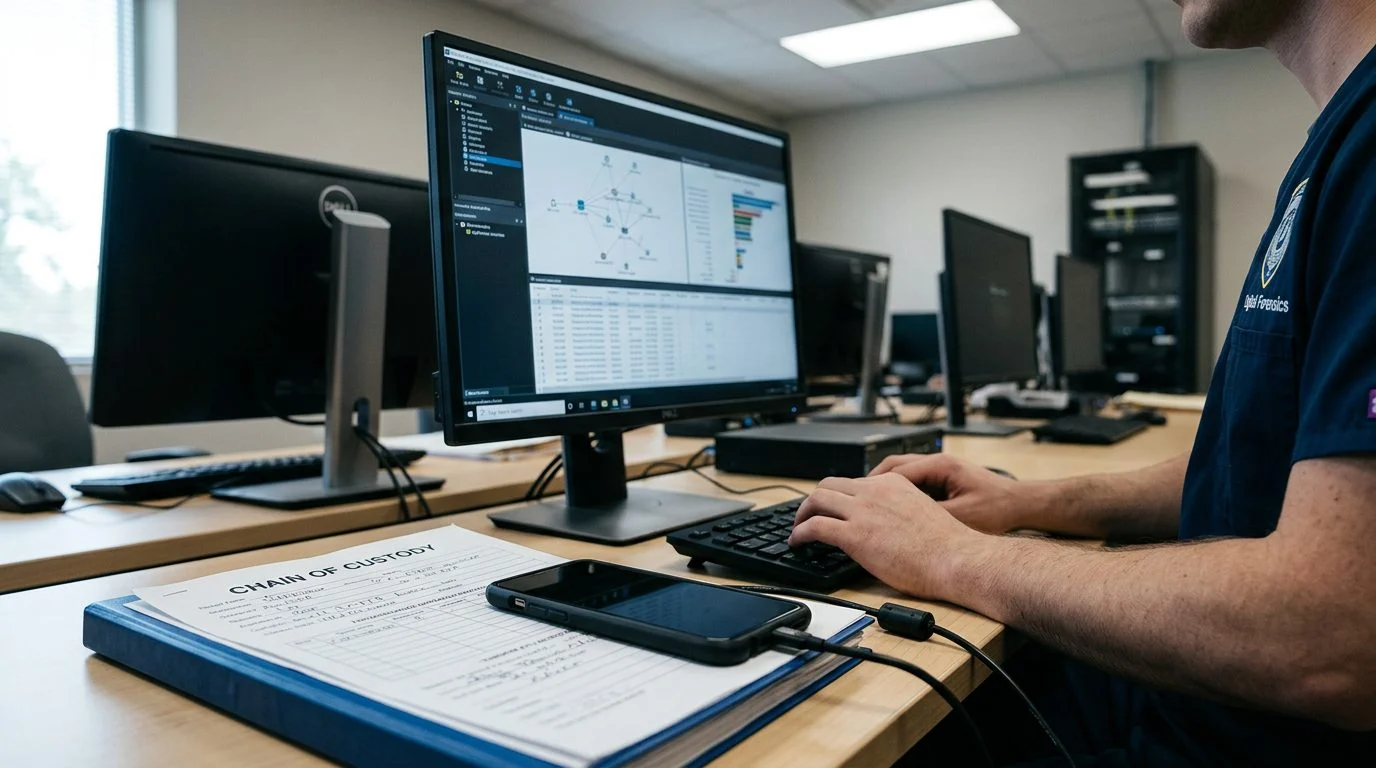
An examiner makes a copy of the phone’s data, then searches and reports on that copy.
Extraction means specialized software pulls data from the device. The examiner reviews the copy, not the phone you carry. The copy can hold more than the screen shows. Deleted messages, app data, cached images and location history can sometimes be recovered. That is why the report may look very different from what you remember.
Ask for the full extraction report, the software tool and its version, and the examiner’s notes. Each step can be checked for accuracy and completeness. Chain of custody matters too. Ask who had the phone, when it was logged, and whether it was kept powered or accessed in ways that could change the data.
What the State Will Try to Prove From Your Messages and Images
The state will try to tie the messages and images to you and to your accounts, and that link is a central question.
A chat log shows words. It does not, by itself, show who typed them. Prosecutors will look at usernames, timestamps, photos, account details and linked devices. Ask which accounts are said to be yours and what evidence supports each link.
Context matters. A short exchange can read differently with the full thread, the replies that followed and the questions never asked. Ask for the complete conversation, not only the excerpts in the papers. The National Center for Missing & Exploited Children describes online enticement and the grooming tactics often tied to it.
Sting cases raise extra questions. Under Penal Code § 33.021, a “minor” includes someone the actor believes is younger than 17. The statute also says it is not a defense to prosecution under subsection (c) that the meeting did not occur. Entrapment is different. Penal Code § 8.06 covers someone induced by a law enforcement agent using persuasion or other means likely to cause the offense. Merely giving an opportunity is not entrapment.
Passcodes, Interviews and What to Say Before You Speak
Talk with your lawyer before you give anyone a passcode or answer questions about your phone.
Do not hand over a passcode, or unlock the phone with a fingerprint or face scan, before speaking to counsel. Ask your lawyer how to respond to each request. If you can, handle the response in writing.
Statements to police, recorded jail calls and messages to family or friends can end up in the state’s file. Keep the case out of texts, social media and calls with anyone except your lawyer.
Do not delete, wipe, reset or change any device or account. Also check with your lawyer before contacting anyone connected to the case, including the people named in the charge.
How the Phone Case Affects Your Children, Custody and CPS
A phone case and a family court or CPS case can run at the same time, and what is said in one can show up in the other.
If a divorce, custody dispute or CPS case is open, phone evidence may surface there too. Ask whether any temporary order limits your contact with a child. Ask what deadlines apply in each case. Ask whether a CPS plan asks you to make statements about the allegations.
Coordinate every filing with counsel before you request parenting time, sign a safety plan or give a statement. A well-meant filing can create a new problem in the criminal case.
Not sure what your next step is?
Talk it through with our team — the first consultation is free, confidential, and carries no obligation.
Charges, Penalties and Registration in Texas
Online solicitation of a minor is covered by Penal Code § 33.021. Under subsection (c), the offense is a second-degree felony, but it can be raised to the next higher category if it is shown at trial that it happened during regular primary or secondary school hours and the actor knew or reasonably should have known the minor was enrolled in school. Under subsection (b), the grade depends on the minor’s age and other facts.
If your charging papers allege a first-degree felony, Texas Penal Code § 12.32 provides for imprisonment in the Texas Department of Criminal Justice for life, or for any term of not more than 99 years or less than 5 years. A fine of up to $10,000 can be added.
Registration depends on the reportable conviction. Code of Criminal Procedure art. 62.001 includes deferred adjudication in that definition. Article 62.101 sets when the duty to register ends. For many offenses outside its life-duty list, the duty ends on the 10th anniversary of the applicable date. Article 62.301 allows a petition for exemption in limited cases, such as a single reportable conviction with the required affirmative finding. The judge decides after a hearing.
Ask your lawyer for a written explanation of the penalty range, the registration rules and any other consequences of the exact charge.
What to Do in the First Days After Your Phone Was Seized
Write down what you remember, and collect the warrant, the property receipt and any consent form you signed.
Write your memory of the arrest or seizure while it is fresh. Share those notes only with your lawyer.
Request copies of the warrant, the inventory or property receipt, and any consent form. Bring them to your first meeting.
List every device, account and cloud service you use, including email, messaging apps and backup accounts. Your lawyer can then request the right records quickly.
Keep public statements and social media quiet about the case. A post can reach the court, the complaining person and your family.
Talk Through Your Phone Case With Barbieri Law Firm
If your phone is in police hands and a charge is pending, a first meeting can focus on the warrant, the extraction and the messages.
At that meeting, your lawyer can review the seizure, the warrant’s scope, the extraction process and your charging papers with you. You will leave knowing which questions to ask next.
The initial consultation is free, confidential and comes with no obligation to continue. Call (972) 424-1902 or send your case details through the contact page.
No lawyer can promise an outcome, including whether phone evidence will be excluded or a charge will be dismissed. A lawyer can test each step of the process and explain your options.

About the Firm and the Responsible Lawyer
Barbieri Law Firm is an all-women criminal defense firm in Frisco, Texas, and Heather Barbieri leads it.
The firm defends people accused of sex crimes and assaultive offenses across Collin County, Dallas-Fort Worth and Texas.
Heather Jean Barbieri, Board Certified, Criminal Law — Texas Board of Legal Specialization.
Frequently Asked Questions
Can police search my phone after they take it?
Ask which legal basis police used, such as a warrant or consent. Then check what that paper allows.
Do I have to give my passcode?
Talk with your lawyer before you give a passcode to anyone. Ask how to respond to the request.
What is a phone extraction report?
It is the examiner’s written account of the data pulled from the phone. It lists the tool used and the items found.
What is the penalty for online solicitation of a minor in Texas?
Under Penal Code § 33.021, an offense under subsection (c) is a felony of the second degree. An offense under subsection (b) is a felony of the third degree, or a felony of the second degree if the minor is younger than 14 years of age or the actor believes the minor is younger than 14. Under subsection (f-1), the punishment is increased to the next higher category of offense if it is shown at trial that the offense was committed during regular public or private primary or secondary school hours and the actor knew or reasonably should have known that the minor was enrolled in school. Your charging papers show the exact charge.
Does deferred adjudication mean I must register?
Under Code of Criminal Procedure art. 62.001, a deferred adjudication can count as a reportable conviction. Ask how that applies to your charge.
Attorney responsible for this site: Heather Barbieri, Barbieri Law Firm, Frisco, Texas.
How we review phone evidence in your case
We review the legal basis
We look at whether officers relied on a warrant, consent or another authority, and what that paper actually allows them to search.
We request the full report
We review the extraction report, the tools used to create it and the data it includes and leaves out.
We test what the data shows
We examine timestamps, account links and recovered files to see what the evidence does and does not establish.
We explain your options
We walk you through the evidence and the choices available to you, so you can decide how to proceed with full information.
Before you respond to a phone request
Ask which legal basis officers are relying on.
Common questions about phone extraction
Warrant or consent?
We review the document they used and whether it matches the search that was performed.
What the report includes
An extraction report can be long and technical. We review what it contains, how it was generated and what it fails to explain.
Passcodes and locked devices
Requests for passcodes or biometric unlocking raise separate questions. Speak with a lawyer before you respond to any such request.
Deleted files and cloud data
Forensic tools can recover data a user believed was gone, and phones may connect to cloud accounts. We examine whether the report reaches beyond the device.
Talk with our team about the phone evidence in your case
Related practice areas
- Online Sex Crimes Defense Lawyer
- Sex Crimes Defense Lawyer in Collin County
- Sex Crimes Defense Lawyer in Prosper
Request a Consultation
Fill out the short form and we will take it from there.