

Sex Crimes Defense | Collin County and Dallas-Fort Worth, Texas
Facing an Online Solicitation Sting in Texas? Know What Comes Next
Here is how these cases usually move, what the evidence tends to look like, and why the first steps matter.
By Heather Barbieri · Published November 23, 2026
If you’ve been arrested in an online sting, or accused of this offense, you’re probably asking what happens after an online solicitation of a minor arrest in Texas. In short, the case moves through arrest, bond, charging, a possible grand jury indictment and resolution. The charge level depends on the subsection and the facts alleged.
This page walks through each stage in plain language, so you can see the choices ahead.
What Online Solicitation of a Minor Means in Texas
Online solicitation of a minor is a Texas felony based on online communication and what the accused believed about age. Under Penal Code § 33.021, a minor is someone younger than 17, or someone the accused believes is younger than 17. That belief standard is why undercover investigators can build a case around a profile that presents as a child.
The statute covers two main types of conduct. Subsection (b) covers sexually explicit communication, or sending explicit material, to a minor over the Internet, by a person who is 17 years of age or older, with intent to commit a listed sex offense. Under Penal Code § 33.021(d), it is not a defense to the subsection (c) offense that the meeting did not occur.
Subsection (c) is a second-degree felony. Punishment moves up to the next higher category if it is shown at trial that the offense happened during school hours and you knew or should have known the minor attended school. Penal Code § 12.32 sets the punishment for a first-degree felony at life or 5 to 99 years in prison, plus a fine of up to $10,000, but the online solicitation offense under § 33.021 is generally a second- or third-degree felony, and the school-hours enhancement in subsection (f-1) can move it up one category.
For a broader overview, read our online solicitation penal code guide.
An arrest in an online sting can leave you facing decisions before you have the full picture, and we can review your situation in a free, confidential consultation. Talk it through with our team — the first consultation is free, confidential, and carries no obligation.

What Happens in the First Days After an Arrest
In the first days, protecting your rights and avoiding new problems matter most. Those early choices can shape everything that follows.
- Stop talking about the case. Don’t discuss it with police, jail staff or cellmates. Assume jail calls and visits may be recorded.
- Ask for a lawyer. A defendant is entitled to be represented by counsel, including the right to consult privately with a lawyer before a proceeding.
- Know your privilege. The Fifth Amendment says no person shall be compelled in any criminal case to be a witness against himself.
- Avoid contact. Don’t contact the child, the complainant or anyone tied to the investigation.
- Keep everything, and don’t post. Don’t delete messages, accounts or files. Don’t post about the case online or on social media.
Bond, Charging and Parallel Cases in the Weeks That Follow
Your bond order and the charging papers set the first limits on your daily life, so read both closely.
- Bond conditions carry real weight. Under Penal Code § 25.07, violating a bond condition in a sexual assault or abuse case can be its own offense when the condition protects a victim or the community. Conditions can include staying away from a school or child care facility where a protected child normally attends.
- Recordings have a deadline. If your statement was recorded under art. 38.22, your attorney must receive a complete copy no later than the 20th day before the proceeding.
- Family and CPS matters may matter. If a divorce, custody or CPS case is open, coordinate before answering questions there. Your words in those matters may affect the criminal case.
- An indictment takes a vote. After the grand jury hears the testimony, at least nine grand jurors must concur to find the bill, under art. 20A.301.
The Evidence a Defense Tests in an Online Sting Case
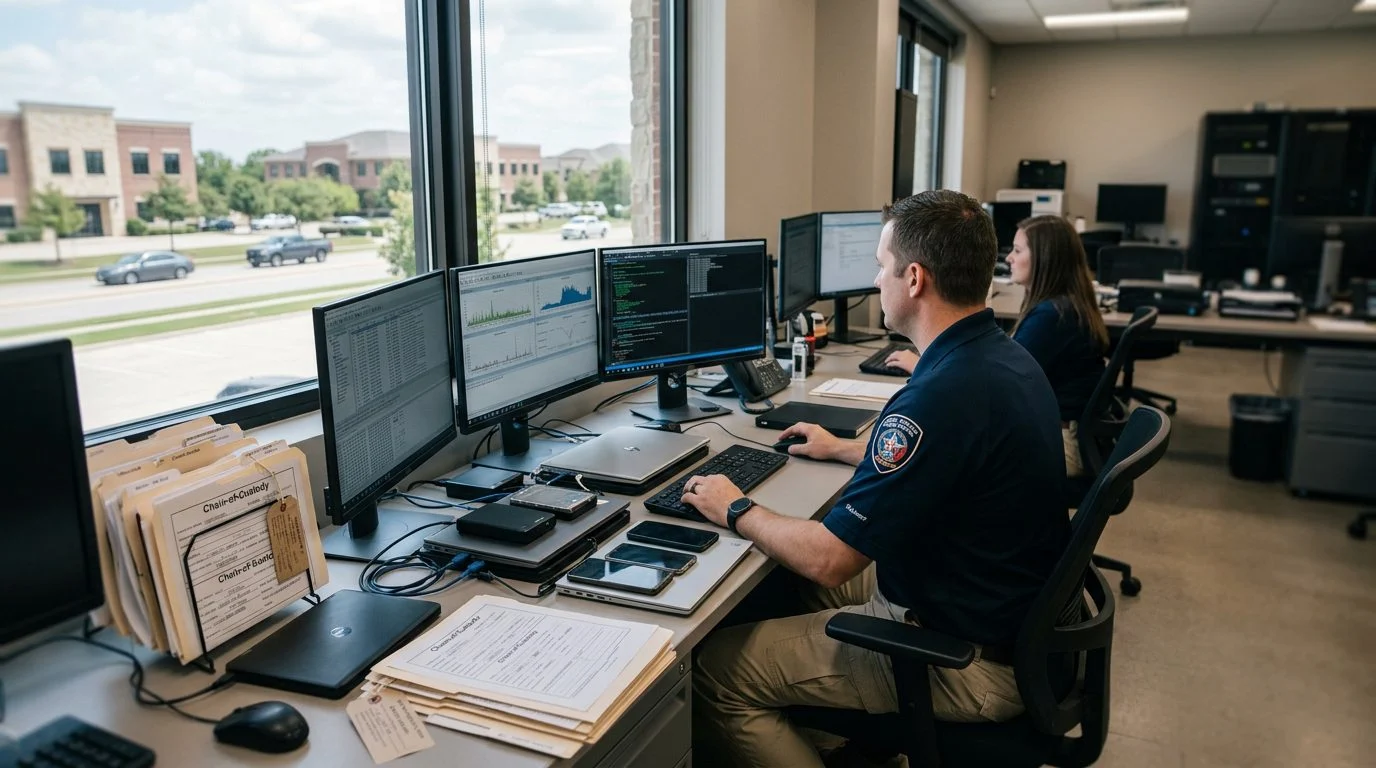
A defense tests where each message came from, what was said in full, and how police gathered the evidence.
- The full conversation. Excerpts can mislead. A defense reviews complete chat logs, timestamps and screenshots.
- Who was at the keyboard. A defense checks account and device records and whether anyone else used the device or account.
- The undercover profile. Its stated age, its photos and who started the contact all matter.
- Phone searches. Police generally need a warrant to search a phone, even after an arrest, under Riley v. California. Art. 18.0215 allows warrantless searches only in listed situations, such as consent or a stolen phone.
- Excluded evidence. Under art. 38.23, evidence obtained in violation of state or federal law may not be admitted. The article allows an exception where a law enforcement officer acted in objective good faith reliance on a warrant issued by a neutral magistrate based on probable cause.
- Child-related material. Under art. 39.15, a court must deny copies of certain material involving minors if the state makes it reasonably available to view at a state facility. Your lawyer may need to review it there.
Penalties, Classification and Sex Offender Registration
Penalties follow from the subsection charged and the facts alleged. Registration follows from the offense of conviction.
- The offense is covered. Article 62.001 lists online solicitation of a minor among the offenses covered by chapter 62 of the Code of Criminal Procedure.
Because those records can stay accessible, public exposure is a real concern for many people in your position.
From Indictment to Resolution: Motions, Plea Talks and Trial
Each stage gives the defense a chance to challenge the case, the charge and any offer.
- Motions. Pretrial motions can challenge the search, the arrest, the undercover contact and the use of statements or digital evidence. The Sixth Amendment gives the accused the right to the assistance of counsel for his defense.
- Plea talks. Weigh any offer against the evidence, the penalty range and effects such as registration and records. Ask what each choice means for your future, not only the headline charge.
- Trial. A jury decides the case on the evidence presented in court. No lawyer can say how a jury will decide.
- Timing. The schedule varies by county and by the issues raised, so early review of records and bond terms matters.
Not sure what your next step is?
Talk it through with our team — the first consultation is free, confidential, and carries no obligation.
How Barbieri Law Firm Approaches These Cases
Barbieri Law Firm is an all-women firm based in Frisco, Texas. It defends professionals accused of sex crimes and assaultive offenses across Collin County, Dallas-Fort Worth and Texas.
Heather Barbieri leads the firm. The firm’s lawyers include Heather Barbieri and Carrie Thomas.
Heather Jean Barbieri, Board Certified, Criminal Law — Texas Board of Legal Specialization.
Our team reviews every piece of the accusation and the evidence. We explain your options in plain terms and keep you informed at each step. No lawyer can say how a case will end, so our approach is to test the evidence carefully. For a step-by-step look at the first month, read the first 30 days after an online sex crime arrest.
Frequently Asked Questions
What happens after an online solicitation of a minor arrest in Texas?
The case usually moves through bond, charging, possible indictment and resolution. Each stage depends on the charge and the evidence.
Can I be charged if the person I messaged was an undercover officer?
The statute covers someone the accused believed was a minor. A sting investigation can therefore lead to this charge.
Will I have to register as a sex offender in Texas?
Registration depends on whether you are convicted of a covered offense under chapter 62. Ask a lawyer to review the charge and its effects.
Should I talk to police or family court before I speak with a lawyer?
It’s usually wiser to speak with a lawyer first. Statements to police, family court or CPS can matter later in the criminal case.
Do I need a lawyer before the first hearing?
You have the right to counsel and to consult privately before a proceeding. Early review of your bond terms and records helps you prepare.
Next Step: Talk Through Your Situation
A consultation is the next step if you want to review your situation with a lawyer. If you were arrested in an online sting, or a child-related accusation surfaced during a custody or divorce case, you may be facing decisions before you have the full picture. You don’t need to sort that out alone.
A consultation can help you see which questions matter most right now. The initial consultation is free, confidential and carries no obligation to continue.
Call (972) 424-1902 or send your case details through our contact form.
Attorney responsible for this site: Heather Barbieri, Barbieri Law Firm, Frisco, Texas.
How Barbieri Law Firm Approaches These Cases
Evidence-first review
We review the messages, timestamps, account records, and how the investigation was conducted, then explain your options in plain language.
An all-women criminal defense firm
Barbieri Law Firm is an all-women firm in Frisco, Texas, representing clients in Collin County, Dallas-Fort Worth, and across Texas. Heather Jean Barbieri, Board Certified, Criminal Law — Texas Board of Legal Specialization, leads the firm.
Clear communication at every stage
We explain each step, from bond through any charging decision or resolution, so you know what is happening and what comes next.
Early, confidential planning
Our team focuses on the questions that matter most early on, including what to say, what to avoid, and what to preserve.
Be Careful What You Say About the Case
Calls, texts, social media posts, and conversations with the person who messaged you, or with anyone connected to the investigation, can end up as evidence. Speak with our team before you answer questions about the case.
Stages in a Texas Online Solicitation Case
Arrest and bond
Initial court appearance, bond conditions, and any no-contact terms are often set early. We review them with you right away.
Charging decision
Prosecutors review the messages, identity evidence, and the investigative file before deciding how a case proceeds.
Indictment and arraignment
If the case moves forward, it may go before a grand jury and then to arraignment, where the charge is formally read.
Pretrial and resolution
Discovery, motions, negotiations, and trial preparation all shape how a case resolves. No lawyer can ensure an outcome, but a careful defense starts with the evidence.
Talk with Barbieri Law Firm About Your Case. The First Consultation Is Free, Confidential, and Carries No Obligation to Continue. Call (972) 424-1902.
Related practice areas
Request a Consultation
Fill out the short form and we will take it from there.