

Frisco, Texas | Online Sex Crimes Defense
Charged With an Online Sex Crime in Texas? Get Informed Defense From the Start
Barbieri Law Firm defends people accused of online sex crimes across Collin County, Dallas-Fort Worth and Texas. Your first consultation is free, confidential and carries no obligation to continue.
By Heather Barbieri · Published November 6, 2026
An online sex crime charge in Texas can exist with no in-person contact at all. Under Penal Code § 33.021, the offense can be complete over the Internet. The meeting not happening is no defense to solicitation.
If you were arrested, or a detective contacted you, over messages you sent or received, this page explains what the State must prove. It also explains what a Texas defense lawyer tests in an online sex crime charge with no in-person contact.
Charged Online With No Physical Contact: What the Accusation Means
An online charge means the State says the crime happened through words and images, not a meeting. Picture a knock at the door, a detective’s call, or an arrest over messages you thought were private. No one met anyone, and the case can still be serious.
The statute reaches anyone who knowingly asks a minor, over the Internet or by text, to meet. The request must carry intent for sexual contact, sexual intercourse or deviate sexual intercourse. A “minor” includes a person the accused believes is under 17. Your belief matters, not only the real age.
Many of these cases involve an undercover officer or investigator posing as a minor. Who was behind the account, and what that persona said, become central questions.
Check the grade of the charge. A solicitation charge under subsection (c) is a second-degree felony, but the punishment rises to the next higher category if the State shows the offense happened during regular school hours and the accused knew or reasonably should have known the minor was enrolled in a primary or secondary school. Read the exact charging papers first.
If investigators have reached out over your messages, you don't have to face the charge alone, and our team will review it with you. Talk it through with our team — the first consultation is free, confidential, and carries no obligation.

What the State Must Prove and How Investigators Build the Case
Investigators often tie an account to a person through digital records, and each link can be tested.
For a subsection (c) charge, the State must show you knowingly solicited a minor to meet, with the required intent. Each piece is a point of proof, not a formality.
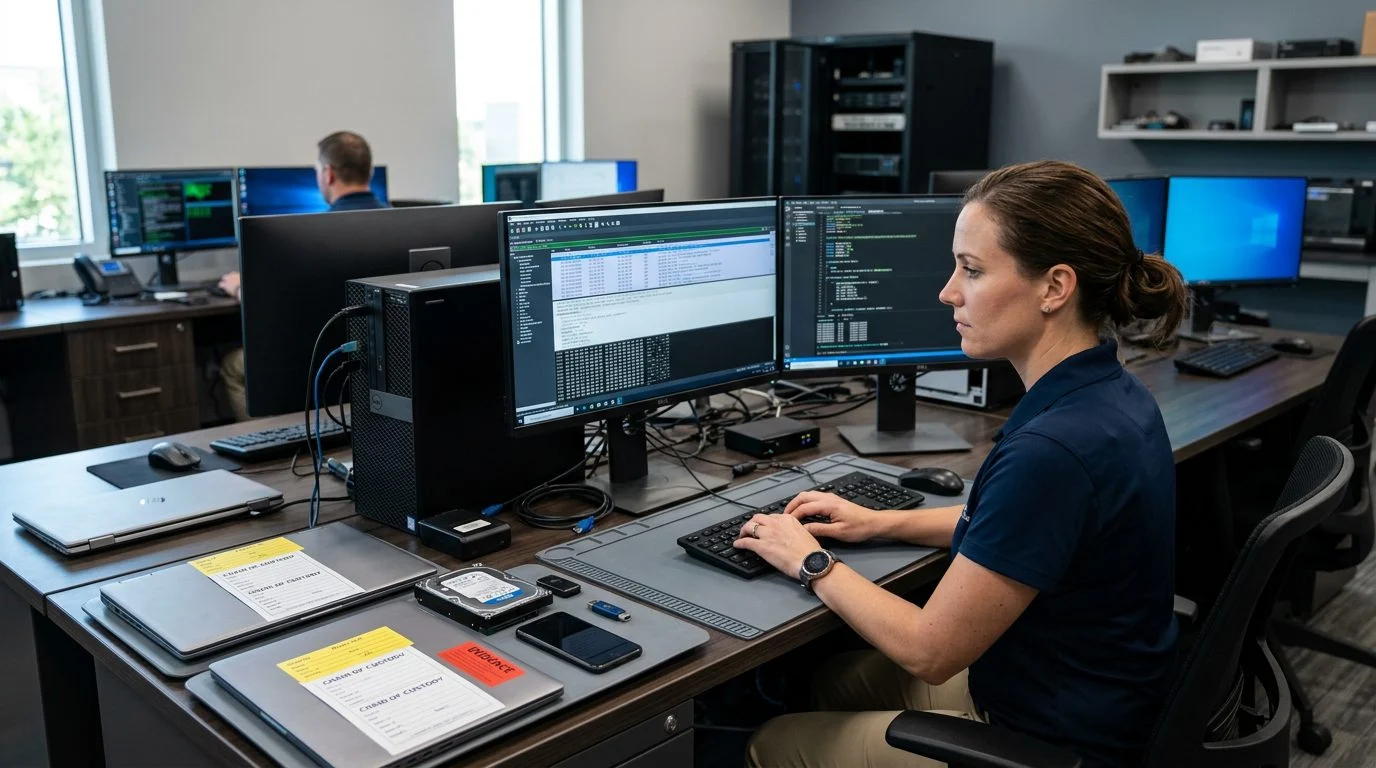
Investigators often try to connect the account to you through provider records, seized phones and computers, account logs and forensic extraction. Each link needs its own support. A device is not a person, and an account is not always the one typing.
Undercover chats and screenshots show only what the officer saved. They may leave out what came before, what came after, and who else had access to the device. Compare the warrant to what officers actually searched or took. Those gaps can matter.
What Our Defense Tests in an Online-Only Case
A strong defense tests who sent the messages, what the full conversation said, and whether the evidence was lawfully gathered. Here is what that review covers:
- Attribution: Who used the device or account, and whether others had access to it.
- Context: Full message threads, timing, and what was said before and after the disputed messages.
- Searches: Whether the warrant, its scope and its execution hold up.
- Forensics: Chain of custody, extraction tools, reports, and whether the examiner’s conclusions go beyond the data.
- Entrapment: Under Penal Code § 8.06, entrapment is a defense when a law enforcement agent induces the conduct with persuasion or means likely to cause the offense. Giving someone only an opportunity is not entrapment.
- Shared access: Shared accounts, borrowed phones and passwords others knew all raise real questions.
No lawyer can assure an outcome. We review the evidence and explain the options it supports.
When a Criminal Charge Overlaps With Family Proceedings
A criminal case can run alongside a divorce, custody fight or CPS case. Each one can set its own rules for your contact with your children.
Bond conditions and protective orders can limit that contact. Under Penal Code § 25.07, violating a bond condition in a family violence, sexual assault or abuse case can be a separate offense. That includes communicating with a protected person in any manner, except through your attorney or a court-appointed person, when the order prohibits it.
Agreements between family members do not end an order. Under § 25.07(d), reconciliatory actions or agreements do not affect the validity of the order.
Statements made in family court, to a caseworker or to a spouse can reach the criminal file. Speak with counsel before you testify or sign anything in those proceedings.
Keep copies of the messages you have and give them to your lawyer. Follow every court and bond order exactly. Do not contact the complaining party or your children in ways an order does not allow.
How the Case Moves: A Step-by-Step Process
Most of these cases move from arrest and bond, to evidence review, to pretrial motions, and then to negotiation or trial.
- Arrest and bond. Ask what conditions apply to your home, your phone and your children.
- Before any interview. Speak with a lawyer first. If detectives request an interview or your phone, let counsel review the request before you answer.
- Evidence review. Obtain the charging papers, warrants, affidavits, device reports and sting materials through discovery.
- Pretrial motions. We will review the evidence in your case with you and explain which pretrial motions, if any, may be worth considering.
- Negotiation or trial. We explain each option, its risks and its consequences, including registration and prison exposure. One path the law may allow after a plea of guilty or no contest is deferred adjudication, if the judge hears the evidence, finds it substantiates guilt, and believes it serves the interest of society and the defendant, except where Article 42A.102(b) bars it, under art. 42A.101.
Timelines depend on the court’s docket, the complexity of the digital evidence, and the facts of your case.
Why Barbieri Law Firm for an Online Sex Crime Defense in Texas
Barbieri Law Firm is an all-women criminal defense firm in Frisco, Texas. It defends people accused of sex crimes and assaultive offenses in Collin County, Dallas-Fort Worth and across Texas.
Heather Jean Barbieri, Board Certified, Criminal Law — Texas Board of Legal Specialization, leads the firm and is responsible for this page. Carrie Thomas is also a lawyer at the firm. Our support staff include assistants and office staff.
We describe the firm and its work only as the facts support. We make no claims about results in any case.
Your first consultation is confidential. We review the charge, the messages and the evidence with you, and we explain your options.
Not sure what your next step is?
Talk it through with our team — the first consultation is free, confidential, and carries no obligation.
Questions Men Ask Before Calling a Lawyer
Yes, a charge can exist with no in-person meeting. Here are answers to the questions you may be asking now.
Can I be charged in Texas if I never met anyone in person?
Yes. Under Penal Code § 33.021, the meeting not occurring is no defense to the solicitation offense.
Should I talk to the detective to explain myself?
Speak with a lawyer before any interview. Your statements can affect both the criminal case and your family matters.
Will I have to register as a sex offender?
How long the duty to register lasts depends on the offense. Under the Texas Code of Criminal Procedure, art. 62.101, the duty ends when the person dies for certain listed offenses, so those carry lifetime registration, while for other offenses it ends on the 10th anniversary of the relevant release, discharge, dismissal or disposition date, whichever is later, subject to the statute’s exceptions.
Will I lose my children?
Custody is a separate matter from the criminal case. Bond terms and protective orders can limit contact, so have those terms reviewed right away.
Is the first consultation free?
Yes. The firm offers a free initial consultation that is confidential and carries no obligation to continue.

Next Step: Send Your Case Details or Call Today
Your charge is on paper, the messages are in the State’s file, and an interview request or family hearing could come soon. Early review helps you prepare for those moments.
Call (972) 424-1902 or send your case details through our contact form. We will then schedule your consultation.
Attorney responsible for this site: Heather Barbieri, Barbieri Law Firm, Frisco, Texas.
How We Approach an Online Sex Crime Case
Protecting you from the start
Early decisions matter. We advise you on communicating with police, detectives and prosecutors before you say anything about your messages or accounts.
Reviewing the evidence
We will review the digital evidence, the charging documents and the investigation, then explain your options in plain language.
Clear communication
We explain each stage of the case, what to expect and what decisions are yours to make.
Our team
Heather Jean Barbieri, Board Certified, Criminal Law — Texas Board of Legal Specialization. Our team is led by a criminal defense lawyer who focuses on sex crimes and assaultive offenses.
Serving Collin County and beyond
We represent clients in Frisco, Plano, McKinney, Prosper, Allen, Celina, Southlake and Dallas, and across Texas.
Before You Talk to Anyone, Talk to a Lawyer
Statements made to police, detectives or prosecutors about online messages, images or accounts can affect your criminal case and your personal life. Contact a lawyer before any interview.
Related Criminal Defense Matters
Child Sex Crimes Defense
Defense for people accused of offenses involving minors, including allegations arising from online contact.
Sex Crimes Defense
Representation for people facing allegations of sexual offenses in Collin County, Dallas-Fort Worth and across Texas.
Aggravated Sexual Assault Defense
Careful, evidence-based defense for serious felony charges that carry significant penalties.
Family Violence Defense
Defense for family violence and aggravated assault allegations, with attention to how charges affect your family.
Talk to a Frisco Criminal Defense Lawyer Today
Related practice areas
Request a Consultation
Fill out the short form and we will take it from there.