


Online Sex Crimes Defense | Collin County, Texas
Facing an Online Sex Crime Allegation in Collin County?
Barbieri Law Firm, an all-women criminal defense firm in Frisco, offers a confidential first conversation so you can understand what the allegation means and what your next steps could be.
By Heather Barbieri · Published November 15, 2026
An arrest or accusation can arrive without warning. If you’re facing an online sex crime allegation in Collin County, the first case review is a private meeting where a lawyer goes through your charging papers, bond terms and the evidence available so far. It ends with a plain explanation of your charges and your options.
This page explains those steps in general terms and speaks to the fears many people carry into that first meeting. For the broader picture, read our online sex crimes defense page.
If You Are Facing an Online Sex Crime Allegation in Collin County, Where Do You Start?
Start with the paperwork and the rules you must follow right now. Early days matter, because charging papers, bond terms and early statements can shape what comes next.
You may be reading this for yourself, or while a divorce, custody fight or CPS case is already underway. Those cases run on their own tracks, but they can overlap with a criminal charge.
Some online cases begin with a tip. The National Center for Missing & Exploited Children’s CyberTipline reviews tips and refers them to law enforcement agencies for possible investigation. A case can start from a report you never saw.
Texas defines these offenses by statute. It is no defense that the meeting did not occur. Read the exact charge in your papers closely, because that is where the review starts.
If a charge, a bond hearing or a custody deadline has you unsure what comes next, you do not have to sort it out alone. Our team can talk it through with you. Talk it through with our team — the first consultation is free, confidential, and carries no obligation.

What steps happen during an initial case review for an online sex crime allegation in Collin County?
An initial case review moves in a clear order: paperwork first, then evidence, the timeline and your options. Each step builds on the one before it.
Collect the paperwork. Gather arrest or charging documents, bond and release conditions, any protective or no-contact orders, and any divorce, custody or CPS filings with their dates. The initial consultation is free, confidential and carries no obligation to continue.
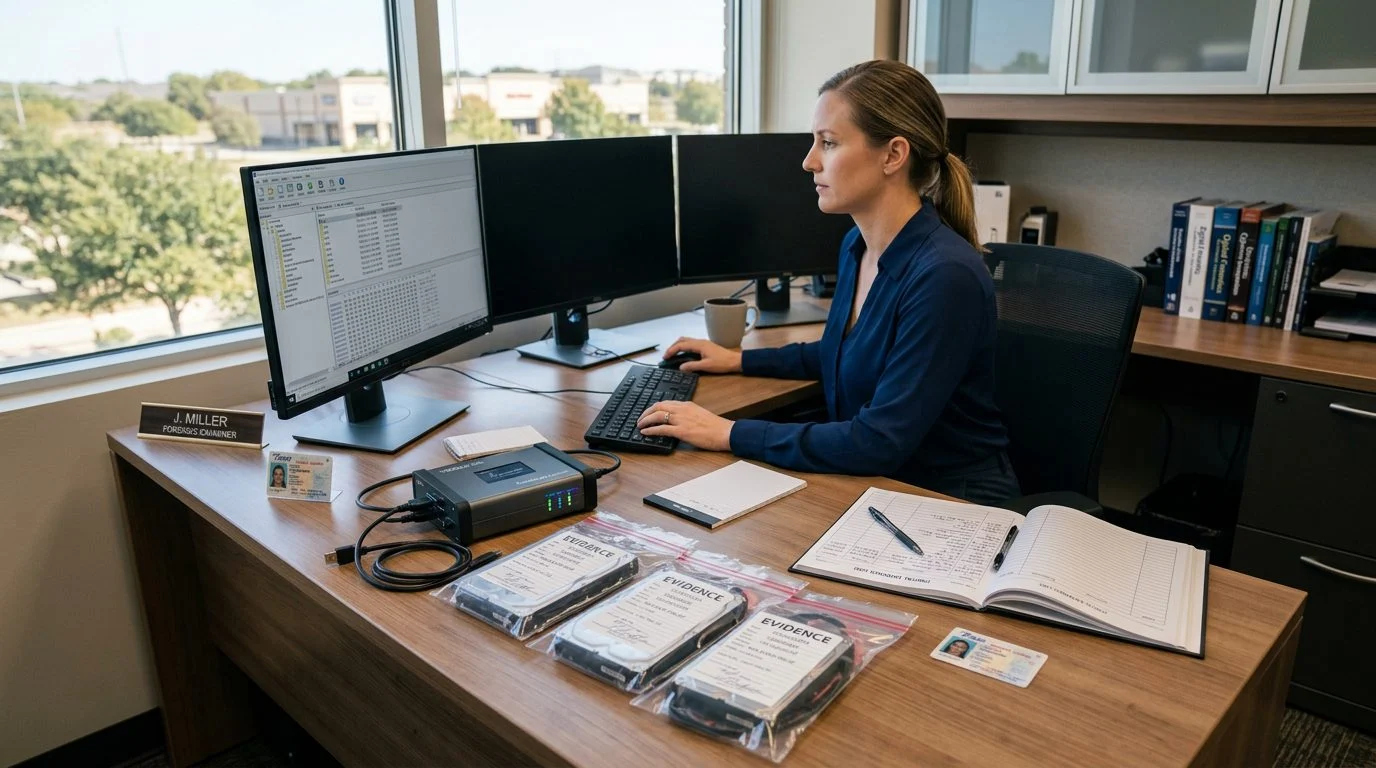
Review the evidence so far. That can include messages or chat logs, account and device records, the timing of contact, and forensic or digital reports. Note what is missing. Under Code of Criminal Procedure Art. 39.15(a), child pornography under Penal Code § 43.26, material whose promotion or possession is prohibited under § 43.261, and material described by Art. 38.071 are subject to separate rules. Under Code of Criminal Procedure art. 39.15, a court must deny a defense request to copy, photograph, duplicate, or otherwise reproduce such material if the state makes it reasonably available. That means the state provides ample opportunity, at a facility under its control, for the material to be inspected, viewed, and examined by the defendant, the defendant’s attorney, and any individual the defendant seeks to qualify to give opinion testimony at trial based on specialized knowledge, skill, experience, training, or education.
Check any phone search. Under Code of Criminal Procedure art. 18.0215, an officer may not search a phone after a lawful arrest without a warrant under that article. Listed exceptions include consent.
Build the timeline and identify next steps. Map each count as written and show how the allegations connect to dates and messages. Then list what must be requested or tested, and explain your options in plain language.
What Do the Fears About Prison, Registration and Your Children Mean at This Stage?
Reviewing your case starts with identifying the exact charge as it is written. No one can predict how a case will end this early.
Texas sorts felonies into five categories, under Texas Penal Code § 12.04. A first-degree felony carries life or any term of not more than 99 years or less than 5 years, plus a fine of up to $10,000, under Texas Penal Code § 12.32. That range is wide, and it is why the exact charge matters.
Registration depends on the offense and on any conviction. Texas handles that question under Chapter 62 of the Code of Criminal Procedure, so the review covers it along with the charge.
If you have children, the fear of losing contact is real. Custody and CPS matters run on their own tracks and can overlap with the criminal case. Raise them with your lawyer early, before you make any statement in those proceedings.
How Should You Protect Your Position While an Online Sex Crime Case Is Open in Collin County?
Follow every bond and no-contact condition exactly, and discuss the case only with your lawyer present.
Bond terms carry their own risk. In a sexual assault or abuse case, Texas Penal Code § 25.07 makes it an offense to knowingly or intentionally violate a bond condition related to the safety of a victim or the community in ways the law lists. Examples include going to or near a protected person’s home or workplace described in the condition, or possessing a firearm.
Do not answer questions from police or investigators without counsel. Under Miranda, police must give warnings, including the right to remain silent, before custodial questioning, a requirement that the Supreme Court in Dickerson v. United States, 530 U.S. 428 (2000) recognized as a constitutional rule. Your right to consult with counsel in private is set out in Code of Criminal Procedure art. 1.051.
Keep existing messages, accounts and devices. Deleting them can create new problems. Family and CPS proceedings deserve the same care, because information shared there can affect the criminal case. Talk with your lawyer before you testify or sign anything in those matters.
What Happens After the Initial Review Finishes?
After the review, you leave with a clear summary of the charges, the evidence reviewed, the open questions and your options.
You decide what to do next, including whether to continue with Barbieri Law Firm. We explain your options in plain terms and do not predict results. The firm is based in Frisco and serves Collin County.
Do I have to hire the firm after the review?
No. You decide whether to continue after the review.
Can police search my phone after an arrest?
Generally, police need a warrant to search the data on a phone, even after an arrest. As Riley v. California explains: “Our holding, of course, is not that the information on a cell phone is immune from search; it is instead that a warrant is generally required before such a search, even when a cell phone is seized incident to arrest.”
Is entrapment a defense to an online sting?
Texas law makes entrapment a defense when a law enforcement agent induces the conduct. Simply giving someone an opportunity to offend is not entrapment, under Texas Penal Code § 8.06.
Take the Next Step Toward a Confidential Review
The next step is a confidential first consultation about your own paperwork, bond terms and charges.
If a charge, a bond hearing or a custody or CPS deadline has you unsure what comes next, you do not have to sort it out alone. Call (972) 424-1902 or send your case details through our contact form.
Attorney responsible for this site: Heather Barbieri, Barbieri Law Firm, Frisco, Texas.
What the initial review covers
The allegation itself
We go through the charge, the complaint, and what the investigation says so far, so you know exactly what you are being asked to answer.
The digital evidence
We review the messages, images, account records, and device data at issue, including how they were obtained and whether the process followed the law.
Your rights and options
We explain how questions, searches, and interviews work at this stage and what choices are available to you before anything is filed.
Plain-language answers
You will leave with a clear explanation of the case in terms you can use to make your own decisions, not a sales pitch.
Talk to a lawyer before you respond
Investigators or other people may ask you to explain messages, send a phone, or give an account online or in person. Speaking with a lawyer first helps you understand what each choice could mean before you say or send anything.
How the first consultation works
1. Tell us what happened
Share what you know about the allegation, the platform involved, and any contact from police or prosecutors. The conversation is confidential.
2. We review the evidence
We look at the available records and explain what they show, what they do not show, and what questions remain open.
3. You decide the next step
We explain your options under Texas law. You decide whether to continue, and there is no obligation to hire the firm after the review.
Get a free, confidential review of your online sex crime allegation
Related practice areas
- Online Sex Crimes Defense Lawyer
- Sex Crimes Defense Lawyer in Collin County
- Sex Crimes Defense Lawyer in Prosper
- Sex Crimes Defense Lawyer in Celina
Request a Consultation
Fill out the short form and we will take it from there.