

Online Sex Crimes Defense | Frisco, Texas
Challenging Unlawful Phone and Online Evidence in Your Texas Case
Barbieri Law Firm reviews how digital evidence was gathered and explains whether a motion to suppress may apply to your case in Collin County or the Dallas-Fort Worth area.
About Barbieri Law Firm
Frisco, Texas
Where our criminal defense firm is based
All-women
Criminal defense firm led by Heather Barbieri
Collin County
And the Dallas-Fort Worth area
Free
Initial consultation, confidential and without obligation
By Heather Barbieri · Published November 3, 2026
A motion to suppress online sex crime evidence in Texas asks a judge to keep certain evidence away from the jury. In these cases, the evidence is often a phone, a computer or the records of an online account. This page explains how that challenge works, what it can cover and what families can expect. It is written for family members who are trying to understand a case involving someone they care about.
What a Motion to Suppress Is and Who It Is For
The defense files it before trial. The judge decides it, often at a pretrial hearing where witnesses can testify and exhibits can be shown. If the judge agrees, that evidence stays away from the jury.
A challenge may target one item, such as a phone extraction, while other evidence remains in the case. Texas law covers many kinds of online conduct. Online solicitation of a minor is one example. Penal Code § 33.021 makes it a crime to knowingly solicit a minor online to meet another person, with intent that the minor engage in sexual contact or intercourse. An offense under subsection (c) is a second-degree felony. It is not a defense that the meeting did not happen.
This page is for family members who want to know whether a seized phone, message or account record could be challenged. It does not decide any case.
If police seized a phone or online account in your loved one's case, our team can review that evidence and explain your options at a free consultation. Talk it through with our team — the first consultation is free, confidential, and carries no obligation.
Phone and Online Account Evidence That Can Be Challenged
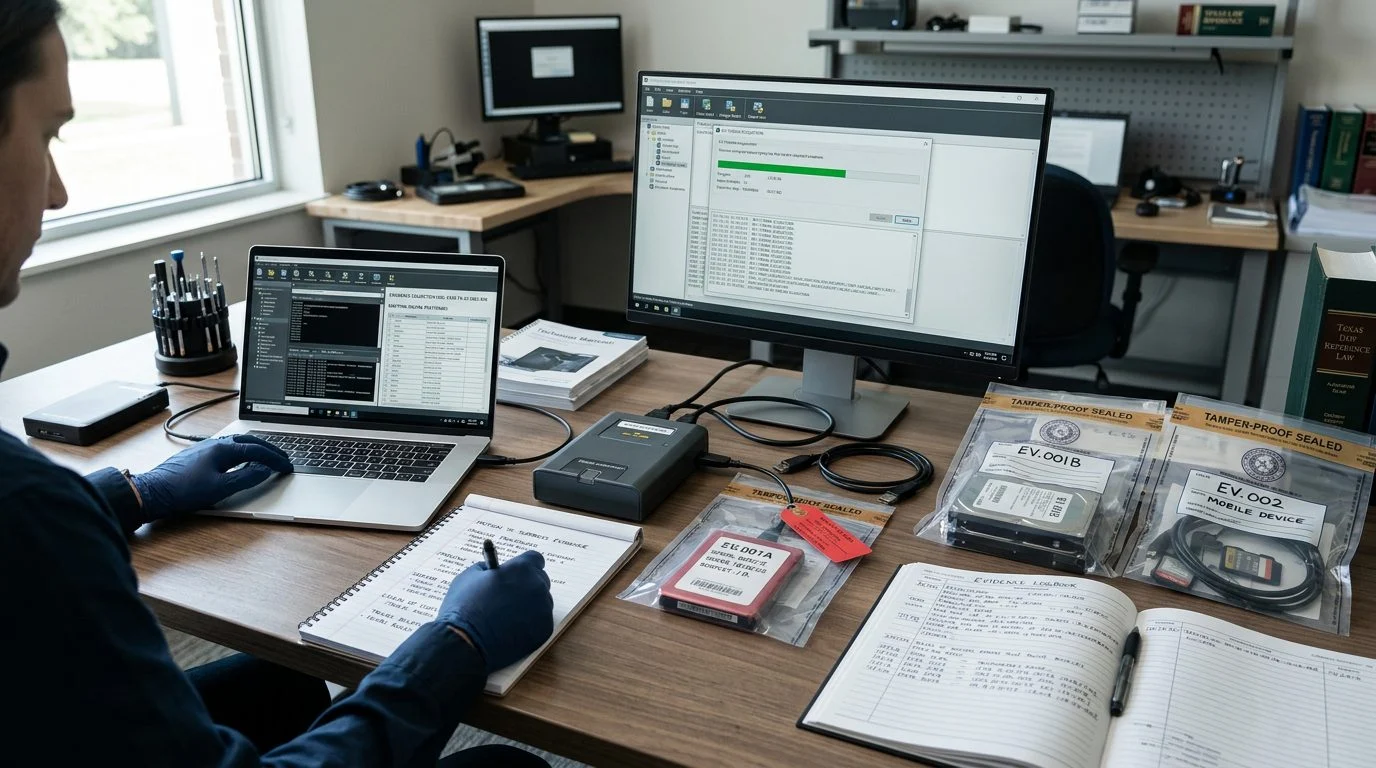
Phones, computers and online accounts often hold the core evidence in these cases. Each piece can be checked for how it was gathered.
- Phones and computers seized at an arrest, at a home or at a workplace
- Forensic extraction reports of texts, chats, photos and app data
- Records from online platforms or phone companies obtained through legal process
- Cloud backups and account contents reached through a warrant or other legal process
- Statements made during or after a device search
Several agencies can touch the same evidence. It investigates online child exploitation. Texas Attorney General ICAC overview explains the state program.
A federal program, administered through the Office of Juvenile Justice and Delinquency Prevention, supports this kind of technology-facilitated investigation. OJJDP task force program describes it. Account records may also come from an online platform’s response to legal process. Knowing where each item came from helps the defense ask the right questions.
The National Center for Missing & Exploited Children describes online enticement and the grooming tactics often linked to it. NCMEC online enticement gives that background. A family may receive more than one report from the same device. Each report can hold different data, so comparing them matters.
Grounds a Defense Motion May Raise
A motion usually challenges how the evidence was gathered, and the right grounds depend on the facts.
- Consent that was not freely given, or a search that went beyond what was agreed to
The charge also shapes the defense. Under Penal Code § 43.261(f), a defense to possessing minor-to-minor visual material applies only if the person did not produce or solicit it. The person must also have received it from another minor and destroyed it within a reasonable time.
Families often assume that a person who sent a photo willingly has no legal issue. The depicted person’s creation of the material or voluntary sending of it does not end the question.
How the Process Works and What to Expect
A suppression challenge usually moves from review to a written motion to a pretrial hearing. Timing depends on the court’s schedule. Every motion to suppress online sex crime evidence Texas judges decide follows a similar path.
- Early review of the arrest report, warrant papers, affidavits and any consent forms.
- Request and review of discovery, including device extraction reports, provider returns and any recorded interview.
- Evaluation of each seizure and search against the grounds above.
- Drafting and filing the written motion with supporting argument, then the State’s response.
- A pretrial hearing, where testimony and exhibits go before the judge.
- The judge’s ruling, which decides what evidence can be used at trial.
Discovery can be slow. The defense may need several rounds of review before deciding which motion to file. Early review also helps the defense decide which grounds to raise.
Families can avoid common mistakes. Don’t delete messages or photos. Don’t log in to a loved one’s accounts, and don’t hand over passwords. Don’t talk with investigators without a lawyer, and don’t post about the case online.
Why Barbieri Law Firm for This Work
Barbieri Law Firm is an all-women criminal defense firm in Frisco, Texas. The firm defends people accused of sex crimes and assaultive offenses.
Heather Jean Barbieri, Board Certified, Criminal Law — Texas Board of Legal Specialization, is the responsible lawyer for this site.
Our lawyers include Heather Barbieri and Carrie Thomas. Assistants and office staff support their work.
The firm handles online sex crime defense in Collin County, Dallas-Fort Worth and across Texas. Our team reviews the evidence, including device reports, warrant papers and provider records. Then we explain the options in plain terms.
No lawyer can promise how a judge will rule. What we offer is a careful review of the evidence and a clear explanation of what it means for your loved one’s case.
Common Questions About Suppression Motions in Online Sex Crime Cases
Short answers to common questions can help a family decide what to ask next.
Does a suppression motion end the case?
No. A ruling on evidence is one part of the case. No lawyer can promise how the judge will rule.
Can police search a phone without a warrant?
The answer turns on specific details, especially whether consent was freely given. A lawyer reviews those details with the family.
Does the motion have to be filed before trial?
Do federal agencies get involved in these cases?
Federal and state task forces investigate online child exploitation. More than one agency may hold related evidence.
Will the family hear about the strategy?
Lawyers keep client information confidential. Ask at the consultation what can be shared with family.
What should the family bring to a consultation?
Bring arrest paperwork, any warrant or consent forms, and a list of dates of police contact. Nothing has to be sent before the consultation.
Not sure what your next step is?
Talk it through with our team — the first consultation is free, confidential, and carries no obligation.

Talk With Us About Your Loved One’s Case
If police seized a phone or online account in a case involving your loved one, the evidence can be reviewed and your options explained.
You may be learning about a phone search or a police interview you did not expect. You may be trying to help someone you care about while you still have many questions.
Call (972) 424-1902 or send your case details. Your initial consultation is free, confidential, and without obligation. It is a chance to ask questions and learn how the review would work.
Attorney responsible for this site: Heather Barbieri, Barbieri Law Firm, Frisco, Texas.
How we approach digital evidence
Review the search
We examine the warrant, its supporting affidavit and the way officers obtained the device, account or data, and identify any gaps in the paperwork.
Test consent and scope
We look closely at whether consent was freely given and whether any search stayed within the limits of the warrant or other legal authority.
Examine the forensic work
We review extraction reports, chain of custody and how investigators handled and labeled the data, looking for problems that may support a motion to suppress.
Explain your options
We walk you through what the evidence review shows, what a motion to suppress can and cannot accomplish, and what choices remain open in your case.
Digital evidence issues we review
Phone and device searches
Searches of cell phones, computers and tablets, including whether a warrant described the device and the data sought.
Online account records
Subpoenas and warrants for messaging, social media and cloud account records, and whether they were properly served and limited.
Consent to search
Whether a person agreed to a search voluntarily, and whether that consent was limited or withdrawn.
Forensic reports and chain of custody
How digital evidence was copied, stored, analyzed and reported, and whether the process can be trusted.
Before you speak with investigators
Do not give a statement, agree to a phone search or hand over passwords before talking with a lawyer. Anything you say or allow can become evidence in your case.
Talk with Barbieri Law Firm about your digital evidence. Your first consultation is free, confidential and without obligation.
Related practice areas
- Online Sex Crimes Defense Lawyer | Collin County & Texas
- Indecency With a Child Charge Defense Texas | Barbieri
Request a Consultation
Fill out the short form and we will take it from there.