

Child Abuse Allegations | Collin County and Dallas-Fort Worth, Texas
Facing a Forensic Interview in a Texas Child Abuse Case?
Talk with a criminal defense team that focuses on protecting families accused of serious offenses before you take the next step.
By Heather Barbieri · Published November 11, 2026
Learning that a child named you in a forensic interview is frightening, especially if a divorce, custody fight or CPS case is already underway.
A forensic interview is one piece of evidence in a Texas child abuse allegation. It is not a verdict, and by itself it does not prove that anything happened. This page explains what the interview is, what it can and cannot show, and how a defense lawyer reviews it.
Your name came up in a child’s forensic interview: what that does and does not mean
Being named in a forensic interview does not, by itself, mean you have been charged with a crime.
The interview is a step in an investigation, not a finding. Texas separates two tracks. A CPS investigation focuses on a child’s welfare. A law-enforcement investigation looks at whether a crime occurred. The Texas Department of Family and Protective Services explains that difference in its reporting guidance. Each track has its own steps, and you may face both at once.
You may be afraid of prison time, of registering as a sex offender, of losing contact with your children, and of your name in the news. Those fears make sense. The penalties are serious, and the next steps depend on the facts of your case. Knowing how the process works is the first step toward a clear plan.
Not sure what your next step is?
Talk it through with our team — the first consultation is free, confidential, and carries no obligation.
What a forensic interview is and what gets recorded
A forensic interview is a structured conversation between a trained interviewer and a child, often held at a Children’s Advocacy Center.
The goal is to gather the child’s account in a careful, neutral way. OJJDP forensic interview guidance describes general professional standards, including open-ended questions and avoiding repeated questioning.
Interviews are usually recorded on audio and video, and the interviewer may keep notes. A defense lawyer will ask for the complete recording, not a summary or a short clip. The full conversation shows how questions were asked and in what order.
A summary is what someone wrote about the interview. The recording is what was actually said. A lawyer needs both, plus the paperwork that shows when and how each was made.
Is a forensic interview proof that the accusation is true?
No. A forensic interview is evidence to be tested. It does not, by itself, prove that any act occurred.
The child’s statements, the way questions were asked, and the way answers were written down are all open to review. Any gap or inconsistency becomes a point to examine, not a conclusion to accept.
Some Texas offenses are built around a pattern. Continuous sexual abuse of a young child requires two or more acts of sexual abuse during a period of 30 or more days. The person must be 17 or older, and the child must be younger than 14 (Penal Code § 21.02).
The details matter here. If a jury hears that kind of case, jurors need not agree on which specific acts occurred or on the exact dates. They must agree unanimously that two or more acts occurred during a period that is 30 or more days in duration (Penal Code § 21.02(d)). An interview cannot replace that proof.
What typically happens next after the interview
After the interview, the case can move through an investigation, possible interviews of the accused, and a prosecutor’s decision on whether to file charges.
The sequence varies from case to case.
Criminal exposure is serious. Continuous sexual abuse of a young child is a first-degree felony punishable by life, or by any term of not less than 25 years and not more than 99 years (Penal Code § 21.02(h)). A fine of up to $10,000 may be added (Penal Code § 12.32).
Because the stakes are high, talk with a lawyer before you discuss the allegation with investigators, the child, or family members.
How a Texas criminal defense lawyer reviews the interview
A defense lawyer starts with the complete recording and the interviewer’s documentation, then tests how the child’s statements were gathered.
Our lawyers focus on four areas:
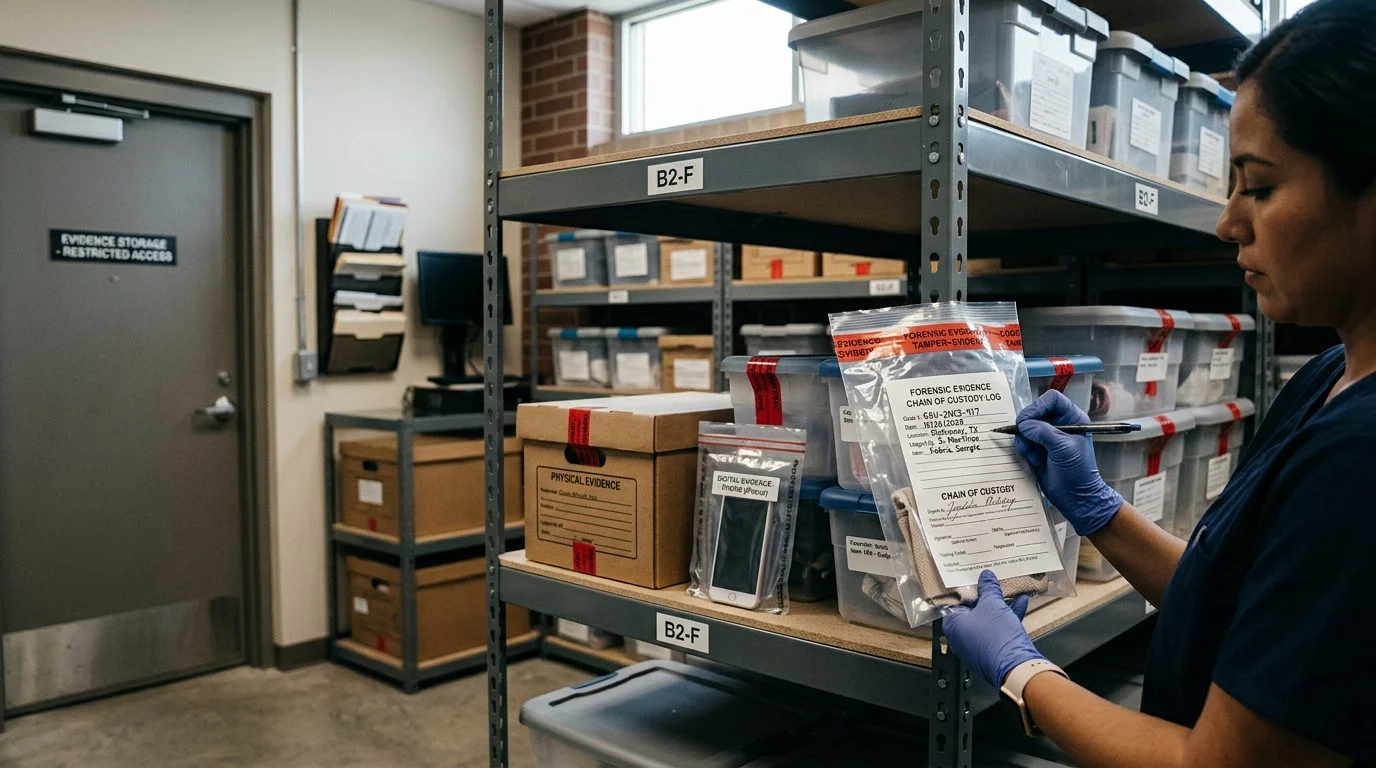
- The full recording and notes. The review covers the whole interview, not a clip. It also checks chain of custody, the written record of who held the evidence and when.
- Timing and sequence. When did the child first say something, and to whom? What came before it? Earlier conversations can shape later ones.
- Questioning technique. Were questions open-ended, or did they suggest an answer or get repeated? OJJDP guidance describes avoiding repeated questioning, so a lawyer can measure the interview against that standard (OJJDP forensic interview guidance).
- Gaps in documentation. What was not recorded, or not written down, can matter as much as what was.
How the interview fits into the state’s overall case
The interview is one part of the state’s case, so a defense review covers everything around it.
That includes any online messages, device data, witness statements, and the context of the divorce, custody or CPS matter. Online cases carry their own evidence. The National Center for Missing & Exploited Children describes online enticement and the grooming tactics involved. Under Penal Code § 33.021, it is not a defense to prosecution under Subsection (c) that the meeting did not occur.
Registration depends on the offense and the conviction. Under Code of Criminal Procedure art. 62.101, the duty to register ends at death for some listed offenses, but for certain of them only if the person also receives or has received another reportable conviction or adjudication, other than an adjudication of delinquent conduct. For many others, the statute sets a 10th-anniversary end date measured from a defined event.
No lawyer can promise how a case will end. A review can test every part of the accusation and the evidence, then explain your options.
Not sure what your next step is?
Talk it through with our team — the first consultation is free, confidential, and carries no obligation.
Talk with a Texas criminal defense lawyer about your situation
Talking with a lawyer early gives you a clear review of the recording, the documentation and your options.
Is being named in a forensic interview the same as being charged?
No. Being named in an interview does not, by itself, mean you have been charged.
Does a forensic interview prove that abuse happened?
No. It is evidence that can be tested, and by itself it does not prove that an act occurred.
Will a defense lawyer review the full recording?
Yes. A defense lawyer will ask for the complete recording and notes so the review covers the whole interview.
Barbieri Law Firm is based in Frisco and defends clients in Collin County, Dallas-Fort Worth and across Texas. If a child’s interview has put your name in an investigation, call (972) 424-1902 or send your case details through our contact form. Our free initial consultation is confidential and carries no obligation to continue.
You can also read more about online sex crimes defense or our work in Collin County.
Attorney responsible for this site: Heather Barbieri, Barbieri Law Firm, Frisco, Texas.
How our team approaches a forensic interview case
We review the recording
We obtain and study the forensic interview, its recording and any related reports so we understand exactly what was said and how the interview was conducted.
We protect your position
We explain how statements made now may be used later and advise you on what to say, and what not to say, to investigators.
We explain your options
We walk you through the allegation, the evidence that has been gathered and the choices available at each stage, in plain language.
We stay with you
Our team keeps you informed about each step, so you know what is happening in your case and why.
Before you speak with investigators
Do not discuss the allegation in text messages, on social media or with the child, other family members or witnesses. Speak with a criminal defense lawyer before you agree to a forensic interview or give any written or recorded statement.
Common questions about forensic interviews
Does being named in an interview mean I have been charged?
No. Being named in a forensic interview does not, by itself, mean you have been charged with an offense. We can explain where your case stands.
Does a forensic interview prove abuse happened?
A forensic interview is evidence that can be tested. By itself, it does not establish that an act occurred, and we review how it was conducted.
Can a defense lawyer review the interview?
Yes. We review the recording, the questions asked, the process used and the other evidence in the case, and explain what it may mean for you.
Talk with Barbieri Law Firm about your case
Related practice areas
Request a Consultation
Fill out the short form and we will take it from there.