

Online Sex Crimes Defense | Frisco, Texas
Deleted Messages Recovered in Texas Online Sex Crime Cases
Deleted does not always mean gone. Learn how investigators try to recover texts, app messages and photos, and why a careful review of the extraction report matters to your case.
By Heather Barbieri · Published October 26, 2026
If you are facing a Texas investigation, you may wonder whether deleted messages recovered online sex crime Texas police use can still be found. Often they can. This page explains how investigators try to recover deleted data, which records show that work, and why those records matter to a defense. It is general information, not advice about your specific case.
The Short Answer: Deleted Messages Are Often Recoverable
Investigators often use forensic tools to recover deleted messages from phones, computers and online accounts. Deleting a message from your screen does not always remove it from the device or the account that stored it. Data can remain in storage, in backups or on the other person’s device.
Many people assume a deleted message is gone for good. That assumption is often wrong.
Three records matter most when digital evidence is involved. They are the recovery method, the tool used, and the examiner’s notes. Together, they show what was found, how it was found, and what was not found.
Recovery is not the same as proof. A recovered message still has to be read in context, dated correctly and matched to the right person. Ask early what investigators actually pulled from each device, because the answer shapes every other question in the case.
If investigators have pulled your deleted texts or app messages, you don't have to sort out that evidence alone. Our team offers a free, confidential first consultation. Talk it through with our team — the first consultation is free, confidential, and carries no obligation.

Where Deleted Messages Can Still Exist
Deleted messages can still exist in several places, and each one can matter. Start with the phone itself. Data may remain in device storage until the space is overwritten, depending on the device and how it was used.
Cloud backups and synced app accounts are another source. A message removed from one phone may still sit in a backup or on a tablet signed into the same account.
The other person’s phone is often overlooked. A conversation has two ends, and the other device may still hold the same thread. That is a common source of evidence in these cases.
Companies that run messaging apps can also keep records on their own systems. Those records are usually obtained through legal process, not from the accused person’s phone alone. Each source can show different parts of the same conversation, so none should be ignored.
How Investigators Typically Attempt Recovery
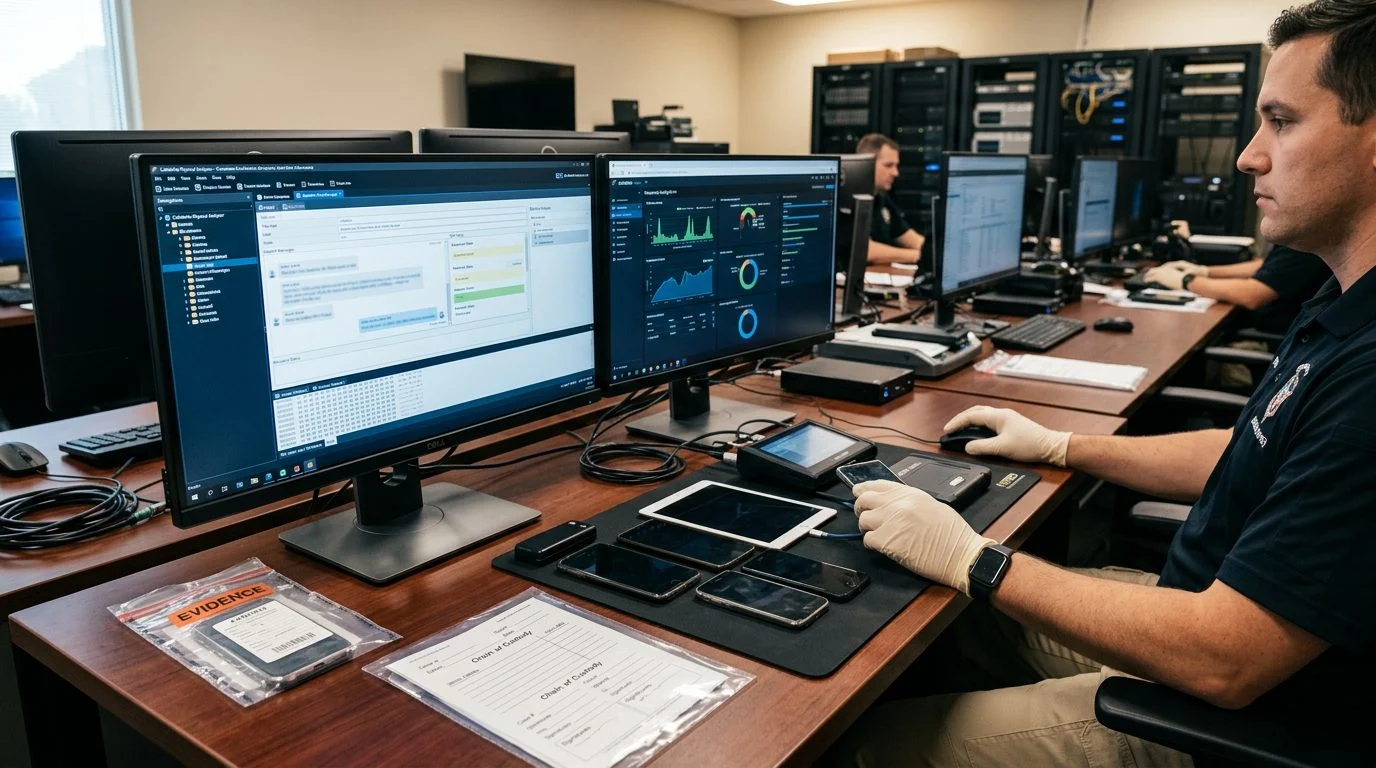
Investigators usually recover deleted data by making a copy of the device and examining that copy. Forensic extraction is usually done on a copy rather than the original. Specialized software reads the storage and pulls out what it can find. The method is designed to leave the original device unchanged.
Recovery can produce more than the user ever saw on screen. Results may include message text, timestamps, fragments of deleted files and app data. Some items may be partial or damaged.
Recovery can also fail. Content may be overwritten, encrypted or otherwise unrecoverable. When that happens, the report should say so. A missing message does not prove it never existed, and a recovered fragment does not prove a full conversation.
Texas investigations often involve specialized teams. Internet Crimes Against Children task forces in Texas investigate online child exploitation, including sexual solicitation, and the Texas Attorney General’s ICAC page offers background on the program.
Why the Extraction Report and Examiner’s Notes Matter
The extraction report and examiner’s notes show what was found, from which device, and how. Those records are the first place to look when digital evidence is part of a case.
The extraction report is the main record of what was pulled from which device, and when. It should identify each device and list the items recovered.
The examiner’s notes explain the tool and version used, the recovery method, and what was and was not found. These notes often show the limits of the work. That is why they matter as much as the data itself.
Chain of custody records show who handled the device and each copy, and when. They also show whether the copy matches the original. A gap in those records is a question to raise, not a detail to skip.
Timestamps need checking too. Time-zone settings and device clock errors can change how a message sequence appears. A message that seems to come first may not. Every timestamp should be checked against the report.
What the Firm Reviews When Digital Evidence Is Involved
A review of deleted messages recovered online sex crime Texas evidence starts with the records. Our review requests the extraction report and the examiner’s notes, so the work can be checked against what investigators say they did.
The review covers the tool, the method, the chain of custody, and whether the recovered content is complete and accurately dated. It also looks at the content in context. Who sent each message, to whom, and when? Does the message say what the State claims it shows?
A screenshot of a recovered message is not the same as the full extraction. Comparing the two is part of the review.
Each case turns on its own facts. No lawyer can say how digital evidence will be treated in any particular case. The records above are the starting point for an informed explanation of your options.
Why Deleting a Message Does Not Take It Outside the Law
Texas statutes focus on what the material is, not on whether it still sits on a device. Under Texas Penal Code § 21.16, visual material includes any file in a digital format that allows an image to be displayed on a computer or other video screen. It is also not a defense that the depicted person voluntarily sent the material to the actor.
Under Texas Penal Code § 21.19, a person commits a Class C misdemeanor by knowingly sending, by electronic means, visual material that shows any person engaging in sexual conduct or with intimate parts exposed, or shows a male person’s covered genitals in a discernibly turgid state, if the recipient did not request it or expressly consent to receiving it. Each of these questions turns on the records and the facts.
Not sure what your next step is?
Talk it through with our team — the first consultation is free, confidential, and carries no obligation.
Related Questions Under Texas Online Sex Crime Law
Texas law sets several separate online sex offenses, and each carries its own penalty grade. The same message can fall under different charges depending on the facts.
Online solicitation of a minor is covered by Texas Penal Code § 33.021. The statute treats anyone younger than 17 as a minor, or anyone the actor believes is younger than 17. For a person 17 or older, intentionally communicating in a sexually explicit manner with a minor over the Internet, by email, text or another electronic message service, with the intent to commit an offense listed in Article 62.001(5)(A), (B), or (K), Code of Criminal Procedure, is a third-degree felony, or a second-degree felony if the minor is younger than 14 or is an individual the actor believes to be younger than 14 at the time of the offense. The punishment for any offense under the section is increased to the next higher category if it is shown at trial that the actor committed the offense during regular public or private primary or secondary school hours and knew or reasonably should have known the minor was enrolled in a public or private primary or secondary school. Soliciting a minor to meet for sexual contact is a second-degree felony.
The statute says it is not a defense to the meeting offense that the meeting did not occur. The listed defenses are that the actor was married to the minor, or that the actor was not more than three years older and the minor consented. Texas Penal Code § 33.021 reads: “(f) An offense under Subsection (b) is a felony of the third degree, except that the offense is a felony of the second degree if the minor is younger than 14 years of age or is an individual whom the actor believes to be younger than 14 years of age at the time of the commission of the offense.” The penalty also rises when the offense happens during school hours and the actor knew or reasonably should have known the minor was enrolled.
Knowingly producing or distributing by electronic means deep fake media that appears to depict a person engaging in sexual conduct in which the person did not engage, without effective consent, is covered by Texas Penal Code § 21.165. A disclaimer saying the media is unauthorized is not a defense under that section.
The NCMEC online enticement page describes how online enticement and grooming work. The firm’s related guides cover sexting between adults in Texas, the magistrate hearing after an online sex crime arrest, and employer action before a charge is filed. The online sex crimes defense page covers the wider Texas framework.
Talk Through Your Phone and Messages With a Texas Lawyer
If investigators have your phone or say they recovered deleted messages, the records they relied on are worth reviewing with us. Heather Jean Barbieri, Board Certified, Criminal Law — Texas Board of Legal Specialization, reviews extraction reports, examiner’s notes and the surrounding facts in these cases.
Barbieri Law Firm is based in Frisco and serves Collin County, Dallas-Fort Worth and Texas. The firm offers a free initial consultation that is confidential and carries no obligation to continue.
Call (972) 424-1902 or send your case details through the contact form.
Frequently Asked Questions
Can police recover deleted texts in Texas?
Investigators often can, using forensic tools, depending on the device and how it was used.
What is an extraction report?
It is the record of what was pulled from a device, from which source, and when.
Are deleted messages recovered online sex crime Texas cases reviewed by a lawyer?
Yes, a lawyer can review the extraction report, the examiner’s notes and the surrounding facts.
Is it a defense that the depicted person sent the image voluntarily?
No. Texas Penal Code § 21.16(e)(2) provides that it is not a defense to prosecution under that section that the depicted person voluntarily transmitted the visual material to the actor.
Attorney responsible for this site: Heather Barbieri, Barbieri Law Firm, Frisco, Texas.
How we review recovered messages
We read the extraction report
Every recovery is documented in a report that shows what was pulled from which device, from which source and when. We review those details closely.
We question the tools and process
We look at which forensic tools were used, how the data was collected and whether the steps were documented in a way that can be checked.
We explain what the data does and does not show
Recovered data can be incomplete, out of order or hard to date. We explain what the evidence shows and what it leaves open.
We keep you informed
We will review the evidence with you and explain your options at every stage, in plain language.
Talk to a lawyer before changing your devices
Wiping, resetting or replacing a phone or account can affect the evidence in your case. Speak with a lawyer before you make changes to any device or account.
Common questions about deleted messages
Can police recover deleted texts in Texas?
Investigators often can, using forensic tools, depending on the device and how it was used.
What is an extraction report?
It is the record of what was pulled from a device, from which source, and when.
Who reviews recovered data?
Our team reviews the extraction report, the device details and the source of each message, and explains what the data shows.
What happens next?
Call (972) 424-1902 for a free, confidential consultation with no obligation to continue. We will review the evidence and explain your options.
Have questions about recovered messages in your case?
Related practice areas
- Online Sex Crimes Defense Lawyer | Collin County & Texas
Request a Consultation
Fill out the short form and we will take it from there.