

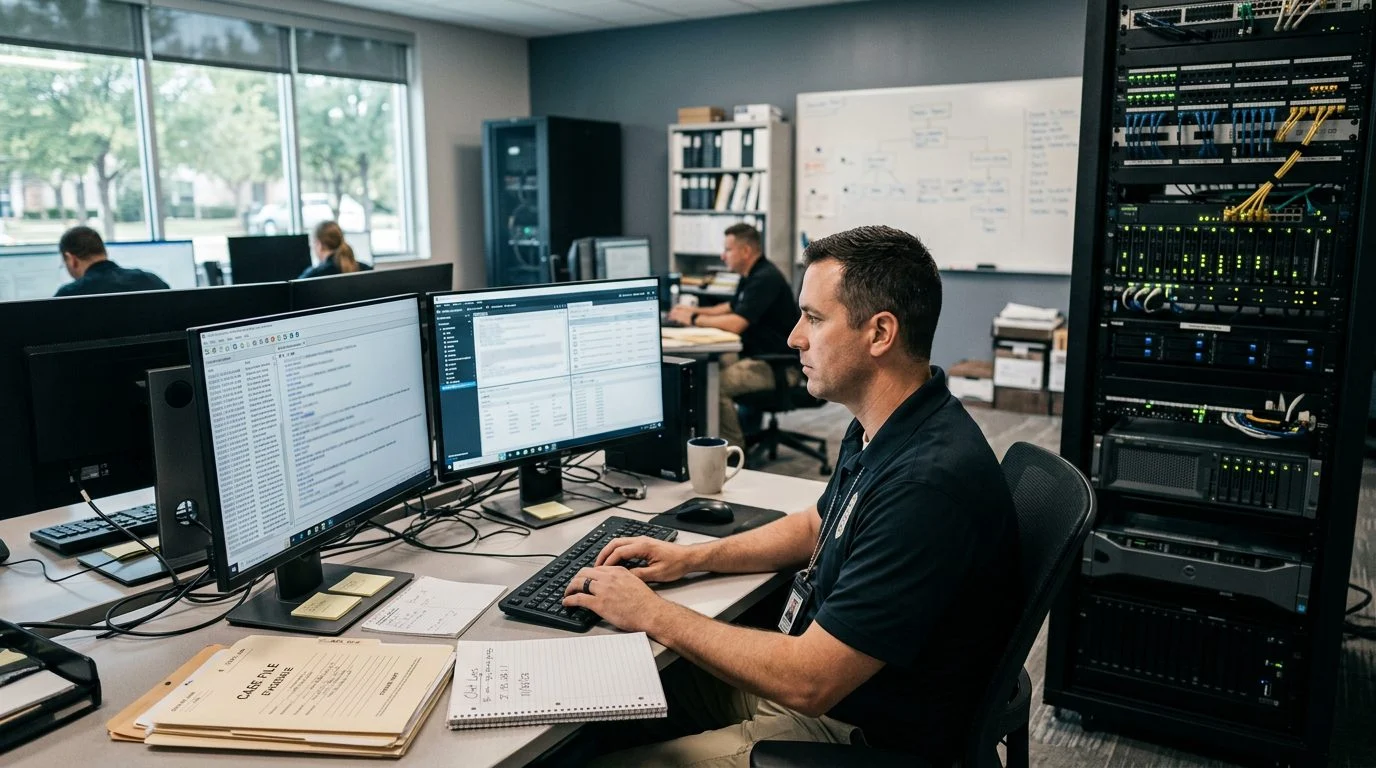
Frisco Online Sex Crimes Defense
Facing Chat Log Evidence? Start With a Careful Review of Every Message
Barbieri Law Firm reviews how messages were captured, stored and presented, so you understand what the evidence shows and which questions it raises. Serving Frisco, Collin County and Dallas-Fort Worth.
By Heather Barbieri · Published October 20, 2026
Chat logs and screenshots are often the main proof in an online sex crime case in Texas. A screenshot shows only the lines someone chose to copy. Barbieri Law Firm, an all-women criminal defense firm in Frisco, Texas, starts with the full record behind those images. This guide explains how a Texas online sex crime lawyer reviews chat log screenshots evidence, step by step.
What Chat Log and Screenshot Evidence Defense Covers
Chat log and screenshot evidence defense means reviewing and challenging the messages prosecutors use to prove an online sex crime. It covers text threads, app messages, social-media exchanges, and the screenshots taken from them.
This service is for adults charged after an online exchange. It also helps people told that an investigation is open and their messages are under review. Family members often help make this decision.
The work fits within the firm’s sex crimes practice. It covers:
- Online sex crimes and online solicitation of a minor.
- Child sex crimes charges that rest on digital messages.
- Assaultive or family violence allegations supported by texts or chats.
Texas defines “minor” for the solicitation statute as someone younger than 17, or someone the actor believes is younger than 17 (Penal Code § 33.021). That definition matters when the only proof of age is what someone typed. Under Subsection (b) of § 33.021, a person 17 or older commits a felony of the third degree by intentionally communicating in a sexually explicit manner with a minor, or distributing sexually explicit material to a minor, over the Internet or another electronic message service, but only when acting with the intent to commit an offense listed in Article 62.001(5)(A), (B), or (K), Code of Criminal Procedure. The offense becomes a felony of the second degree if the minor is younger than 14 or is someone the actor believes to be younger than 14. Solicitation to meet is a second-degree felony.
If your charge rests on messages you sent or received, our team will review the full chat record with you and explain your options in a free, confidential consultation. Talk it through with our team — the first consultation is free, confidential, and carries no obligation.

How Prosecutors Use Chats and Screenshots in Texas Cases
Prosecutors use chats and screenshots to show what was said, who said it, and what the writer meant. Those three points are where a defense starts.
Many online cases begin with a report. The National Center for Missing & Exploited Children runs a CyberTipline, and it refers suspected online enticement tips to law enforcement for possible investigation (NCMEC CyberTipline).
Messages can come from several places. They may come from a complainant’s phone, an investigator’s download, platform records produced under legal process, or a device taken from the accused. Each source can change what is visible and what is missing.
Solicitation to meet turns on intent. Under § 33.021(c), a person commits an offense if the person, over the Internet, by electronic mail or text message or other electronic message service or system, or through a commercial online service, knowingly solicits a minor to meet another person, including the actor, with the intent that the minor will engage in sexual contact, sexual intercourse, or deviate sexual intercourse. It is a defense if the actor was married to the minor, or was not more than three years older than the minor and the minor consented (Penal Code § 33.021). A single line rarely shows that intent alone.
Each charged offense is made up of specific elements, and reviewing how the evidence bears on each one is a core part of our work. Chat evidence is one part of that proof, not a verdict on its own. The Texas Attorney General’s cyber safety initiative also explains online solicitation of minors under Texas law.
What Our Team Reviews in the Digital Evidence File
Our team starts with the complete digital record, not the excerpt in the charging papers. The review looks at six areas:
- Full exports. We request whole conversations, not selected screenshots. We note what the state has produced and what it has left out.
- Timestamps and time zones. We check message order and times against device or account records.
- Account control. We look at who had access to each phone, login, or profile, including shared devices.
- Screenshot versus native data. We compare images with the original data to spot cropped text, missing messages, and gaps.
- Stated age and identity. We check what the other person actually said about age and identity, and whether that appears in the full thread.
- Each element. We map every message to the element of the charge the state must prove.
A line that looks clear in a screenshot can read differently with the messages before and after it. Context often changes the meaning.
Defense Challenges Used Against Chat and Screenshot Evidence
Defense challenges test how messages were obtained, whether they are complete, and who typed them. Each challenge is checked against the actual record before we raise it.
- We review how a phone, computer, or account was accessed.
- Authentication and chain of custody. We ask who collected the messages, how they were stored, and whether the record ties reliably to the accused.
- Incomplete context. A short excerpt can change meaning once the surrounding messages appear.
- Attribution. We examine whether the accused was the person typing, or whether someone else used the device or profile.
- Entrapment. Texas makes entrapment a defense when a law enforcement agent induces the conduct using persuasion or other means likely to cause persons to commit the offense. Giving someone an opportunity to commit an offense is not entrapment (Penal Code § 8.06). This question often arises in online sting cases, where an investigator runs the chat.
- Lack of intent. We examine whether the words show the intent the statute requires, or whether they were role-play, jokes, or unrelated to the charged conduct.
How the Process Works, Step by Step
The process runs in five steps, from the first call to ongoing updates. Each stage builds on the record from the one before.
- Free initial consultation. The consultation is free, confidential, and carries no obligation to continue. Bring the charging paperwork, any bond conditions, and the messages or screenshots you have.
- Evidence intake. We identify what the state has produced and what it has not. We request missing native data and complete records.
- Record review. We analyze full threads, device and account data, and the timeline. We explain what the evidence shows and what it leaves open.
- Motion and resolution planning. We identify suppression issues, authentication problems, and facts that may bear on bond and resolution.
- Ongoing updates. We explain each stage in plain language, including bond conditions and any internet restrictions.
How long each stage takes depends on the court’s schedule, how much digital data the state produces, and whether the case goes to trial.
Why Barbieri Law Firm for Digital Evidence in Sex Crime Cases
Barbieri Law Firm is an all-women criminal defense firm in Frisco, Texas. It defends professionals and others accused of sex crimes and assaultive offenses across Collin County, Dallas-Fort Worth, and Texas.
- Heather Jean Barbieri, Board Certified, Criminal Law — Texas Board of Legal Specialization.
- Our lawyers include Heather Barbieri and Carrie Thomas, supported by our office staff.
- Our approach starts with the complete digital record, not the screenshot in the charging documents.
- Our work covers the offenses described above, including online solicitation of a minor.
No lawyer can promise a particular outcome in a criminal case. What we can do is review the record carefully and explain your options.
Not sure what your next step is?
Talk it through with our team — the first consultation is free, confidential, and carries no obligation.
Common Questions About Chat and Screenshot Evidence Defense
Most questions come down to what to say to police, what happens to deleted messages, and what comes after a case ends.
Can a screenshot alone support a charge?
Charges can rest on messages shown in several forms. The defense checks where each copy came from and whether it is complete.
Should I give police my phone password?
Talk with a lawyer before answering police requests about a phone or password. Those choices carry legal consequences.
What if I deleted the messages?
Deleted content can still exist on devices, accounts, or platform records. The review looks at what remains and how it was obtained.
Does the consultation commit me to hire the firm?
No. You are not required to hire the firm after the consultation.
Can a dismissed case be cleared from my record?
Texas allows expunction when a dismissal falls within the categories in Code of Criminal Procedure art. 55A.053. Not every dismissal qualifies.
Talk With Our Team About Your Chat or Screenshot Evidence
The next step is a free, confidential consultation about the messages in your case. Maybe you were shown a screenshot you have not seen in full, or police took your phone during a search. In either case, you do not have to sort through the record alone.
Call (972) 424-1902 or send your case details through our contact page. We will schedule your consultation and review what the state has produced so far. Have the charging paperwork, court dates, bond conditions, and any messages or screenshots ready.
Attorney responsible for this site: Heather Barbieri, Barbieri Law Firm, Frisco, Texas.
How We Approach Chat Log Evidence
Source Review
We look at where each chat copy came from, who captured it, and whether the full conversation is shown.
Your Rights First
We discuss your options before you answer police questions about a phone, an online account or a password.
Context Matters
We read messages within the full conversation, including timing, device details and account information.
Plain-Language Explanations
We explain the evidence clearly so you can make informed decisions about your case.
Think Before You Delete or Respond
Deleting messages, closing accounts or contacting the other person can create new problems. Talk with a lawyer before you respond to police, prosecutors or anyone involved in the matter.
Common Questions About Chat Log Evidence
Can a screenshot alone support a charge?
Messages can be presented in several forms. We check where each copy came from and whether it is complete.
Should I give police my phone password?
Talk with a lawyer before answering police requests about a phone or password. Those choices carry legal consequences.
What if the other person said they were an adult?
Age and identity questions often depend on the full context. We review what each side can show and explain how it fits.
How do I get started?
Call (972) 424-1902 or send us your case details. The first consultation is free, confidential and comes with no obligation.
Free Initial Consultation: Confidential and Without Obligation. Call (972) 424-1902.
Related practice areas
- Online Sex Crimes Defense Lawyer | Collin County & Texas
Request a Consultation
Fill out the short form and we will take it from there.