

Online Sex Crimes Defense | Frisco, Texas
Defending Fake Profile Online Sex Crime Charges in Texas
Barbieri Law Firm, an all-women criminal defense firm in Frisco, reviews the accounts, messages and digital records behind the charge and explains your options from the first call.
By Heather Barbieri · Published November 11, 2026
The police say a profile, username or chat thread is yours. If you never wrote those messages, and someone else may have used the account, the central question is who was actually typing them.
This page explains how a case like this is usually investigated, where the evidence can be questioned, and what to expect if you hire a Texas criminal defense lawyer.
What This Defense Covers and Who It Is For
This defense applies when a fake profile, username, chat log or account sits at the center of an online sex crime charge, and you say you did not create or control it.
Under Texas Penal Code § 33.021, knowingly soliciting a minor to meet, over the Internet or by electronic message, with the intent that the minor will engage in sexual contact, sexual intercourse, or deviate sexual intercourse with the actor or another person, is a crime. That solicitation offense is a second-degree felony. It is not a defense that the meeting did not occur. The statute counts a person you believed was under 17 as a minor.
Accounts get faked or taken over in ordinary ways:
- Someone copied your photos into a new profile.
- A password was saved on a shared phone or computer.
- An email or social media account was hacked.
- A family member, roommate or former partner had access to your device.
Texas law defines an online identifier to include a name used in instant messages, social networking and similar Internet communication, including a user name or nickname. That definition describes what a username is. It does not say who typed it.
This page is for a man accused of an online sex crime who wants to know whether the account evidence can be challenged.
If the charge rests on a profile or account you say you did not create, you do not have to sort out the evidence alone. Call (972) 424-1902 or send your case details today. Talk it through with our team — the first consultation is free, confidential, and carries no obligation.

How Investigators Tie an Account to a Person, and Where the Link Is Weak
Investigators try to match records from the platform, the phone company and the device to one person at one time. Each match can be tested.
- Subscriber and login records. These show which IP address, device or phone number the platform linked to the account, and when. An IP address points to an internet connection. It does not, by itself, name the person who used it.
- Device extractions. These show whether messages were sent from the phone or computer the state says you used, and who else could reach that device.
- Screenshots versus full data. A screenshot may leave out timestamps, sender details, or the messages before and after the part shown.
- Gaps in the timeline. Messages may have been sent while you were somewhere else, from a shared device, through a saved login, or from an account that others can reach.
The complainant’s story and the digital data should be compared, not assumed to agree. For background on how online enticement is described, the National Center for Missing & Exploited Children publishes an issue page on the topic.
What a Defense Tests in Your Case
A defense tests whether the state can prove that you, specifically, sent the messages. A lawyer checks each part of the state’s case.
- Charging papers and discovery. A lawyer reviews the charge, the discovery file, and every message or record the prosecution relies on.
- Identity. Is there anything beyond the profile itself that shows you were the person operating it?
- Timeline. Message times are matched against where you were and which devices you had.
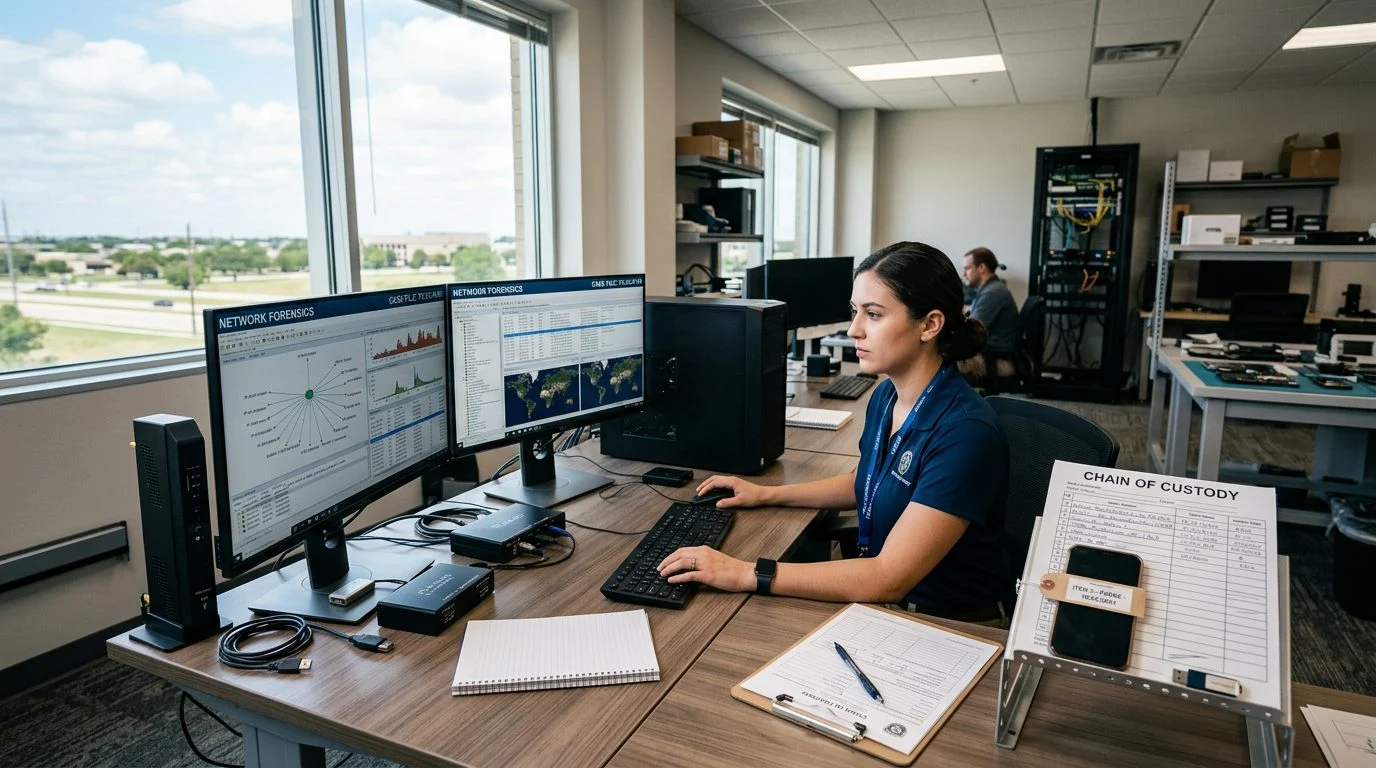
- Chain of custody. The lawyer examines how the phone, computer or account data was collected, stored and reviewed.
- The contact itself. Who started the exchange, and what the recorded messages actually say?
- Entrapment. Texas law makes entrapment a defense when a law enforcement agent induces the conduct using persuasion or other means likely to cause persons to commit the offense. Giving someone only an opportunity to commit an offense is not entrapment (Texas Penal Code § 8.06).
- Context. The lawyer considers whether the timing of the complaint, during a divorce, custody or CPS matter, bears on the evidence.
After the review, the lawyer explains your options and what each one would mean before you decide anything.
What to Expect From First Call to Defense Plan
The process starts with a first consultation and moves through evidence review to a written defense plan.
- First consultation. The firm offers a free, confidential first consultation with no obligation to continue. Bring the charging papers, bond paperwork and any notice you received.
- Preservation requests. The lawyer asks the platform, phone carrier and device sources to keep records that may show who used the account.
- Discovery review. Reports, recordings and other evidence are reviewed as the state produces them.
- Investigation. This may include a digital forensic examiner, depending on what the evidence contains.
- Motions and negotiation. These are pursued where the evidence review supports them.
- Written defense plan. You receive your options, the likely stages, and the consequences for your record, your registration and your family.
Timing depends on the court’s schedule and on when the digital data is produced. The plan is updated as those dates become known.
What to Avoid Before You Speak With a Lawyer
Early mistakes can hurt a defense, so hold off on these steps until you have spoken with a lawyer.
- Don’t delete anything. That includes accounts, messages, photos and apps. Deleting can look like hiding evidence and can damage your defense.
- Don’t contact the complainant or any possible witness about the accusation. Contact can complicate matters for you.
- Don’t post about the case, the accuser or the accusation on social media or in any group chat.
- Don’t give a recorded or written statement to police or investigators without a lawyer present.
- Keep devices and passwords as they are. Write down, for your lawyer only, who else had access to them.
Why Barbieri Law Firm for This Defense
Barbieri Law Firm is an all-women criminal defense firm in Frisco, Texas. It defends people accused of sex crimes and assaultive offenses across Collin County, Dallas-Fort Worth and Texas.
Heather Jean Barbieri, Board Certified, Criminal Law — Texas Board of Legal Specialization, leads the firm. The firm’s lawyers include Heather Barbieri and Carrie Thomas. Our team also includes support staff.
When you contact the firm, the lawyer reviews the account records, device data and recorded messages. Then the lawyer explains your options.
Not sure what your next step is?
Talk it through with our team — the first consultation is free, confidential, and carries no obligation.

Questions You May Be Asking
If someone else used my account, how does that affect my case?
What is the punishment range for a first-degree felony?
A first-degree felony carries life or a term of 5 to 99 years in prison, plus a fine of up to $10,000 (Texas Penal Code § 12.32).
Will a conviction affect my registration?
Registration depends on the offense and the outcome, and Article 62.001 defines the offenses tied to registration. Your defense plan covers that effect for each option.
Can I wait to see what the state does?
Early steps, such as asking that records be kept, help the defense request data while it is still on file.
If the charge rests on a profile or account you say you did not create, call (972) 424-1902 or send your case details. The firm will walk you through what happens next.
Attorney responsible for this site: Heather Barbieri, Barbieri Law Firm, Frisco, Texas.
How We Approach Online Cases
Review the digital evidence
We examine the account records, messages, screenshots and device data to understand what the State is relying on and what it does not show.
Confidential from the first call
What you share with us stays confidential. We ask for the facts you are comfortable giving so we can begin protecting your position.
Identity and attribution questions
Many online cases turn on who actually operated an account, when, and from where. We look closely at those questions with you.
Clear explanations
We explain the charges, the process and the options in plain language so you can make informed decisions at every stage.
Talk to a Lawyer Before You Act
Deleting messages, closing accounts or discussing an online profile with others can create problems of its own. Speak with a lawyer before you change or remove anything connected to the case.
Where We Serve
Collin County
Clients in Frisco, Plano, McKinney, Allen, Prosper, Celina and Southlake.
Dallas-Fort Worth
Representation for accused clients throughout the Dallas-Fort Worth area, including Dallas.
Across Texas
Criminal defense matters across Texas, including clients in The Woodlands and Midland.
Free, confidential initial consultation with no obligation to continue. Call (972) 424-1902 or send us your case details.
Related practice areas
- Online Sex Crimes Defense Lawyer
- Can You Be Charged With Online Solicitation of a Minor in Texas If No Meeting Happened?
Request a Consultation
Fill out the short form and we will take it from there.