

Child Sex Crimes Defense · Frisco, Texas
A Child's Statement Alone: What It Can and Cannot Mean in a Texas Case
An accusation can start quickly. Understanding how the State builds its case, and where it may fall short, is the first step in protecting your future.
By Heather Barbieri · Published November 14, 2026
If a child has made a statement that accuses you of sexual conduct, the question you need answered first is whether that statement alone can lead to a charge. Can that statement alone lead to a sexual abuse charge in Texas?
Can a Child’s Statement Alone Lead to a Charge?
A child’s statement can start an investigation. Whether it leads to a charge depends on the offense alleged and on what else the State can produce.
An accusation is not the same as a charge. Each step involves separate decisions by different people. The Texas Department of Family and Protective Services (DFPS) investigates child-abuse allegations (DFPS investigations). A criminal case is a separate process, and it can move on its own timeline.
Because one statement can start both tracks, it helps to understand each one early.
If a child's statement has put you under investigation, you do not have to work through the Texas process alone; our team can review your facts with you. Talk it through with our team — the first consultation is free, confidential, and carries no obligation.

How a Child’s Statement Enters the Case
A child’s statement usually reaches the system through an adult the child told first. That may be a parent, relative, teacher or counselor.
The Children’s Advocacy Centers of Texas guide explains how a report leads to DFPS and law-enforcement involvement.
Investigators may then ask to interview the child. How that interview is done matters. So do the questions asked and how the child’s words are recorded or written down. The adult who heard the first statement is also part of the record. You should know who heard it and when. Our team looks closely at these details when reviewing a case.
What the State Must Prove for Child Sexual Offenses
Each Texas offense has its own elements. In the sexual assault statute, Texas Penal Code § 22.011(c)(1) defines a “child” as a person younger than 17 years of age. Chapter 21 of the Penal Code, except as provided by Section 21.11 or 21.12, defines “sexual contact” as any touching of the anus, breast, or any part of the genitals of another person with intent to arouse or gratify the sexual desire of any person (Texas Penal Code § 21.01(2)).
Indecency with a child covers sexual contact, or certain exposure, with a child younger than 17 (Texas Penal Code § 21.11). Sexual contact is a second-degree felony, and exposure is a third-degree felony.
Under Texas Penal Code § 21.11, indecency with a child is a felony of the second degree for sexual contact under Subsection (a)(1) and a felony of the third degree for exposure under Subsection (a)(2). For aggravated sexual assault, a separate offense, the minimum term rises to 25 years if the victim is younger than 10, or younger than 14 when the offense is committed in a manner described by Subsection (a)(2)(A) (Texas Penal Code § 22.021).
Why Child Statements Are Tested Closely
A child’s statement is tested by asking how it was obtained, when it was first told, and whether it stayed the same.
Those questions are practical. Were leading questions asked? Are the words the child’s own, or do they sound like an adult’s? When did the child first describe the events, and to whom? Did the account change over time, and were details added later? Were there family disputes, custody issues or earlier talk about the subject that could shape the account?
These are questions a court and a defense lawyer must answer. They are not conclusions that the child is untruthful.
Other Evidence Investigators Commonly Collect
Investigators often look beyond the child’s words. What they find can help or hurt either side.
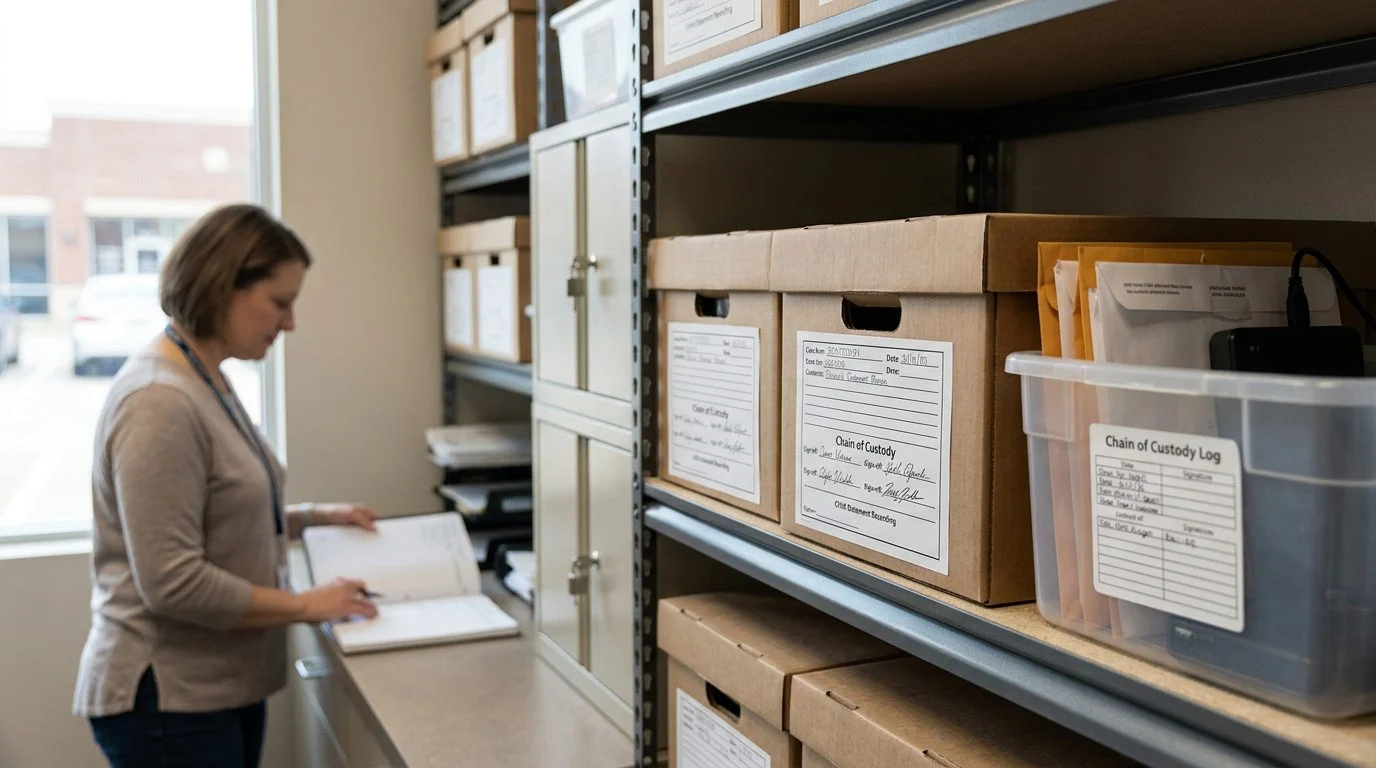
Medical records matter where they exist. Physical evidence, such as DNA, clothing or digital devices, may or may not connect to the accusation. The DNA page in this guide covers how samples are taken after an arrest.
When contact was online, messages and account records become central. The National Center for Missing & Exploited Children describes what online enticement involves and the grooming tactics it covers. The Texas Attorney General’s ICAC program states that the Southern Texas ICAC Task Force covers 134 Texas counties and investigates online child exploitation.
The absence of physical evidence does not end a case. The presence of it does not prove one.
Offenses Where the Child’s Account Is Central
Continuous sexual abuse, indecency with a child and online solicitation of a minor often turn heavily on what a child reports.
Continuous sexual abuse requires two or more acts of sexual abuse over a period of 30 or more days. The person must be 17 or older, and the child must be younger than 14 or a disabled individual (Texas Penal Code § 21.02). Jurors need not agree on which specific acts occurred or on the exact dates. They must agree that two or more acts occurred during a period of 30 or more days (§ 21.02(d)). The offense is a first-degree felony, punishable by life in prison or by a term of not less than 25 and not more than 99 years.
Section 21.02(g) provides an affirmative defense in cases involving only victims younger than 14. It has several conditions, including that the accused was not more than five years older than the victim and used no duress, force or threat.
Online solicitation is different. It involves knowingly soliciting a minor online, by text, or through a commercial online service to meet for sexual contact or intercourse (Texas Penal Code § 33.021). A “minor” includes a person the actor believes to be younger than 17. It is not a defense that the meeting did not occur. Penalties depend on the exact subsection charged, so read the charging papers closely.
Not sure what your next step is?
Talk it through with our team — the first consultation is free, confidential, and carries no obligation.
What Happens After an Accusation Is Made
An accusation can lead to an investigation, an arrest or a formal charge. Each step is a separate decision.
Investigators may ask to interview you or seek search warrants before any arrest. Early choices can shape what follows.
Time limits depend on the offense. Penal Code § 12.01 provides that a person adjudged guilty is punished in accordance with the Penal Code chapter and the Code of Criminal Procedure, while Texas Code of Criminal Procedure art. 12.01 provides no limitation period for continuous sexual abuse of young child or disabled individual under Section 21.02, Penal Code. Penal Code § 12.01 sets punishment in accordance with the Penal Code chapter and the Code of Criminal Procedure; the biological-evidence time-limit conditions are found in Texas Code of Criminal Procedure art. 12.01(1)(C). Penal Code § 12.01 sets punishment in accordance with the Penal Code chapter and the Code of Criminal Procedure; the three-year limitation for most other felonies is in Texas Code of Criminal Procedure art. 12.01(11).
For the full sequence after a charge, read our guide to what happens next.

Testing the Accusation Early
Early review of the evidence is where a defense usually begins.
A first review can cover the recorded interview, the timeline, the digital messages and any medical records that exist. It can also show what the State has disclosed, what it has not produced, and which questions need answers before you make decisions.
If you have just learned that a child’s statement could lead to a charge against you, the next step is comparing that statement with the facts you know. The initial consultation is free, confidential, and carries no obligation to continue. Call (972) 424-1902 or send your case details through the contact form. No lawyer can say in advance how a case will end.
Frequently asked questions
Can a child’s statement alone lead to a sexual abuse charge in Texas?
It can start an investigation. Whether it leads to a charge depends on the offense and what else the State can produce.
Is there a time limit for continuous sexual abuse in Texas?
Penal Code § 12.01 says a person guilty of an offense under the code shall be punished in accordance with the punishment chapter and the Code of Criminal Procedure. Art. 12.01(1)(D) of the Texas Code of Criminal Procedure provides no limitation period for continuous sexual abuse of young child or disabled individual under Penal Code § 21.02.
What is the minimum sentence for aggravated sexual assault of a child under 10?
Penal Code § 22.021(f)(1) increases the minimum term to 25 years when the victim is younger than 10. Penal Code § 12.01(a) ties offenses under the code to the punishment chapter and the Code of Criminal Procedure.
Attorney responsible for this site: Heather Barbieri, Barbieri Law Firm, Frisco, Texas.
How we approach these cases
We review the full record
We examine the forensic interview, police reports, recordings and any medical or school records to see what the State actually has.
We test the statement
We look at how the account was obtained, who asked the questions, and whether the details have changed over time.
We explain your options
We walk you through the charge, the evidence and the possible paths forward so you can make informed decisions.
Your matter stays confidential
Everything you share with Barbieri Law Firm is kept confidential.
Speak with a lawyer before you answer questions
Police and Child Protective Services investigators may ask for statements, interviews or access to your home or devices. Talk with a criminal defense lawyer before you respond.
What we need to know about your situation
The allegation
The offense alleged, the age of the child and the date and place described in the accusation.
Who has spoken
Any interviews, statements or recorded conversations already given to police, prosecutors or child welfare workers.
Notices and court papers
Any warrant, summons, protective order or letter you have received, with its date.
Questions you have
Write down what worries you most so we can address it during your consultation.
Talk with Heather Barbieri about your case. The initial consultation is free, confidential and carries no obligation to continue.
Related practice areas
- Child Sexual Abuse Allegations in Texas
- Accused of Child Abuse in Texas: What Happens Next
Request a Consultation
Fill out the short form and we will take it from there.