

Child Sex Crimes Defense | Frisco, Texas
Understanding the Forensic Interview in a Texas Child Sex Crime Case
Heather Barbieri, a Frisco criminal defense lawyer, explains what a recorded forensic interview is, who takes part, and what the recording can and cannot show.
By Heather Barbieri · Published October 19, 2026
A forensic interview is a recorded conversation between a trained interviewer and a child, held to learn what the child may have experienced. In a Texas child sex crime case, this interview can shape the whole investigation. Here is what happens at a forensic interview, who is involved, and what the recording can and cannot show. This guide is written for the accused, so it explains what the record contains and why it gets read closely.
What Is a Forensic Interview of a Child?
A forensic interview is a structured, recorded conversation with a child, held to gather information about possible abuse or other harm. Its purpose is to collect the child’s own account in a neutral, child-friendly setting, not in a police station or courtroom. The goal is an accurate account, not a particular answer.
The interviewer uses open-ended questions and lets the child answer in their own words. Professional standards for these interviews include avoiding repeated questioning, according to the OJJDP child forensic interview guidance. Those are general standards, not Texas rules on admissibility, parental access or discovery.
In many Texas cases the interview takes place at a Children’s Advocacy Center, a setting built for children. It is one step in a larger investigation. For how these cases are built, read our Texas child sex crimes guide.
Who Conducts the Interview and What Training Is Involved?
The interviewer is a trained professional who follows a set protocol, not an informal conversation. The protocol guides the pace, the wording and the order of topics. Protocols differ by agency, so the same case can be handled in different ways depending on where the interview is held.
The interviewer’s job is to draw information out of the child. The interviewer does not decide whether the allegation is true. That decision belongs to the wider investigation.
A particular interviewer’s training and qualifications are facts about that person. Defense counsel reviews them, along with the protocol followed and how each question was asked. Those details matter because a child’s answer can only be read in light of the question that produced it. A recording lets anyone see that sequence.
Who Can Watch the Interview and Who Else Is Involved?
Whether a parent can watch depends on the facts of the case and the protocol the agency follows. Observation may happen from another room or through the recording, depending on that protocol.
Several agencies are often involved. A multidisciplinary team (MDT) can include law enforcement, Child Protective Services (CPS) and prosecutors, and each has its own role. The CPS basic investigation handbook describes an ongoing child-safety assessment as part of CPS investigation procedure. One case can involve more than one track at once.
Child victims also have support. An advocate may therefore be part of the process. For the accused, the practical point is simple: who is in the room affects how the recording was made and what it shows.
What Happens During a Typical Forensic Interview?
A typical interview moves through a set sequence: rapport, ground rules, open narrative, follow-up and a closing check.
Rapport. The interviewer introduces themselves and builds comfort before the topic comes up.
Ground rules. The child is told to tell the truth, to say when a question is not understood, and that saying “I don’t know” is fine.
Open narrative. The child describes what happened in their own words, with simple prompts such as “Tell me more.”
Follow-up. The interviewer asks clarifying questions about what the child has already said.
Closing. The child is asked whether there is anything else to share before the session ends.
The interview is usually recorded. Anyone reviewing it can see exactly what was asked, what was answered and in what order. Each stage has a purpose, so knowing the order helps when you read the recording or a written summary of it.
What Does the Interview Create for the Case?
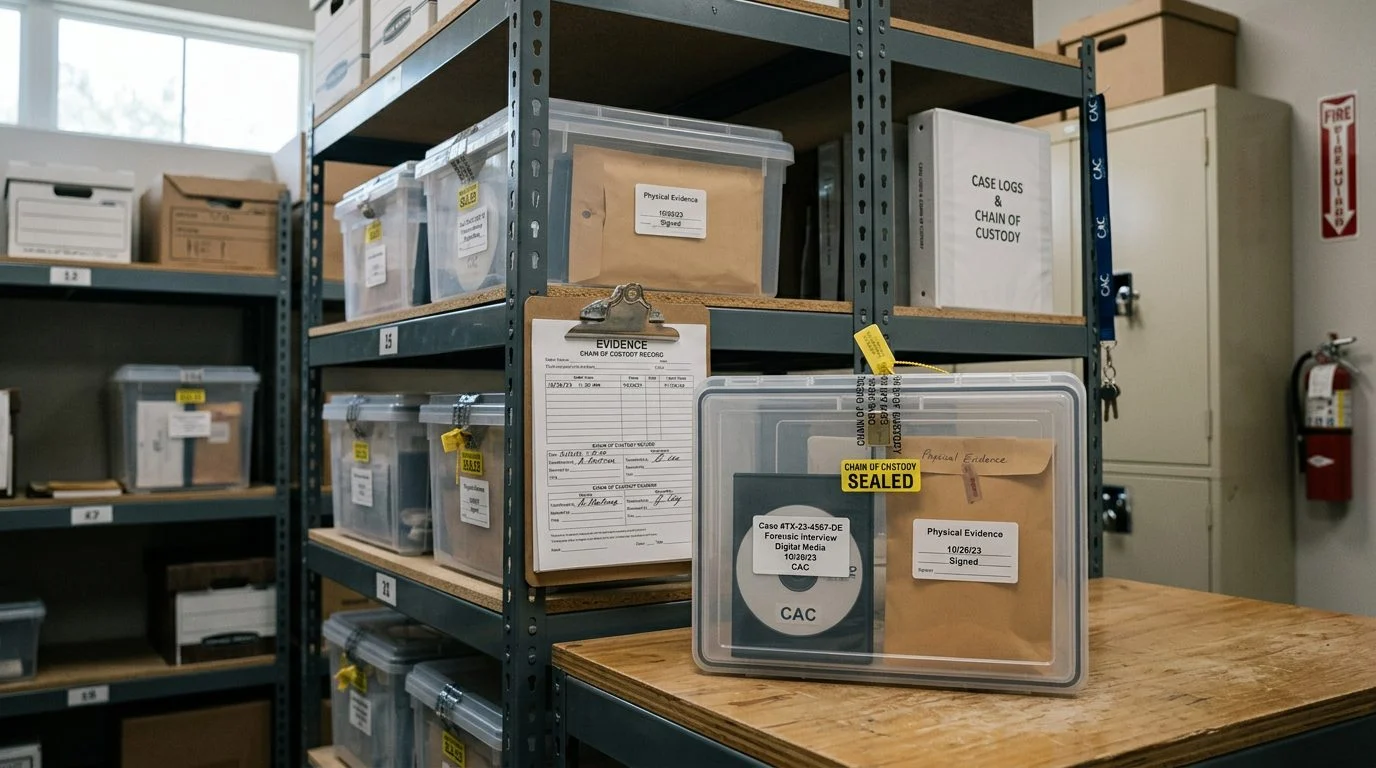
The recording and any notes or reports from the interview become part of the investigative file. Defense counsel obtains and reviews that file as part of building the defense.
The recording matters because it shows three things: the exact questions asked, the child’s exact words and the order in which details came out. Defense counsel reads the questions as carefully as the answers.
A written summary shows what someone chose to write down. The recording shows what was actually said. That is why the wording and sequence can become central to the review.
These details help the defense test the account. They also show whether the interview followed the professional standards described in the OJJDP guidance, including the avoidance of repeated questioning.
What Can a Forensic Interview Establish?
A forensic interview alone does not decide what happened. It records what a child said under particular conditions, and it is one piece of evidence weighed with the rest of the case.
The questions shape the answers. Defense counsel looks at whether the interviewer asked open questions, whether the same topic was revisited again and again, and how much time passed between the event and the interview.
The charge also matters. Under Texas Penal Code § 21.11, indecency with a child by sexual contact requires touching, even through clothing, of a child’s anus, breast or any part of the genitals, or touching any part of a child’s body with a person’s anus, breast or genitals, done with intent to arouse or gratify the sexual desire of any person. The statute applies to a child younger than 17.
The same section sets out affirmative defenses. One requires, among other things, that the actor was not more than three years older than the child, was of the opposite sex, and used no duress, force or threat. Questions about ages, force and threats in the interview can therefore matter a great deal.
Can a Child Decline a Forensic Interview?
Whether a child can decline or stop an interview depends on the facts of the case and the agency involved. The accused generally does not schedule, arrange or cancel the interview. That choice sits with the agency and the child’s situation, not with the person under investigation.
Timing is set by agency rules.
How a child’s participation was handled is one of the questions defense counsel reviews as part of the case. Knowing the timeline helps the defense ask what happened, and when.
If a Child Was Interviewed in Your Case
If you learned that a child was interviewed about you, the most useful step is to understand the recording and how it fits the charge. That news may come from investigators, an agency, or the charging documents.
Heather Jean Barbieri, Board Certified, Criminal Law — Texas Board of Legal Specialization, leads Barbieri Law Firm. It is an all-women criminal defense firm in Frisco, Texas, serving Collin County, Dallas-Fort Worth and Texas. The firm defends people accused of sex crimes and assaultive offenses.
If a child was interviewed about you and you want to talk through what the recording means, call (972) 424-1902 or send your case details through our contact page. The first consultation is free, confidential and carries no obligation to continue.
Attorney responsible for this site: Heather Barbieri, Barbieri Law Firm, Frisco, Texas.
How Our Firm Approaches a Forensic Interview Case
We review the full recording
We look at the complete interview, including the questions asked, how they were phrased, and how the conversation was guided from start to finish.
We compare the interview to the rest of the file
We review reports, prior statements, and other evidence to see whether the interview matches what else the investigation has gathered.
We explain your options
We walk you through what the record contains, what it may mean for your case, and the choices available to you, so you can make informed decisions.
We protect your confidentiality
Everything you share with our office is kept confidential. Our team handles calls and case materials with discretion from the first contact.
Be Careful What You Say About the Allegations
Statements you make about the allegations, to family, friends, coworkers, or anyone else, can become part of the record. Talk with your lawyer before discussing the interview or the allegations with anyone.
Questions Often Asked About Forensic Interviews
Who conducts the interview?
A trained interviewer, often at a child advocacy center, speaks with the child. Law enforcement or child protective services personnel may observe or review the recording.
Is the interview recorded?
Forensic interviews are commonly video-recorded. Reviewing the actual recording, rather than a summary, is an important part of evaluating the case.
What can the recording not show?
A recording shows words, tone, and demeanor. It does not show what happened outside the room, what was said before recording began, or how the child was prepared.
What should I do next?
Call our office at (972) 424-1902. Heather Barbieri will discuss the charges, the interview, and the evidence with you in a free, confidential initial consultation, with no obligation to continue.
Talk With Heather Barbieri About Your Case
Related practice areas
Request a Consultation
Fill out the short form and we will take it from there.