

Child Sex Crimes Defense | Frisco, Texas
When a Children's Advocacy Center Interview Is Part of Your Case
Barbieri Law Firm reviews how the interview was conducted, what was recorded, and what options you may have next.
By Heather Barbieri · Published November 10, 2026
You’ve learned that a child was interviewed at a Children’s Advocacy Center, and your loved one now faces a child sex crime allegation. You want to know what that interview is and whether the defense can challenge it.
A children’s advocacy center forensic interview is a structured interview of a child about alleged abuse.
Short answer: what the interview is and whether it can be challenged
The interview often sits at the center of a case, so reviewing it is one of the first steps a defense lawyer takes. A challenge can narrow the evidence the State relies on. It cannot decide how a court will rule. No lawyer can predict or assure an outcome. The sections below explain how the interview works, why it matters in Texas, and what a review looks like. Think of the review as a close look at the evidence, not a forecast of the ending.
If you've just learned a child was interviewed about an allegation involving your loved one, you don't have to face the next steps alone, so send us your case details. Talk it through with our team — the first consultation is free, confidential, and carries no obligation.
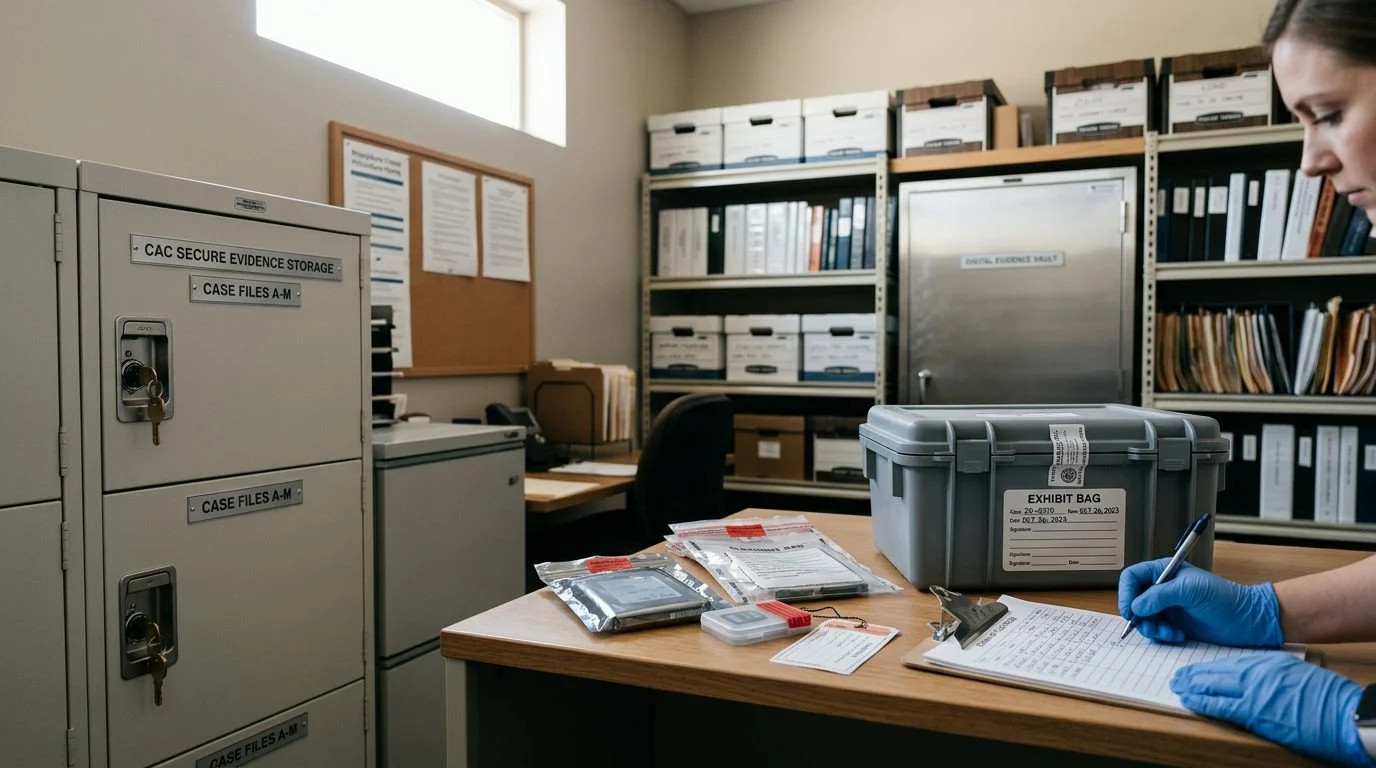
What a Children’s Advocacy Center is
A Children’s Advocacy Center is a child-focused facility where several agencies work on a child abuse case together. Texas Children’s Advocacy Centers coordinate forensic interviews within a multidisciplinary response. They also provide a child-friendly setting where a child can share an account, according to Children’s Advocacy Centers of Texas.
Because the interview is coordinated, it often becomes the main record of what the child said. That is why a defense lawyer looks at it closely. The center is the setting for the interview, not a court. The criminal case moves through the police, the prosecutors, and the courts.
How a forensic interview is conducted
A trained forensic interviewer leads the conversation with the child in a child-friendly setting. Professional standards call for open-ended questions and for avoiding repeated questioning, according to OJJDP guidance on child abuse investigations. That gives a defense lawyer a clear test: does the recording show those standards were followed?
A forensic interview is not a medical exam. A medical exam checks the child’s body. The interview records what the child says about what happened. Both may appear in the same case file, so ask which records exist. If the interview was recorded, the recording is the most complete record of the questions asked and the answers given.
Why the interview matters in a Texas case
The interview often becomes the main account of what a child said, and it can carry weight in court. Texas law addresses a child’s statements at protective-order hearings. Under Texas Code of Criminal Procedure art. 7B.004, a statement by a child younger than 14 who is the victim of listed Penal Code sex offenses, and that describes the offense, is admissible at that hearing. Under Texas Code of Criminal Procedure Art. 7B.004, in a hearing on an application for a protective order, a statement by a child younger than 14 years of age who describes an offense under Section 21.02, 21.11, 22.011, 22.012, or 22.021, Penal Code, committed against the child is admissible as evidence in the same manner that a child’s statement about alleged abuse is admissible under Section 104.006, Family Code, in a suit affecting the parent-child relationship.
The rule speaks to protective-order hearings. Ask your lawyer which proceeding your family is facing, because the answer shapes the review.
Can the defense get the recording and the file?
A defense lawyer will want to review the recording, any notes, and the reports tied to the interview. Early in a case, the lawyer focuses on what the file actually contains. Family members often hear secondhand summaries, and those summaries can differ from the recording.
Your part is to protect that material. Don’t copy, share, or post any part of it. Don’t ask the child about the interview or the allegations, because questions can change what a child remembers and complicate the review. Send every question about the case to the defense lawyer.
How a defense lawyer can challenge a forensic interview
A defense lawyer checks how the interview was done, what came before it, and how the account is being used.
Protocol review. The lawyer checks whether the interviewer used open-ended questions or repeated, suggestive questions. The OJJDP guidance above sets the standard that review measures against.
Contamination review. The lawyer asks whether the child talked about the allegations with family, caregivers, school staff, or others before the interview. If those talks happened, the review looks at whether they may have shaped the account.
Timing review. The lawyer looks at how much time passed between the alleged events and the interview. The review also asks whether the child told anyone else in between, such as a counselor or medical provider.
Gap review. If parts of the conversation were not recorded, the lawyer looks at what was left out and who was in the room.
Use review. The lawyer checks which rule governs how the statement may be offered and at which hearing. For a protective-order hearing, the rule in art. 7B.004 is the starting point.
These are factual and legal review points. A court decides which ones succeed.
Not sure what your next step is?
Talk it through with our team — the first consultation is free, confidential, and carries no obligation.
What a challenge can and cannot do
A successful challenge limits evidence; it does not end a case on its own. Other evidence may still be part of a case, such as other statements, medical findings, or witness testimony. The defense reviews all of it, not just the interview.
A protective order can set specific conditions. In a protective order, a court may prohibit the alleged offender from communicating with the applicant or a member of the applicant’s family or household in a threatening or harassing manner. It may also prohibit going to or near a residence, place of employment or business, or child-care facility or school. If an order includes a ban on going to or near a location, the court must describe each prohibited place and the minimum distance, if any, that must be kept, unless the court has received a request to maintain confidentiality of information revealing the locations. Read any order closely with your lawyer, since each condition is specific.
What to gather now and why timing matters
Gather your papers and dates before your first meeting with a defense lawyer. Bring any charging papers or protective-order papers you have. Include the date of the interview, the dates of any medical visits, and a written list of who has talked with the child about the allegations and when.
Write the list while your memory is fresh. Keep it private, and share it only with your lawyer. Bring any questions about the interview itself, too.
Early review also gives the defense more time to prepare for any hearing that is set. Whether a case can be dismissed depends on the evidence and the facts.
About Barbieri Law Firm and the next step
Barbieri Law Firm is an all-women criminal defense firm in Frisco, Texas. The firm defends people accused of sex crimes and assaultive offenses, including child sex crimes, online sex crimes, and family violence, across Collin County, Dallas-Fort Worth, and Texas. Heather Barbieri and Carrie Thomas are the firm’s lawyers.
Heather Jean Barbieri, Board Certified, Criminal Law — Texas Board of Legal Specialization.
The first consultation is free, confidential, and without obligation.
Frequently asked questions
Is a forensic interview the same as a medical exam?
No. A forensic interview records what a child says about alleged abuse, while a medical exam checks the child’s body.
Can a defense lawyer challenge a Children’s Advocacy Center interview?
Yes. A defense lawyer can review how the interview was done and raise legal challenges, but a challenge limits evidence and does not decide the case alone.
Can a child’s statement be used at a protective order hearing in Texas?
Under art. 7B.004, a statement describing listed sex offenses can be admissible at that hearing when the child is younger than 14.
Protective orders and schools.
Under Tex. Code Crim. Proc. art. 7B.005, a court may prohibit the alleged offender from going to or near the residence, place of employment or business, or child-care facility or school of the applicant or a family or household member. When a protective order includes that condition, the court must specifically describe each prohibited location and any minimum distance the alleged offender must maintain, unless the court has received a request to maintain confidentiality of information revealing the locations (art. 7B.005).
If you’ve just learned that a child was interviewed about an allegation involving your loved one, you don’t have to work through the next steps alone. Call (972) 424-1902 or send your case details through the contact form to set up your consultation.
Attorney responsible for this site: Heather Barbieri, Barbieri Law Firm, Frisco, Texas.
How Barbieri Law Firm Approaches These Cases
Review of the interview itself
We look at how the forensic interview was conducted, including the recording, the questions asked, and the timeline, and explain what those details may mean for your case.
An all-women firm
Barbieri Law Firm is an all-women firm in Frisco, Texas. Our team represents clients in Collin County, Dallas-Fort Worth, and across Texas.
Review of all the evidence
We review the full record, including reports, related evidence, and any other statements, so we can explain the charges and the options available to you.
Heather Barbieri leads the defense
Heather Jean Barbieri, Board Certified, Criminal Law — Texas Board of Legal Specialization, founded Barbieri Law Firm and leads each defense we handle.
Before You Speak About the Interview
What you say about the interview, whether to the child, to family members, to school staff, or online, can become part of the case. Talk with a lawyer before you respond to anyone about it.
Questions We Help You Work Through
What the interview recorded
We review the recording and the interviewer's notes to understand what was said, how it was asked, and what was left out.
Whether the process was followed
We examine the interview protocol and the steps taken before and after the interview to identify issues that may affect the evidence.
How the interview fits the other evidence
We compare the interview with medical findings, reports, and other statements to see where the case is strong and where it is not.
Your options going forward
We explain the possible paths in your case and what each one would involve, so you can make informed decisions.
Talk With Barbieri Law Firm About Your Case
Related practice areas
Request a Consultation
Fill out the short form and we will take it from there.