

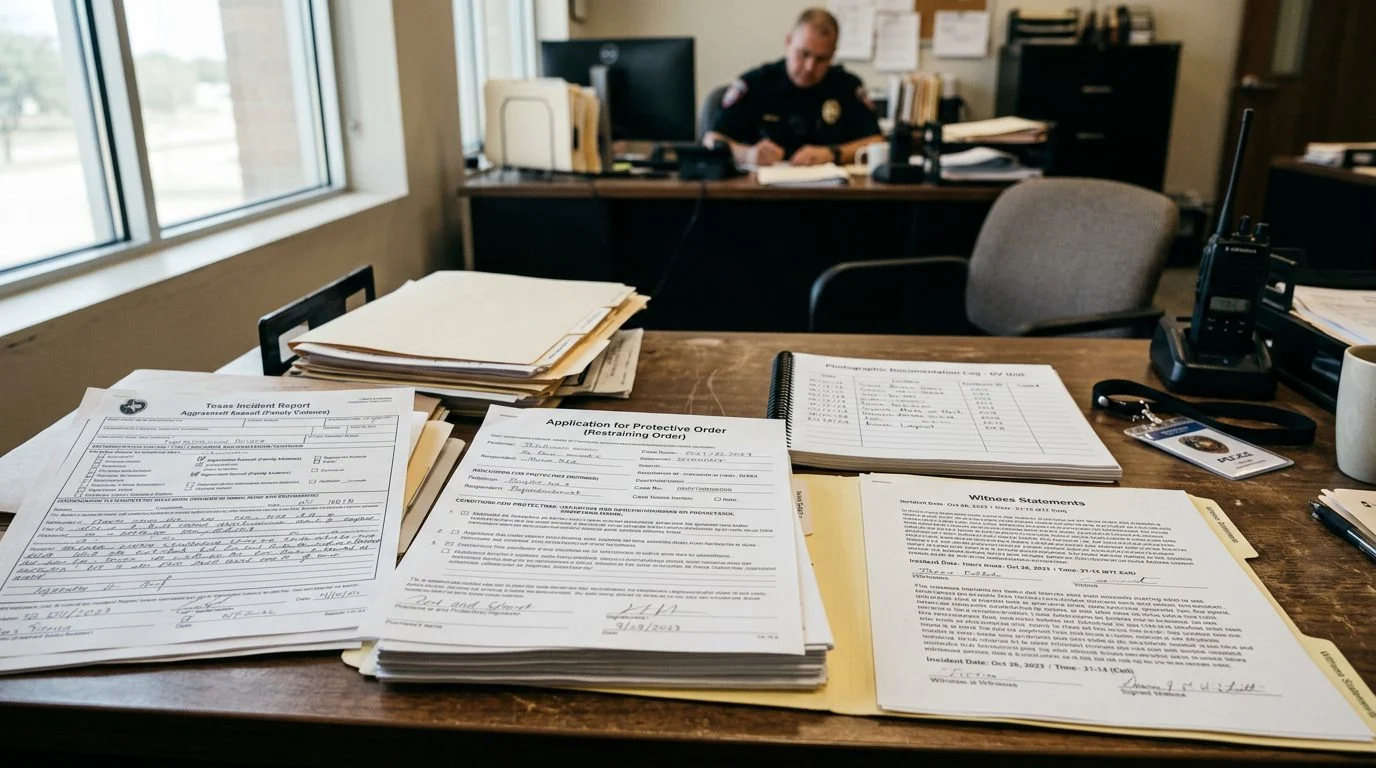
Charged With Aggravated Assault After 911 Call, Texas
By Heather Barbieri · Published November 9, 2026
You called 911 because someone needed help, and officers still arrested you. That can feel unfair, and the charge can feel confusing. A 911 call does not by itself decide who the aggressor is. Here is how a Texas aggravated assault or family violence charge works, and what you can do now.
Why calling 911 did not keep you from being charged
A 911 call does not protect you from a charge. Officers respond to a scene, not just to the person who called, and they can make an arrest based on what they find there.
An arrest can follow even when the caller was the one who was hurt. Officers talk to everyone involved before they decide what happens next.
After an arrest for an offense involving family violence, a magistrate may issue an emergency protection order under Texas law. A court can also issue a temporary ex parte order without notice or a hearing if, based on the information in an application for a protective order, it finds a clear and present danger. That is how a protective order can keep you out of your home early in the case.

What aggravated assault and family violence mean under Texas law
Aggravated assault is an assault that causes serious bodily injury, or that uses or exhibits a deadly weapon during the assault. Plain assault is the lower-level offense.
Under the Texas assault statute, assault covers intentionally, knowingly or recklessly causing bodily injury to another. It also covers threatening someone with imminent bodily injury. Under the aggravated assault statute, the offense adds serious bodily injury or a deadly weapon.
Family violence is an act by a family or household member against another member. The act must be intended to cause physical harm, bodily injury or assault, or be a threat that reasonably places the member in fear of imminent harm. The family violence definition does not include defensive measures to protect oneself. A household is people living together in the same dwelling, whether or not they are related.
Aggravated assault is generally a second-degree felony. A second-degree felony carries 2 to 20 years in prison and a fine of up to $10,000, under Texas felony punishment law. Under Penal Code § 22.02(b)(1)(A), aggravated assault is a first-degree felony when the accused uses a deadly weapon during the assault and causes serious bodily injury to a person in a family, household or dating relationship described in the Family Code. Section 22.02(b) also lists other first-degree circumstances, including certain assaults against public servants, process servers or security officers, discharging a firearm while inside or directly en route to or from a motor vehicle, and an assault committed as part of a mass shooting.
The charge named on your arrest paperwork is not always the final charge. Read every page closely.
How officers decide who the aggressor is at the scene
At the scene, officers act on what they can see and learn at that moment. No single fact settles the question right away.
Officers typically look at visible injuries and each person’s condition. They also take statements from the people present, talk to neighbors or bystanders, and check for any weapon. The 911 recording may capture what was said as things happened.
The person who called for help is not automatically treated as the victim. The person who was hurt is not automatically treated as the aggressor, either.
Whether someone acted in self-defense depends on what each person did and why. That is a legal question, so don’t assume the call answered it. Keep that question in mind from the start, because the family violence definition leaves out defensive measures.
How prosecutors review the case after the arrest
After an arrest, a prosecutor reviews the evidence and decides what charge to file or pursue. The review usually includes the offense report and any body or dash camera footage.
The prosecutor may also look at medical records, photographs, witness statements and the 911 recording. The charge can change as the evidence is reviewed.
At trial, if the court determines the offense involved family violence, it must make an affirmative finding. The judge then enters that finding in the judgment. That is why the label on the case matters to your record.
Your own words on the 911 recording and in the officer’s report are part of this review. The case is still being evaluated. What happens next depends on the evidence and on how the case proceeds.
Why your first statement matters and what to do right now
Your first statement matters because it becomes part of the record the prosecutor reviews. Think before you speak to anyone about what happened.
Questions from officers can affect your case, so it helps to talk with a lawyer before you answer them.
Don’t discuss the incident with officers, the other person, family members or coworkers. Avoid talking about it on recorded jail or phone lines.
Follow every bond condition and every protective order term exactly. A person who knowingly violates certain bond conditions or orders in a family violence case can face a separate offense.
Write down what you remember, in private, for your lawyer. Keep any texts, photos and messages. Share them only with your lawyer.
The protective order, your home, your firearms and your job
A protective order can keep you away from your home and bar firearm possession. Under Texas protective order requirements, a court may bar a person found to have committed family violence from going to or near the residence of a protected person. The court may also bar that person from possessing a firearm, unless the person is a peace officer, as defined by Section 1.07, Penal Code, meaning a person elected, employed, or appointed as a peace officer under Article 2A.001, Code of Criminal Procedure, Section 51.212 or 51.214, Education Code, or other law. In a protective order, the court shall suspend a license to carry a handgun held by that person.
If an order states no end date, it lasts until the second anniversary of the date it was issued. If the order was issued against someone charged with a family violence offense, it lasts until the second anniversary of the final disposition of the criminal case, under Texas protective order duration law. Except for a protective order issued under Subchapter A, Chapter 7B, Code of Criminal Procedure, after the first anniversary, a person under an order may file a motion asking the court to review whether it is still needed.
The emergency protection order statute sets out when a magistrate may issue an order for emergency protection after an arrest for an offense involving family violence.
Ask your lawyer how a pending charge could affect your job and your license.

Next steps if you were charged after calling 911
The next step is a confidential talk with Heather Barbieri about your charge and your protective order. Heather Barbieri defends professionals charged with aggravated assault and family violence in Collin County, across the Dallas-Fort Worth area and throughout Texas.
You can call (972) 424-1902 or send your case details through the contact page. The first consultation is free, confidential and carries no obligation to continue. No lawyer can say for certain how a case will end, but a conversation can help you understand your options.
For more on aggravated sexual assault charges in Texas, read our Texas guide to aggravated sexual assault charges.
Can I be arrested for aggravated assault if I called 911 for help?
A 911 call does not prevent an arrest. Officers respond to the scene and act on what they find there.
What is the difference between assault and aggravated assault in Texas?
Aggravated assault adds serious bodily injury or a deadly weapon to an assault. It is generally a second-degree felony.
How long does a protective order last in Texas?
Attorney responsible for this site: Heather Barbieri, Barbieri Law Firm, Frisco, Texas.
Ready to take the next step?
Related practice areas
Request a Consultation
Fill out the short form and we will take it from there.