

Aggravated Assault Defense | Frisco, Texas
Accused of Aggravated Assault With Your Car? Speak With a Texas Defense Lawyer Now
A collision charge can raise serious questions about intent, injury and the evidence. Our all-women firm reviews the facts with you and explains the options available.
By Heather Barbieri · Published November 15, 2026
A car isn’t a weapon in most people’s minds, so a charge that calls yours one can feel unreal. Maybe it started with a parking-lot argument, a road-rage moment or a close call on the highway. Now the State says the vehicle was a deadly weapon.
Under Texas law, a car can be a deadly weapon when, in the way it is used or intended to be used, it can cause death or serious bodily injury. This page explains how an aggravated assault with a motor vehicle charge works in Texas, what the State must prove, what is at stake, and what happens next.
How a Car Becomes a Deadly Weapon Under Texas Law
A car becomes a deadly weapon when its use is capable of causing death or serious bodily injury. Under Texas law, a deadly weapon includes a firearm or anything manifestly designed, made, or adapted for the purpose of inflicting death or serious bodily injury, and anything that, in the manner of its use or intended use, is capable of causing death or serious bodily injury.
Aggravated assault has two routes. The State can show that an assault caused serious bodily injury to another person. It can also show that a deadly weapon was used or exhibited during the assault. Texas Penal Code § 22.02 sets out both routes.
Serious bodily injury means an injury that creates a substantial risk of death. It also means an injury that causes death, serious permanent disfigurement, or long-lasting loss of a body part’s function.
Most of these charges are second-degree felonies. Some are first-degree felonies, such as certain cases where a deadly weapon causes serious bodily injury to a person who has a family, household or dating relationship with the defendant under Texas law.
Whether the charge holds up depends on the facts. The key questions are how you drove or moved the car and what you intended or knew.
If a car is now at the center of a charge you never expected, you don't have to work through the next steps alone, and our team is ready to talk. Talk it through with our team — the first consultation is free, confidential, and carries no obligation.

What the State Must Prove in a Car-Based Case
The State must prove an assault first, then an aggravating factor. Assault has three forms under Texas law:
- Intentionally, knowingly or recklessly causing bodily injury to another person.
- Intentionally or knowingly threatening another person with imminent bodily injury.
- Intentionally or knowingly making physical contact that the person knows or should reasonably believe will be seen as offensive or provocative.
Then the State must tie that assault to a deadly weapon or to serious bodily injury.
Recklessness matters here. A crash is not automatically outside the statute, because bodily injury assault can rest on recklessness. A case built on a collision asks what you did and how the vehicle moved. A case built on intent asks what you meant to do.
Cases like this often turn on speed, direction, distance and the moment of contact. We will review the evidence with you and explain your options.
Defenses That Can Apply to a Car-Related Charge
The right defense turns on what the video and witnesses show. Possible defenses include:
- No intent or recklessness. The contact came from a sudden hazard or a mechanical failure, not a choice.
- No deadly weapon use. The vehicle was not moving in a way capable of causing death or serious bodily injury. Speed, distance and roadway conditions matter here.
- No threat. When the charge rests on words or gestures, the State must show an imminent threat of bodily injury.
- Self-defense, where the facts support it.
- Identity and causation. The questions may be who was driving, or whether the alleged contact caused the injury.
Each defense has to be tested against the evidence. None is a promise of a particular result.
What Is at Stake If You’re Convicted
Under the Texas Penal Code, a conviction can mean 2 to 20 years in prison for a second-degree felony, or 5 to 99 years or life for a first-degree felony. The court may also impose a fine of up to $10,000 (Texas Penal Code § 12.33).
Community supervision, which is a form of probation, is sometimes possible. A judge may suspend the sentence and place you on community supervision after a conviction or plea. Under Section 12.35 of the Penal Code, a state jail felony is punished by confinement in a state jail for any term of not more than two years or less than 180 days. You are not eligible for community supervision if you are sentenced to serve a prison term that exceeds 10 years or a term of confinement under Section 12.35 of the Penal Code (Code of Criminal Procedure art. 42A.053).
Beyond the sentence, questions about your home, your children and your firearms can come up. If a court has ordered you out of your home, that order affects your daily life right away.
If your job requires a license or regulated status, reporting rules depend on your profession. Review those rules early. The first days also shape bond conditions, what you say to investigators and what evidence gets preserved.
What We Review in Your Car Incident
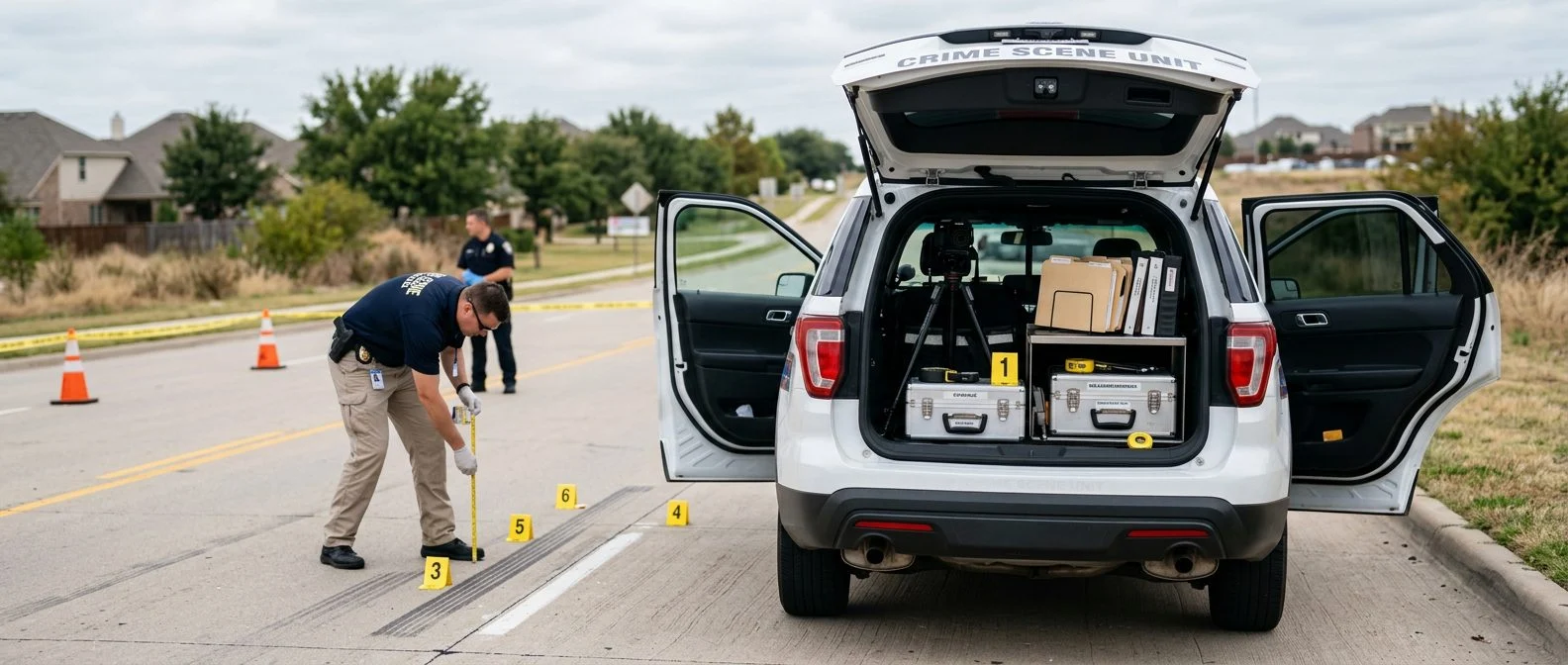
We start with the video, the police file and witness accounts. Those show how the vehicle was actually used.
- Dash-cam, phone and surveillance video from the scene.
- The police report, body-camera footage and the 911 call.
- Witness statements about the driving and the contact.
- Vehicle data such as speed and braking, where it exists.
- Photos of the roadway, lighting and vehicle damage.
- Medical records, to test how serious any alleged injury was.
On a timely request, the State must produce offense reports and written or recorded witness statements (Code of Criminal Procedure art. 39.14). We compare that material with the State’s version of events.
Phones have their own rules. Police generally need a warrant before searching the digital data on a cell phone, even one seized after a lawful arrest. In Riley v. California, the Court explained that its holding “is not that the information on a cell phone is immune from search; it is instead that a warrant is generally required before such a search, even when a cell phone is seized incident to arrest.”
What to Expect From Charge to Resolution
Your case moves in stages, from the first consultation through evidence review, negotiation and, if needed, trial.
- First consultation. The initial consultation is free, confidential and comes with no obligation to continue. Bring the charging papers, any notice you received and everything you remember about the incident.
- Protect your position. We review what to say to police, your bond conditions and the evidence to preserve. A defendant has the right to consult with counsel in private before a proceeding (Code of Criminal Procedure art. 1.051).
- Evidence review. We go through the State’s file and the video. We look for gaps and conflicts.
- Options. We explain negotiation with the prosecutor, pretrial motions and trial, with the trade-offs of each.
- Resolution. Timing depends on the case and the court’s schedule. No lawyer can promise a particular result.
Not sure what your next step is?
Talk it through with our team — the first consultation is free, confidential, and carries no obligation.
Why Barbieri Law Firm for This Charge
Barbieri Law Firm is an all-women criminal defense firm in Frisco, Texas. It defends professionals accused of assaultive offenses and sex crimes across Collin County, Dallas-Fort Worth and Texas.
Heather Jean Barbieri, Board Certified, Criminal Law — Texas Board of Legal Specialization. She leads the firm.
Our lawyers include Heather Barbieri and Carrie Thomas. Our team also includes assistants and office staff. We explain each step of an aggravated assault charge in plain language.
Frequently Asked Questions About Aggravated Assault With a Vehicle
Here are short answers to common questions about a car-based aggravated assault charge.
Can a car be a deadly weapon in Texas?
Yes. A car can be a deadly weapon when its use is capable of causing death or serious bodily injury.
Does a crash without a deliberate act still count?
It can. Bodily injury assault can rest on recklessness, so a crash is not automatically outside the law.
Does the deadly weapon route require a serious injury?
No. A deadly weapon used or exhibited during an assault can support the charge without a serious injury.
What is the maximum sentence?
The maximum depends on the felony level. A second-degree felony is punishable by 2 to 20 years in prison, and a first-degree felony by 5 to 99 years or life, with a fine of up to $10,000 possible at either level.
Can I get community supervision instead of prison?
A judge may place you on community supervision, but not when the prison term exceeds 10 years.
Do I have to answer police questions?
Whether a statement made during custodial questioning can be used depends on whether police first gave the Miranda warnings (Dickerson v. United States). We review what to say with you early.
Will my employer or licensing board find out?
Reporting rules depend on your profession. We review those requirements with you.
Talk With Our Team About Your Car Case
If a car incident has led to an aggravated assault charge, you can talk with our team before you decide what comes next. A parking-lot argument or a road-rage moment can change your week in one afternoon. If a court order has kept you out of your home, or the charge now puts your job and family in question, the next steps matter.
Call (972) 424-1902, or send your case details through our contact page to schedule a free consultation. No lawyer can promise a particular result.
Attorney responsible for this site: Heather Barbieri, Barbieri Law Firm, Frisco, Texas.
How Barbieri Law Firm Approaches a Vehicle Assault Case
Review the Full Record
We examine the crash report, police statements, charging documents and any medical records to understand exactly what the State alleges.
Analyze the Evidence
We look closely at vehicle data, dashcam and body-camera footage, witness accounts and roadway conditions to test the State's version of events.
Explain Your Options
We walk you through the possible paths forward in plain language so you can make informed decisions about your case.
Protect Your Interests
We communicate with prosecutors and handle every court setting on your behalf while keeping you informed at each step.
Be Careful Before You Speak
Statements you make to police, insurers or others about a crash can become evidence. Speak with a lawyer before you give a detailed account of what happened.
What Your Consultation Covers
The Crash Scene and Evidence
We discuss the scene, the vehicle, any recorded video and the witnesses who may have seen what happened.
Your Defense Options
We outline the defenses and strategies that may apply to your facts and what each would involve.
Your Next Steps
We explain what happens next in your case, what to expect in court and how we would keep you informed.
Talk With Heather Barbieri in Confidence. The First Consultation Is Free, Confidential and Carries No Obligation to Continue.
Related practice areas
Request a Consultation
Fill out the short form and we will take it from there.