

Aggravated Assault Defense | Collin County and Dallas-Fort Worth
Aggravated Assault Cases Turn on Evidence. Know What Is Being Used Against You.
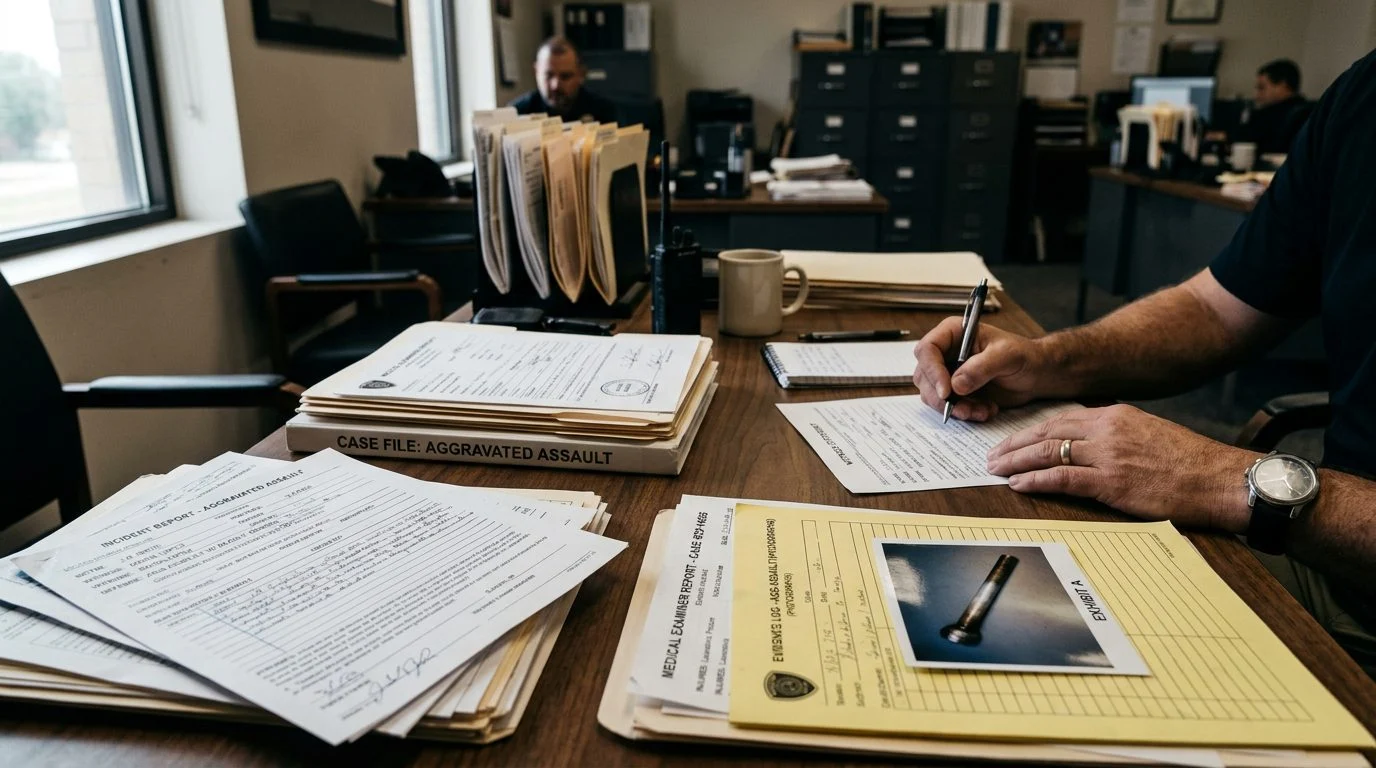
Barbieri Law Firm reviews the police report, medical records, video, recordings and witness statements, then explains what the evidence shows and what your options are.
By Heather Barbieri · Published October 16, 2026
The State must prove that a person committed an assault and that the assault either caused serious bodily injury or involved a deadly weapon. The evidence for each part usually comes from police reports, medical records, video, and witness statements. This guide walks through what each type of evidence has to show and how the defense reviews it. It is general information, not a prediction about any case.
What the State Must Prove for an Aggravated Assault Charge in Texas
Under Texas Penal Code § 22.02, a person commits aggravated assault when they commit an assault and either cause serious bodily injury to another, including a spouse, or use or exhibit a deadly weapon during the assault.
If one link is weak, the file usually shows it.
Other facts can change the charge. The relationship between the people involved and the status of the alleged victim can raise the offense level. The facts of each case decide which version applies.
Reading the charge closely helps you see which part of the statute the State is relying on. That tells you where the evidence will be focused.
If you were just told an aggravated assault investigation has started, you may be waiting to learn what the State has. Talk it through with our team — the first consultation is free, confidential, and carries no obligation.

What Makes an Aggravated Assault Charge?
A case usually starts with a report to police and an investigation. Officers and prosecutors then decide what charge, if any, to file. The charge is an accusation. It is not a finding that someone is guilty.
The early decision looks at what the evidence suggests so far. Many people are surprised to learn the difference.
The file gathered at this stage matters. Statements, photos, and early medical notes shape the charge and can shape how the case moves forward. The charge can also change as the investigation grows.
If you are learning about a charge for the first time, write down the date, the agency, and the case number. Keep any paperwork you receive. These details help a lawyer review the file quickly once it is available.
Essential Elements of the Underlying Assault: Contact, Threat, and Injury
Under Texas Penal Code § 22.01, a person commits assault by intentionally, knowingly, or recklessly causing bodily injury. A person also commits assault by intentionally or knowingly threatening imminent bodily injury, or by intentionally or knowingly causing offensive physical contact.
Each form uses different evidence. Injury cases often rely on photographs, medical records, and the alleged victim’s account. Threat cases often rely on text messages, recorded calls, or a witness who heard the words. Contact cases often rely on video or witness statements about who touched whom.
Bodily injury is broadly defined. In Texas, bodily injury means physical pain, illness, or any impairment of physical condition. That is a lower bar than serious bodily injury, which is covered in the next section.
The mental state, meaning intent, knowledge, or recklessness, is usually shown through the circumstances. Prosecutors look at what was said, what happened first, and how the people acted.
Proof of Serious Bodily Injury: Medical Records and Treating Providers
Serious bodily injury is the element that moves a case into aggravated assault. Under Penal Code § 1.07(a)(46), serious bodily injury is bodily injury that creates a substantial risk of death or causes death, serious permanent disfigurement, or protracted loss or impairment of the function of any bodily member or organ.
The State commonly relies on emergency department and EMS records, imaging results, surgical notes, and testimony from treating providers. These records describe the injury and what the provider expected in the days and weeks afterward.
Medical records often show the history given at intake. That account can differ from later statements, and the difference can matter. Timing, severity, and documentation can all be questioned.
The gap between bodily injury and serious bodily injury is often the central issue. A defense lawyer reviews the records line by line to see whether the documented injury meets the statutory definition.
Proof of a Deadly Weapon: The Object, the Use, and the Testimony
Under Penal Code § 1.07(a)(17), a deadly weapon is (A) a firearm or anything manifestly designed, made, or adapted for the purpose of inflicting death or serious bodily injury, or (B) anything that, in the manner of its use or intended use, is capable of causing death or serious bodily injury.
The second definition means an ordinary object can qualify. A belt, a bottle, or a vehicle can fall within it depending on how it was used. The State’s proof therefore focuses on how the object was held, swung, or driven, not only on what it was.
The evidence often includes recovery of the object, photographs, and DNA or fingerprint testing where that testing is available. Witness descriptions of the movements are also central.
The defense reviews whether the testimony describes a use that was actually capable of causing death or serious bodily injury. Witnesses often disagree about small details, and those details can change the analysis.
Witness Statements, Video, and Digital Records
Witness statements show what each person saw from where they stood. Investigators compare the alleged victim’s account, eyewitness accounts, and any neutral witness accounts. A defense lawyer compares them too.
Prior statements to police carry weight. If a witness’s story changed over time, the change is part of the file. Good defense work tracks each version and the date it was given.
Video often decides how an event reads. Common sources include body-worn and dash camera footage, store or home surveillance, cell phone video, and text or social media messages with timestamps.
The defense reviews the full recording, not only the clip the State highlights. The minutes before and after an incident can change the meaning of what happened in the middle.
Not sure what your next step is?
Talk it through with our team — the first consultation is free, confidential, and carries no obligation.
Justification and Self-Defense Evidence
Evidence that can support a justification claim includes injuries to the accused, prior threats, video, phone records, and witness accounts of who started the physical contact. Records of earlier messages can show whether a threat existed before the event.
Self-defense is one of several fact-based defenses. Which, if any, applies depends on the facts of the case and on what the evidence actually shows.
Witness accounts often conflict on who started the contact. Video can resolve that question, or it can leave it open. A lawyer’s first task is to see what the record already holds before deciding how to present it.
How Evidence Is Gathered and Tested, and What the Defense Reviews
The file usually includes police reports, 911 recordings, dispatch logs, scene photographs, and evidence logs. Each one shows who handled an item and when. Gaps in these records are important to note.
Chain of custody tracks where an item went from collection to testing. A break in that chain can raise questions about whether the item is what the State says it is.
Lab reports and analyst testimony should match the methods the lab used. The defense reviews the testing procedures, the analyst’s notes, and any limits the lab listed on its results.
Evidence obtained through a search warrant or other search is reviewed for the legal basis of the warrant and the scope of the search. A motion to suppress is one way to raise those issues in court. Whether any of these issues applies depends on how the evidence was obtained.
Penalty Range and Enhancements Under Texas Law
Under § 12.33, a second-degree felony carries imprisonment for not more than 20 years or less than 2 years. A fine of up to $10,000 may be added.
The offense is a first-degree felony in several circumstances under § 22.02(b). These include using a deadly weapon during the assault and causing serious bodily injury to a family, household or dating-relationship member; an assault by a public servant acting under color of office or employment; an assault against a person the actor knows is a security officer while the officer is performing a duty as a security officer; retaliation against an informant or a person who reported a crime (not only a witness); and knowingly discharging a firearm from a motor vehicle at or in the direction of a habitation, building or vehicle, while reckless as to whether it is occupied, and causing serious bodily injury. Others include an assault against a person the actor knows is a public servant, committed while that servant is lawfully discharging an official duty or in retaliation for it.
A prior final felony conviction can change the punishment range. Under § 12.42(b), if the State proves a prior final felony conviction (other than a state jail felony punishable under § 12.35(a)), a second-degree felony is punished as a first-degree felony. Under § 12.42(c)(1), if the State proves a prior final felony conviction (other than a state jail felony punishable under § 12.35(a)), a first-degree felony is punishable by life, or by imprisonment for any term not more than 99 years or less than 15 years, and a fine of up to $10,000 may also be imposed. Under § 12.42(d), habitual offenders face 25 to 99 years or life. The base first-degree felony range under § 12.32 is life, or imprisonment for not more than 99 years or less than 5 years.
A juvenile adjudication can also count. Which enhancement applies depends on the facts and the charging document.

Talking With a Lawyer About the Evidence in Your Case
A defense lawyer can review the file once it becomes available. That includes the charge, the medical records, the video, and the witness statements. Each item shows a part of the State’s case, and each one can be tested.
You may be waiting for a call back, a charging decision, or news about a family member. Not knowing what the State already has is hard. A lawyer can explain what each piece of evidence needs to show.
Barbieri Law Firm is based in Frisco, Texas, and serves Collin County and the Dallas-Fort Worth area. Heather Jean Barbieri, Board Certified, Criminal Law — Texas Board of Legal Specialization, leads the firm’s criminal defense work.
Common Questions
What evidence does the State need for aggravated assault in Texas?
The State needs proof of an assault under § 22.01 and either serious bodily injury or a deadly weapon. Each element needs its own supporting evidence.
Is aggravated assault always a second-degree felony in Texas?
No. It is a second-degree felony by default, but some circumstances make it a first-degree felony under § 22.02(b).
Heather Barbieri offers a free initial consultation with no obligation to continue. Call (972) 424-1902 or send your case details through the contact form.
Attorney responsible for this site: Heather Barbieri, Barbieri Law Firm, Frisco, Texas.
Citation status: NOT PUBLISHABLE. Held for human review.
Only one of the provided sources could be honestly linked to a claim in this article: the Harris County “About Texas Felonies” page, used for the second-degree felony classification. The minimum is 2, so this page does not clear the threshold.
The other provided sources do not support claims in this article: – Texas Penal Code/statutes: No statute URL was in the provided list. The statute links already in the article were left as they were and were not counted as new citations. – TDCJ parole bill (bill45): Covers parole for aggravated sexual assault, not aggravated assault. – DPS error codes PDF: Supports the sexual assault vs. aggravated sexual assault reporting distinction, not aggravated assault. – Texas Rule of Evidence 412 (txcourts.gov): Covers evidence of past sexual behavior in sexual assault prosecutions, which is outside this article’s scope. – Texas AG Crime Victims’ Rights: Restricted to the rights it describes, which are for sexual assault victims. It does not support any claim here.
A reviewer should either supply a source covering aggravated assault elements or penalties (for example, the Penal Code provisions for §§ 1.07, 12.32, 12.33, 12.42, 22.01, and 22.02), or confirm whether the claims that need citations should be reduced or removed.
Evidence That Often Matters in Aggravated Assault Cases
Medical and injury records
Emergency room notes, treatment records and photographs of injuries can show how serious an injury was and how it was described at the time.
Witness statements and 911 recordings
Early accounts, dispatch recordings and later interviews can differ in important ways, and we compare each one carefully.
Weapon and physical evidence
Claims involving a deadly weapon depend on what the object was, how it was used and who handled it. We examine the physical evidence and any lab reports.
Messages and phone records
Texts, call logs and social media posts often show the relationship between the people involved and what was said before and after the incident.
Background and context
The history between the parties, what led up to the event and who started the conflict are all part of the picture we build with you.
How We Work Through Your Evidence
Clear explanations
We explain what the evidence shows in plain language, so you understand your options before making decisions.
Free first consultation
Your initial consultation is free and carries no obligation to continue. Call (972) 424-1902 or send us your case details.
Share Everything With Your Lawyer
Tell your attorney every detail about what happened, including facts you think may hurt your case.
Review Your Evidence With a Frisco Criminal Defense Attorney
Related practice areas
Request a Consultation
Fill out the short form and we will take it from there.